A long wire carries a steady current. It is bent into a circle of one turn and the magnetic field at the centre of the coil is $B$. It is then bent into a circular loop of $n$ $turns$. The magnetic field at the centre of the coil will be
AIEEE 2004,NEET 2016, Easy


Download our appand get started for free
Experience the future of education. Simply download our apps or reach out to us for more information. Let's shape the future of learning together!No signup needed.*
Similar Questions
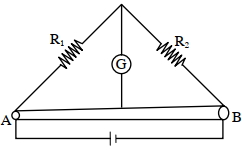
- 1Two resistances $R_1=X \Omega$ and $R_2=1 \Omega$ are connected to a wire $A B$ of uniform resistivity, as shown in the figure. The radius of the wire varies linearly along its axis from $0.2 mm$ at $A$ to $1 mm$ at $B$. A galvanometer ($G$) connected to the center of the wire, $50 cm$ from each end along its axis, shows zero deflection when $A$ and $B$ are connected to a battery. The value of $X$ is. . . . .View Solution
- 2A charged particle is moving in a uniform magnetic field in a circular path. Radius of circular path is $R$. When energy of particle is doubled, then new radius will beView Solution
- 3View SolutionWhich of the following loop is in stable equallibrium
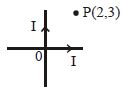
- 4Two mutually perpendicular insulated conducting wires carrying equal currents $I$, intersect at origin. Then the resultant magnetic induction at point $P(2m, 3m)$ will beView Solution
- 5View SolutionWhich of the following particle will experience maximum acceleration when projected with same speed in transverse magnetic field
- 6Charge $q$ is uniformly spread on a thin ring of radius $R.$ The ring rotates about its axis with a uniform frequency $f\, Hz.$ The magnitude of magnetic induction at the center of the ring isView Solution
- 7A particle of mass $m$ and charge $q$ moves with a constant velocity $v$ along the positive $x$ direction. It enters a region containing a uniform magnetic field $B$ directed along the negative $z$ direction, extending from $x = a$ to $x = b$. The minimum value of $v$ required so that the particle can just enter the region $x > b$ isView Solution
- 8A charged particle moves in a magnetic field $\vec B = 10\,\hat i$ with initial velocity $\vec u = 5\hat i + 4\hat j$ The path of the particle will beView Solution
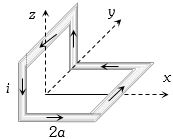
- 9A non-planar loop of conducting wire carrying a current $I$ is placed as shown in the figure. Each of the straight sections of the loop is of length $2a$. The magnetic field due to this loop at the point $P$ $(a,0,a)$ points in the directionView Solution
- 10View SolutionElectrons moving with different speeds enter a uniform magnetic field in a direction perpendicular to the field., time periods of rotation will be :