A current of $2.0$ ampere passes through a cell of $e.m.f$. $1.5\, volts$ having internal resistance of $0.15\, ohm$. The potential difference measured, in $volts$, across both the ends of the cell will be
Easy


Download our appand get started for free
Experience the future of education. Simply download our apps or reach out to us for more information. Let's shape the future of learning together!No signup needed.*
Similar Questions
- 1Two resistances of $400\,\Omega $ and $800\,\Omega $ are connected in series with a $6\,volt $ battery of negligible internal resistance. A voltmeter of resistance $10,000\,\Omega $ is used to measure the potential difference across $400\,\Omega $ . The error in the measurement of potential difference (in volt) approximately isView Solution
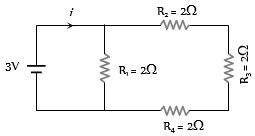
- 2What is the current $(i)$ in the circuit as shown in figure ........... $A$View Solution
- 3View SolutionA steel wire has a resistance twice that of an aluminium wire. Both of them are connected with a constant voltage supply. More heat will be dissipated in
- 4A potentiometer consists of a wire of length $4\, m$ and resistance $10 \,\Omega$. It is connected to cell of $emf$ $2\, V$. The potential difference per unit length of the wire will be ............ $V/m$View Solution
- 5View SolutionWhich one is not the correct statement
- 6View SolutionBy increasing the temperature, the specific resistance of a conductor and a semiconductor
- 7What is the number density of donor atoms which must be added to a pure germanium semiconductor to make $n-$ type semiconductor of conductivity $6.4\ {\Omega ^{ - 1}}\,c{m^{ - 1}}$? The mobility of electr ons in $n-$ type germanium is $4 \times {10^3}\ cm^2\ V^{-1}\ s^{-1}$. Neglect the contribution of holes to conductivityView Solution
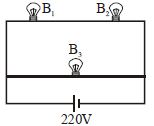
- 8A $100\, W \, bulb\, B_1$ and two $60\, W \,bulbs \,B_2$ and $B_3$, are connected to a $220\, V$ source, as shown in Figure. Now $P_1, P_2$ and $P_3$ are the output powers of the bulbs $B_1, B_2$ and $B_3$ respectively. ThenView Solution
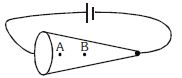
- 9View SolutionSuppose a current carrying wire has a cross-sectional area that, gradually become smaller along the wire, has the shape of a very long cone as shown in figure. Choose the correct statement
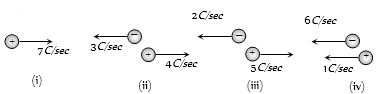
- 10View SolutionFollowing figure shows four situations in which positive and negative charges moves horizontally through a region and gives the rate at which each charge moves. Rank the situations according to the effective current through the region greatest first