What is the number density of donor atoms which must be added to a pure germanium semiconductor to make $n-$ type semiconductor of conductivity $6.4\ {\Omega ^{ - 1}}\,c{m^{ - 1}}$? The mobility of electr ons in $n-$ type germanium is $4 \times {10^3}\ cm^2\ V^{-1}\ s^{-1}$. Neglect the contribution of holes to conductivity
Medium


Download our appand get started for free
Experience the future of education. Simply download our apps or reach out to us for more information. Let's shape the future of learning together!No signup needed.*
Similar Questions
- 1Copper and silicon is cooled from $300\; K$ to $60\; K$, the specific resistanceView Solution
- 2Two metal wires of identical dimensions are connected in series. If $\sigma _1$ and $\sigma _2$ are the conductivities of the metal wires respectively, the effective conductivity of the combination isView Solution
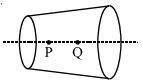
- 3A wire has a non-uniform cross-section as shown in figure.A steady current flows through it. The drift speed of electrons at points $P$ and $q$ is $v_P$ and $v_Q$.View Solution
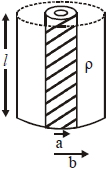
- 4Model a torch battery of length $l$ to be made up of a thin cylindrical bar of radius $'a'$ and a concentric thin cylindrical shell of radius ' $b$ ' fille in between with an electrolyte of resistivity $\rho$ (see figure). If the battery is connected to a resistance of value $R ,$ the maximum Joule heating in $R$ will take place forView Solution
- 5A uniform wire of length $l$ and radius $r$ has a resistance of $100\, \Omega $. It is recast into a wire of radius $\frac{r}{2}$. The resistance of new wire will be ............... $\Omega$View Solution
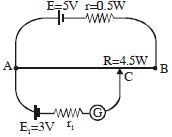
- 6In the given potentiometer circuit length of the wire $AB$ is $3\,m$ and resistance is $R=4.5\,\Omega $. The length $AC$ for no deflection in galvanometer is ............... $m$View Solution
- 7This question contains statement$-1$ and statement$-2$. Of the four choices given after the statements, choose the one that best describes the two statements.View Solution
statement$-1$ : The temperature dependence of resistance is usually given as $R=R_{0}(1+\alpha \Delta t)$. The resistance of a wire changes from $100\; \Omega$ to $150\; \Omega$ when its temperature is increased from $27^{\circ} C$ to $227^{\circ} C$. This implies that $\alpha=2.5$ $\times 10^{-3} /{ }^{\circ} C$
statement$-2\;: R=R_{0}(1+\alpha \Delta t)$ is valid only when the change in the temperature $\Delta T$ is small and $\Delta R=\left(R-R_{0}\right) < < R_{0}$
- 8A uniform metallic wire carries a current $2\,A$. when $3.4\,V$ battery is connected across it. The mass of uniform metallic wire is $8.92 \times 10^{-3} \,kg$. density is $8.92 \times 10^3\,kg / m ^3$ and resistivity is $1.7 \times 10^{-8} \Omega- m$. The length of wire is $l=............\,m$View Solution
- 9The value of internal resistance of an ideal cell is $\Omega$View Solution
- 10A wire of resistance $4 \,\Omega$ is stretched to twice its original length. The resistance of stretched wire would be ........... $\Omega$View Solution