MCQ
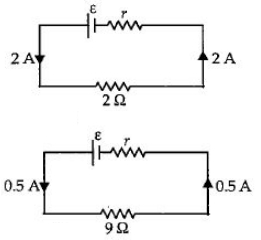
A current of $2\,A$ flows through a $2\,\Omega$ resistor when connected across a battery. The same battery supplies a current of $0.5\,\, A$ when connected across a $9 \,\,\Omega$ resistor. The internal resistance of the battery is 
  • A
    $0.5 \,\Omega$
  • $\frac{1}{3}\;\Omega $
  • C
    $\;\frac{1}{4}\;\Omega $
  • D
    $1.0\,\Omega$

Answer

Correct option: B.
$\frac{1}{3}\;\Omega $
b
Let $\varepsilon $ be the emf and $r$ be internal resistance of the battery.

In the first case,

$2=\frac{\varepsilon}{2+r}$     ....$(i)$

In the second case,

$0.5=\frac{\varepsilon}{9+r}$     ....$(ii)$

Divide $(i)$ by $(ii),$ we get

${\frac{2}{0.5}=\frac{9+r}{2+r} \Rightarrow 4+2 r=4.5+0.5 r} $

${1.5 r=0.5 \Rightarrow r=\frac{0.5}{1.5}=\frac{1}{3} \,\Omega}$

Need a full question paper?

Generate a complete, print-ready paper with questions like this in minutes — across 16+ boards, with answer keys.

Start Generating Free

Similar questions

Heat needed to convert $1$ kilogram ice at $0^o\,C$ to steam at $100^o\,C$ is
The graph which shows the variation of $\left(\frac{1}{\lambda^2}\right)$ and its kinetic energy, $E$ is (where $\lambda$ is de Broglie wavelength of a free particle):
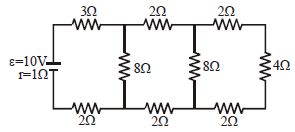
In the circuit shown, the cell has $emf = 10\,V$ and internal resistance $= 1\, \Omega$ :-
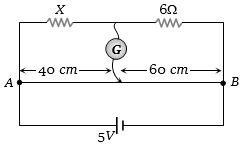
In the circuit shown, a meter bridge is in its balanced state. The meter bridge wire has a resistance $0.1\, ohm/cm$. The value of unknown resistance $X$ and the current drawn from the battery of negligible resistance is
A frictionless heat engine can be $100 \%$ efficient only if its exhaust temperature is ............
The energy of $He ^{+}$ion in its first excited state is $......eV$ (The ground state energy for the Hydrogen atom is $-13.6\,eV )$
Hydrogen atom from excited state comes to the ground by emitting a photon of wavelength $\lambda$. The value of principal quantum number ' $n$ ' of the excited state will be:

($R$: Rydberg constant)

A uniform thin wooden plank $A B$ of length $L$ and mass $M$ is kept on a table with its $B$ end slightly outside the edge of the table. When an impulse $J$ is given to the end $B$, the plank moves up with centre of mass rising a distance $h$ from the surface of the table. Then,
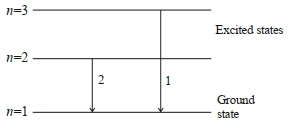
For hydrogen atom, $\lambda_1$ and $\lambda_2$ are the wavelengths corresponding to the transitions $1$ and $2$ respectively as shown in figure. The ratio of $\lambda_1$ and $\lambda_2$ is $\frac{x}{32}$. The value of $x$ is $..........$
Amplitude modulated wave is represented by

$V _{ AM }=10\left[1+0.4 \cos \left(2 \pi \times 10^{4} t \right)\right] \cos \left(2 \pi \times 10^{7} t \right) \text {. }$

The total bandwidth of the amplitude modulated wave is