- Obtain an expression for moment of inertia of uniform circular disc about an axis perpendicular to the plane of disc and passing through its centre.
- Three point masses of 1kg, 2kg and 3kg lie at (1, 2), (0, -1) and (2, -3) respectively. Calculate the co-ordinates of centre of mass of the system.
Download our app for free and get started
- Moment of inertia of a uniform circular disc about an axis $\bot$ to plane of uniform circular disc and mass
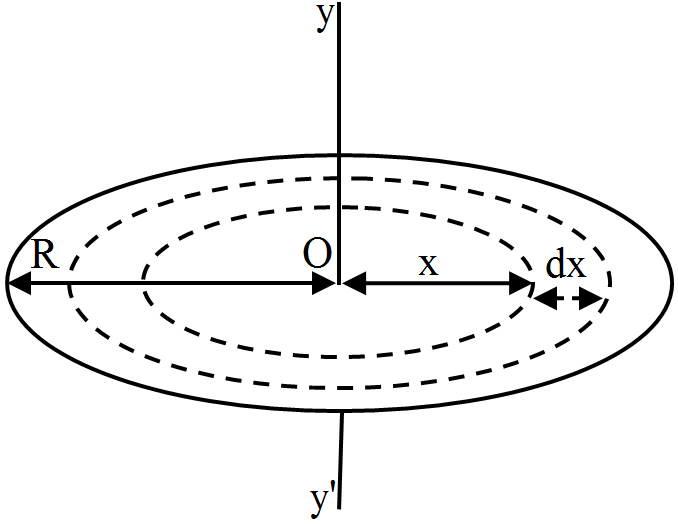
R = Radius of disc
0 = Centre of disc
Surface area of disc $=\pi\text{R}^2$
Mass per unit area of disc $=\frac{\text{M}}{\pi\text{R}^2}$
dx = small element of disc in circular strip of radius R.
Length of this element $=2\pi\text{x}$
Surface area of this element $=\pi\text{xdx}$
$\therefore$ Mass of the element
$=\frac{\text{M}}{\pi\text{R}^2}(2\pi\text{x}\text{dx})=\frac{2\text{Mxdx}}{\text{R}^2}$
M.I. of this element of disc about yoy' axis
$=\text{mass}\times(\text{distance})^2$
$=\frac{2\text{Mx}^3\text{dx}}{\text{R}^2}$
$\therefore$ M.I. of circular disc about yoy'
$\text{I}=\int\limits_{\text{x}=0}\limits^{\text{x}=\text{R}}\frac{2\text{Mx}^3}{\text{R}^2}\text{dx}=\frac{2\text{M}}{\text{R}^2}\int_\limits{\text{r}=0}\limits^{\text{x}=\text{R}}$
$[\therefore$ element is considered to lie between (x = 0) to (x = R)]
$\text{I}=\frac{1}{2}\text{MR}^2$
- $\text{m}_1=1\text{kg,}\text{ m}_2=2\text{kg},\text{ m}_3=3\text{kg}$
$\text{x}=\frac{\text{m}_1\text{x}_1+\text{m}_2\text{x}_2+\text{m}_3\text{x}_3}{\text{m}_1+\text{m}_2+\text{m}_3}$
$\text{y}=\frac{\text{m}_1\text{y}_1+\text{m}_2+\text{y}_2+\text{m}_3\text{y}_3}{\text{m}_1+\text{m}_2+\text{m}_3}$
$=\frac{1(2+2(-1)+3(-3)}{6}=\frac{-3}{2}$
Coordinates of C.O.M
$=\Big(\frac{7}{6},\frac{-3}{2}\Big)$

Download our appand get started for free
Experience the future of education. Simply download our apps or reach out to us for more information. Let's shape the future of learning together!No signup needed.*
Similar Questions
- 1View Solution
- Define moment of inertia. Write the parallel and perpendicular axis theorem.
- Derive an expression for moment of inertia of a disc of radius r, mass m about an axis along its diameter.
- 2View SolutionA metal bar 70 cm long and 4.00 kg in mass supported on two knifeedges placed 10 cm from each end. A 6.00 kg load is suspended at 30 cm from one end. Find the reactions at the knife-edges. (Assume the bar to be of uniform cross section and homogeneous.)
- 3Two discs of moments of inertia $I_1$ and $I_2$ about their respective axes (normal to the disc and passing through the centre), and rotating with angular speeds $\omega_1$ and $\omega_2$ are brought into contact face to face with their axes of rotation coincident.View Solution
- What is the angular speed of the two-disc system?
- Show that the kinetic energy of the combined system is less than the sum of the initial kinetic energies of the two discs. How do you account for this loss in energy? Take $\omega_1\neq\omega_2$
- 4An isolated particle of mass m is moving in a horizontal plane (x - y), along the x-axis at a certain height about the ground. It explodes suddenly into two fragments of masses $\frac{\text{m}}{4}$ and $3\frac{\text{m}}{4}.$ An instant later, the smaller fragment is at y = + 15 cm. What is the position of larger fragment at this instant?View Solution
- 5View SolutionFig. shows two blocks of masses 5kg and 2kg placed on a frictionless surface and connected by a spring. An external kick gives a velocity 14 m/ s to the heavier block in the direction of lighter one. Deduce (i) the velocity gained by the centre of mass and (ii) the separate velocities of the two blocks in the centre of mass coordinates just after the kick.
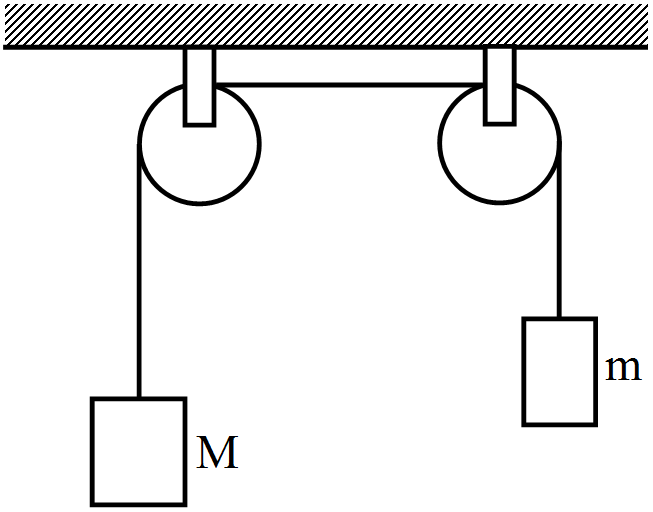
- 6View SolutionThe pulleys in figure are identical, each having a radius R and moment of inertia I. Find the acceleration of the block M.
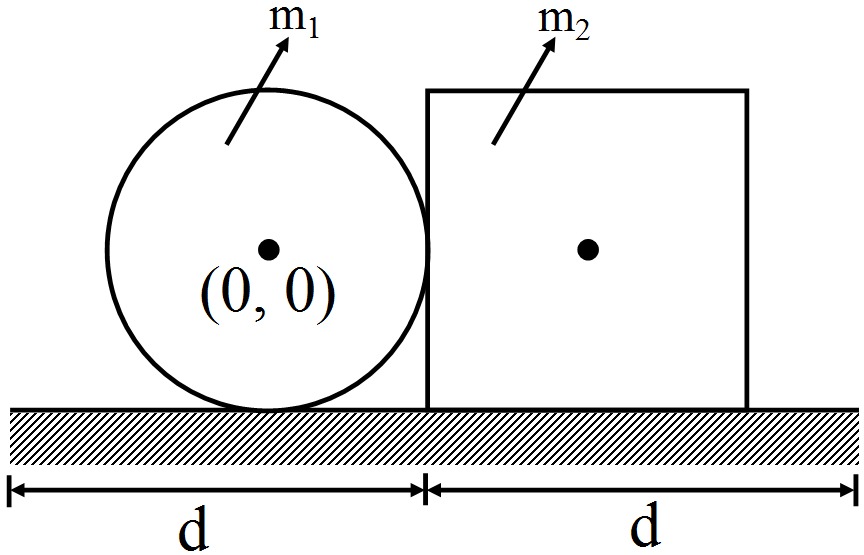
- 7View SolutionA square plate of edge d and a circular disc of diameter d are placed touching each other at the midpoint of an edge of the plate as shown in figure. Locate the centre of mass of the combination, assuming same mass per unit area for the two plates.
- 8A $2kg$ body and a $3kg$ body are moving along the x-axis. At a particular instant, the $2kg$ body is $1m$ from the origin and has a velocity of $3ms^{-1}$ and the $3kg$ body is $2m$ from the origin and has velocity of $-1 ms^{-1}$. Find the position and velocity of the centre of mass and also find the total momentum.View Solution
- 9View SolutionObtain an expression for linear acceleration of a cylinder rolling down an inclined plane and hence find the condition for the cylinder to roll down the inclined plane without slipping.
- 10A star of mass twice the solar mass and radius $106km$ rotates about its axis with an angular speed of $10^{‑6}$ rad per sec. What is the angular speed of the star when it collapses (due to inward gravitational forces) to a radius of $10^4km$? Solar mass = $1.99 \times 10^{23}kg$.View Solution