Question
A discharge tube contains helium at low pressure. A large potential difference is applied across the tube. Consider a helium atom that has just been ionised due to the detachment of an atomic electron. Find the ratio of the distance travelled by the free electron to that by the positive ion in a short time dt after ionisation.
Answer

Let the two particles have charge ‘q’

Mass of electron ma = 9.1 × 10-31kg

Mass of proton mp = 1.67 × 10-27kg

Electric field be E

Force experienced by Electron = qE

$\text{accln.}=\frac{\text{qE}}{\text{m}_\text{e}}$

For time dt

$\text{S}_\text{e}=\frac{1}{2}\times\frac{\text{qE}}{\text{m}_\text{e}}\times\text{dt}^2\ ....(\text{i})$

For the positive ion,

$\text{acceleration}=\frac{\text{qE}}{4\times\text{m}_\text{p}}$

$\text{S}_\text{p}=\frac{1}{2}\times\frac{\text{qE}}{4\times\text{m}_\text{p}}\times\text{dt}^2\ ....(\text{ii})$

$\frac{\text{S}_\text{e}}{\text{S}_\text{p}}=\frac{4\text{m}_\text{p}}{\text{m}_\text{e}}=7340. 6$

Need a full question paper?

Generate a complete, print-ready paper with questions like this in minutes — across 16+ boards, with answer keys.

Start Generating Free

Similar questions

Mr. Verma (50kg) and Mr. Mathur (60kg) are sitting at the two extremes of a 4m long boat (40kg) standing still in water. To discuss a mechanics problem, they come to the middle of the boat. Neglecting friction with water, how far does the boat move on the water during the process?
Compare the bulk modulus of water from the following data : Initial volume $=100.0$ litre, Pressure increase $=100.0 atm\left(1 atm=1.013 \times 10^5\right.$ Pa ), Final volume $=100.5$ litre. Compare the bulk modulus of water with that of air (at constant temperature). Explain in simple terms why the ratio is so large.
An ideal gas is pumped into a rigid container having diathermic walls so that the temperature remains constant. In a certain time interval, the pressure in the container is doubled. Is the internal energy of the contents of the container also doubled in the interval?
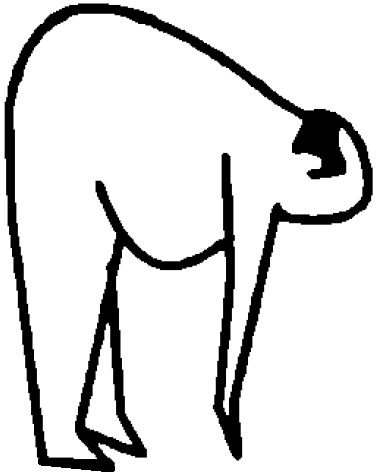
When a fat person tries to touch his toes, keeping the legs straight, he generally falls. Explain with reference to figure.

Choose the correct alternative :
(a) Acceleration due to gravity increases/ decreases with increasing altitude.
(b) Acceleration due to gravity increases/ decreases with increasing depth (assume the earth to be a sphere of uniform density).
(c) Acceleration due to gravity is independent of mass of the earth/mass of the body.
(d) The formula - GMm $\left(1 / r_2-1 / r_1\right)$ is more/ less accurate than the formula $m g\left(r_2-r_1\right)$ for the difference of potential energy between two points $r_2$ and $r_1$ distance away from the centre of the earth.
Two blocks of unequal masses are tied by a spring. The blocks are pulled stretching the spring slightly and the system is released on a frictionless horizontal platform. Are the forces due to the spring on the two blocks equal and opposite? If yes, is it an example of Newton's third law?
A unitless quantity:
  1. Never has a non-zero dimension.
  2. Always has a non-zero dimension.
  3. May have a non-zero dimension.
  4. Does not exist.
Read the passage given below and answer the following questions from 1 to 5.
Principle of Conservation of Energy:
Total energy of an isolated system always remains constant. Since, the universe as a whole may be viewed as an isolated system, total energy of the universe is constant. If one part of the universe loses energy, then other part must gain an equal amount of energy. The principle of conservation of energy cannot be proved as such. However, no violation of this principle has been observed.
  1. When we rub two flint stones together, got them to heat up and to ignite a heap of dry leaves in the form of:
  1. chemical energy
  2. sound energy
  3. heat energy
  4. electrical energy
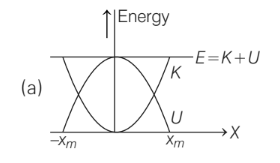
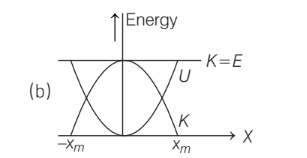
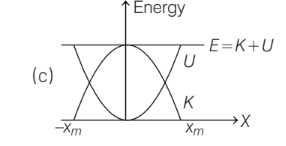
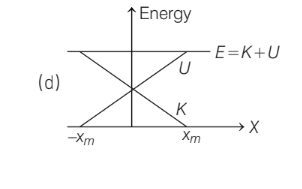
  1. Which graph represents conservation of total mechanical energy?
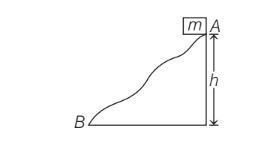
  1. In the given curved road, if particle is released from A, then:

  1. kinetic energy atB must be mgh
  2. kinetic energy atB must be zero
  3. kinetic energy atB must be less than mgh
  4. kinetic energy atB must not be equal to potential energy
  1. U is the potential energy, K is the kinetic energy and E is the mechanical energy. Which of the following is not possible for a stable system?
  1. U > E
  2. U < E
  3. E > K
  4. K > E
  1. A body of mass 5kg is thrown vertically up with a kinetic energy of 490 J. The height at which the kinetic energy of the body becomes half of the original value is
  1. 12.5m
  2. 10
  3. 2.5m
  4. 5m
Read the passage given below and answer the following questions from 1 to 5.
The proportional region within the elastic limit of the stress-strain curve is of great importance for structural and manufacturing engineering designs. The ratio of stress and strain, called modulus of elasticity, is found to be a characteristic of the material.
Experimental observation show that for a given material, the magnitude of the strain produced
is same whether the stress is tensile or compressive. The ratio of tensile (or compressive) stress $(\sigma)$ to the longitudinal strain $(\in)$ is defined as Young’s modulus and is denoted by the symbol Y.
$\text{Y}=\frac{\sigma}{\in}$
Since strain is a dimensionless quantity, the unit of Young’s modulus is the same as that of stress i.e., N-m-2 or Pascal (Pa). As steel has more modulus of elasticity than copper brass and aluminum hence steel is preferred in heavy-duty machines and in structural designs. Wood, bone, concrete and glass have rather small Young’s moduli. Answer the following.
  1. If stress strain changes then young’s modulus is:
  1. Also changes.
  2. Remains constant.
  3. Either changes or remains constant depends on amount of stress and strain.
  4. None of these.
  1. SI unit of young’s modulus is:
  1. N-m-2
  2. Pascal (Pa).
  3. N-m-2 or Pascal (Pa).
  4. None of these
  1. Which of the following is more elastic
  1. Aluminum
  2. Steel
  3. Wood
  4. Glass
  1. Defines young’s modulus. Give its SI unit and dimensions.
  1. Why steel is more preferred in heavy industries than copper and brass?
The amplification factor of a triode operating in the linear region depends strongly on:
  1. The temperature of the cathode.
  2. The plate potential.
  3. The grid potential.
  4. The separations of the grid from the cathode and the anode.