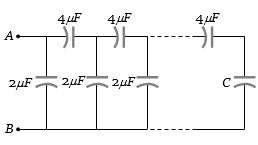
A finite ladder is constructed by connecting several sections of $2\,\mu F,\;4\,\mu F$ capacitor combinations as shown in the figure. It is terminated by a capacitor of capacitance $C$. What value should be chosen for $C$ such that the equivalent capacitance of the ladder between the points $A$ and $B$ becomes independent of the number of sections in between......$\mu F$
Medium
Download our app for free and get started
(a) If the value of $C$ is chosen as $4\,\mu F$, the equivalent capacity across every part of the section will be $4\,\mu F$

Download our appand get started for free
Experience the future of education. Simply download our apps or reach out to us for more information. Let's shape the future of learning together!No signup needed.*
Similar Questions
- 1A regular hexagon of side $10\; cm$ has a charge $5 \;\mu\, C$ at each of its vertices. Calculate the potential at the centre of the hexagon.View Solution
- 2On rotating a point charge having a charge $q$ around a charge $Q$ in a circle of radius $r$. The work done will beView Solution
- 3Within a spherical charge distribution of charge density $\rho \left( r \right)$, $N$ equipotential surfaces of potential ${V_0},{V_0} + \Delta V,{V_0} + 2\Delta V,$$.....{V_0} + N\Delta V\left( {\Delta V > 0} \right),$ are drawn and have increasing radii $r_0, r_1, r_2,......r_N$, respectively. If the difference in the radii of the surfaces is constant for all values of $V_0$ and $\Delta V$ thenView Solution
- 4Capacitance of a capacitor made by a thin metal foil is $2\,\mu F$. If the foil is folded with paper of thickness $0.15\,mm$, dielectric constant of paper is $2.5$ and width of paper is $400\,mm$, then length of foil will be.....$m$View Solution
- 5View SolutionIf a dielectric substance is introduced between the plates of a charged air-gap capacitor. The energy of the capacitor will
- 6View SolutionAssertion: Electron move away from a region of higher potential to a region of lower potential.
Reason: An electron has a negative charge.
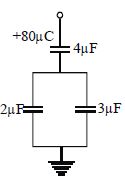
- 7In the given circuit, a charge of $+80\, \mu C$ is given to the upper plate of the $4\,\mu F$ capacitor. Then in the steady state, the charge on the upper plate of the $3\,\mu F$ capacitor is.....$\mu C$View Solution
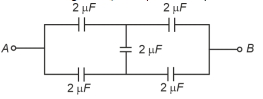
- 8In the following circuit, the equivalent capacitance between terminal $A$and terminal $B$ is :View Solution
- 9If a charged spherical conductor of radius $10\,cm$ has potential $V$ at a point distant $5\,cm$ from its centre, then the potential at a point distant $15\,cm$ from the centre will beView Solution
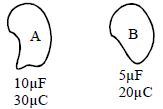
- 10When two isolated conductors $A$ and $B$ are connected by a conducting wire positive charge will flow from :-View Solution