On rotating a point charge having a charge $q$ around a charge $Q$ in a circle of radius $r$. The work done will be
AIIMS 1997, Easy
Download our app for free and get started
(c) Since charge $Q$ moving on equipotential surface so work done is zero.

Download our appand get started for free
Experience the future of education. Simply download our apps or reach out to us for more information. Let's shape the future of learning together!No signup needed.*
Similar Questions
- 1An electric charge $10^{-3}$ $\mu C$ is placed at the origin $(0, 0) $ of $X - Y$ co-ordinate system. Two points $A$ and $B$ are situated at $\left( {\sqrt 2 ,\sqrt 2 } \right)$ and $(2,0)$ respectively. The potential difference between the points $A$ and $B$ will be.......$V$View Solution
- 2Two identical capacitors, have the same capacitance $C$. One of them is charged to potential ${V_1}$ and the other to ${V_2}$. The negative ends of the capacitors are connected together. When the positive ends are also connected, the decrease in energy of the combined system isView Solution
- 3Sixty four conducting drops each of radius $0.02 m$ and each carrying a charge of $5 \,\mu C$ are combined to form a bigger drop. The ratio of surface density of bigger drop to the smaller drop will be ............View Solution
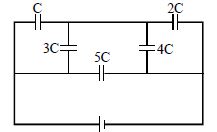
- 4In the given circuit, ratio of charge stored in the capacitors $C, 2C, 3C, 4C, 5C$ isView Solution
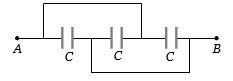
- 5Three equal capacitors, each with capacitance $C$ are connected as shown in figure. Then the equivalent capacitance between $A$ and $B$ isView Solution
- 6A short electric dipole has a dipole moment of $16 \times 10^{-9}\, Cm .$ The electric potential due to the dipole at a point at a distance of $0.6\, m$ from the centre of the dipole, situated on a line making an angle of $60^{\circ}$ with the dipole axis is $.........V$View Solution
$\left(\frac{1}{4 \pi \epsilon_{0}}=9 \times 10^{9} Nm ^{2} / C ^{2}\right)$
- 7The plates of a parallel plate capacitor are charged up to $100\, volt$. A $2\, mm$ thick plate is inserted between the plates, then to maintain the same potential difference, the distance between the capacitor plates is increased by $1.6\, mm$. The dielectric constant of the plate isView Solution
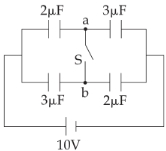
- 8In figure a system of four capacitors connected across a $10\, V$ battery is shown. Charge that will flow from switch $S$ when it is closed isView Solution
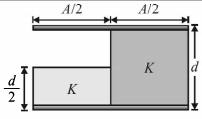
- 9A parallel plate capacitor of area ' $A$ ' plate separation ' $d$ ' is filled with two dielectrics as shown. What is the capacitance of the arrangement?View Solution
- 10Positive and negative point charges of equal magnitude are kept at $\left(0,0, \frac{a}{2}\right)$ and $\left(0,0, \frac{-a}{2}\right)$, respectively. The work done by the electric field when another positive point charge is moved from $(-a, 0,0)$ to $(0, a, 0)$ isView Solution