A wooden piece floats half submerged in a tub of water. If the system is transferred to a lift ascending with acceleration the wooden piece will
Medium


Download our appand get started for free
Experience the future of education. Simply download our apps or reach out to us for more information. Let's shape the future of learning together!No signup needed.*
Similar Questions
- 1A barometer kept in a stationary elevator reads $76 cm$. If the elevator starts accelerating up the reading will beView Solution
- 2Two tubes of radii $r_1$ and $r_2$, and lengths $l_1$ and $l_2$, respectively, are connected in series and a liquid flows through each of them in streamline conditions. $P_1$ and $P_2$ are pressure differences across the two tubes. If $P_2$ is $4P_1$ and $l_2$ is $ \frac{l_1}{4}$ , then the radius $r_2$ will be equal toView Solution
- 3The weight of a body in water is one third of its weight in air. The density of the body is ....... $g / cm ^3$View Solution
- 4Water from a tap emerges vertically downwards with an initial speed of $1.0\,ms^{-1}.$ The cross-sectional area of the tap is $10^{-4}\,m^2.$ Assume that the pressure is constant throughout the stream of water and that flow is streamlined. The cross-sectional area of the stream, $0.15\,m$ below the tap would be: (take $g = 10\,ms^{-2}$ )View Solution
- 5Eight equal drops of water are falling through air with a steady speed of $10\,cm / s$. If the drops coalesce, the new velocity is $.........\,cm/s$View Solution
- 6An object is located at $2\, km$ beneath the surface of the water. If the fractional compression $\frac{\Delta V }{ V }$ is $1.36\, \%,$ the ratio of hydraulic stress to the corresponding hydraulic strain will be ......... . [Given : density of water is $1000\, kg m ^{-3}$ and $\left. g =9.8 \,ms ^{-2} .\right]$View Solution
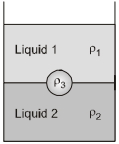
- 7A jar is filled with two non-mixing liquids $1$ and $2$ having densities $\rho_1$ and, $\rho_2$ respectively. A solid ball, made of a material of density $\rho_3$ , is dropped in the jar. It comes to equilibrium in the position shown in the figure.Which of the following is true for $\rho_1 , \rho_2$ and $\rho_3$?View Solution
- 8A cube of external dimension $10\ cm$ has an inner cubical portion of side $5\ cm$ whose density is twice that of the outer portion. If this cube is just floating in a liquid of density $2\ g/cm^3$, find the density of the inner portionView Solution
- 9View SolutionPressure applied to an enclosed fluid is transmitted undiminished to every portion of the fluid and the walls of the containing vessel. This law was first formulated by
- 10An incompressible fluid flows steadily through a cylindrical pipe which has radius $2r$ at point $A $ and radius $r $ at $B $ further along the flow direction. If the velocity at point $A$ is $v, $ its velocity at point $B$ isView Solution