Water is filled to a height $H$ behind a dam of width $w$. The resultant force on dam is ..............
Medium


Download our appand get started for free
Experience the future of education. Simply download our apps or reach out to us for more information. Let's shape the future of learning together!No signup needed.*
Similar Questions
- 1The relative velocity of two consecutive layers is 8 cm/s. If the perpendicular distance between the layers is $0.1\, cm$, then the velocity gradient will be ......... $sec^{-1}$View Solution
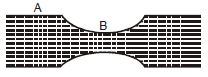
- 2Water flows in a horizontal tube as shown in figure. The pressure of water changes by $600\, N/ m^2$ between $A$ and $B$ where the area of crosssection are $30\, cm^2$ and $15\, cm^2$ respectively. Find the rate of flow of water through the tube.View Solution
- 3The terminal velocity $\left( v _{ t }\right)$ of the spherical rain drop depends on the radius ( $r$ ) of the spherical rain drop asView Solution
- 4A spherical body of radius $R$ consists of a fluid of constant density and is in equilibrium under its own gravity. If $P ( r )$ is the pressure at $r ( r < R )$, then the correct option$(s)$ is(are)View Solution
$(A)$ $P ( I =0)=0$ $(B)$ $\frac{ P ( r =3 R / 4)}{ P ( r =2 R / 3)}=\frac{63}{80}$
$(C)$ $\frac{ P ( r =3 R / 5)}{ P ( r =2 R / 5)}=\frac{16}{21}$ $(D)$ $\frac{ P ( r = R / 2)}{ P ( r = R / 3)}=\frac{20}{27}$
- 5View SolutionTwo pieces of metal when immersed in a liquid have equal upthrust on them; then
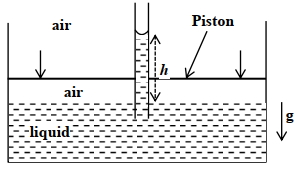
- 6An incompressible liquid is kept in a container having a weightless piston with a hole. A capillary tube of inner radius $0.1 \mathrm{~mm}$ is dipped vertically into the liquid through the airtight piston hole, as shown in the figure. The air in the container is isothermally compressed from its original volume $V_0$ to $\frac{100}{101} V_0$ with the movable piston. Considering air as an ideal gas, the height $(h)$ of the liquid column in the capillary above the liquid level in $\mathrm{cm}$ is. . . . . . .View Solution
[Given: Surface tension of the liquid is $0.075 \mathrm{Nm}^{-1}$, atmospheric pressure is $10^5 \mathrm{~N} \mathrm{~m}^{-2}$, acceleration due to gravity $(g)$ is $10 \mathrm{~m} \mathrm{~s}^{-2}$, density of the liquid is $10^3 \mathrm{~kg} \mathrm{~m}^{-3}$ and contact angle of capillary surface with the liquid is zero]
- 7A liquid is kept in a cylindrical vessel which is being rotated about a vertical axis through the centre of the circular base. If the radius of the vessel is $ r $ and angular velocity of rotation is $\omega $, then the difference in the heights of the liquid at the centre of the vessel and the edge isView Solution
- 8The blades of a windmill sweep out a circle of area $A$. If the wind flows at a velocity $b$ perpendicular to the circle, then the mass of the air of density $\rho $ passing through it in time $t$ isView Solution
- 9A $0.5\ kg$ mass of lead is submerged in a container filled to the brim with water and a block of wood floats on top. The lead mass is slowly lifted from the container by a thin wire and as it emerges into air the level of the water in the container drops a bit. The lead mass is now placed on the block of wood. As the lead is placed on the wood.View Solution
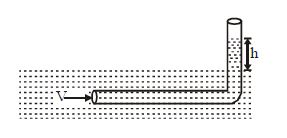
- 10An $L-$ shaped glass tube is just immersed in flowing water towards tube as shown. If speed of water current is $V,$ then the height $h$ upto which water rises will beView Solution