A galvanometer of resistance, $G,$ is shunted by a resistance $S$ $ohm$. To keep the main current in the circuit unchanged, the resistance to be put in series with the galvanometer is
AIPMT 2011, Medium
Download our app for free and get started
Let resistance $R$ is to be put in series with galvanometer $G$ to keep the main current in the circuit unchanged.
$\therefore \frac{G S}{G+S}+R=G$
$R=G-\frac{G S}{G+S} \Rightarrow R=\frac{G^{2}+G S-G S}{G+S}$
$R=\frac{G^{2}}{G+S}$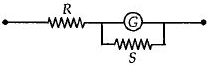

Download our appand get started for free
Experience the future of education. Simply download our apps or reach out to us for more information. Let's shape the future of learning together!No signup needed.*
Similar Questions
- 1View SolutionIf the direction of the initial velocity of the charged particle is neither along nor perpendicular to that of the magnetic field, then the orbit will be
- 2View SolutionElectrons moving with different speeds enter a uniform magnetic field in a direction perpendicular to the field., time periods of rotation will be :
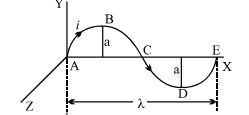
- 3A conductor $ABCDE$, shaped as shown, carries a current i. It is placed in the $xy$ plane with the ends $A$ and $E$ on the $x$-axis. $A$ uniform magnetic field of magnitude $B$ exists in the region. The force acting on it will beView Solution
- 4A deutron of kinetic energy $50\, keV$ is describing a circular orbit of radius $0.5$ $metre$ in a plane perpendicular to magnetic field $\overrightarrow B $. The kinetic energy of the proton that describes a circular orbit of radius $0.5$ $metre$ in the same plane with the same $\overrightarrow B $ is........$keV$View Solution
- 5Given below are two statementsView Solution
Statement $I$ : The electric force changes the speed of the charged particle and hence changes its kinetic energy: whereas the magnetic force does not change the kinetic energy of the charged particle
Statement $II$ : The electric force accelerates the positively charged particle perpendicular to the direction of electric field. The magnetic force accelerates the moving charged particle along the direction of magnetic field. In the light of the above statements, choose the most appropriate answer from the options given below
- 6A long conducting wire having a current $I$ flowing through it, is bent into a circular coil of $N$ turns.Then it is bent into a circular coil of $n$ tums. The magnetic field is calculated at the centre of coils in both the cases. The ratio of the magnetic field in first case to that of second case is:View Solution
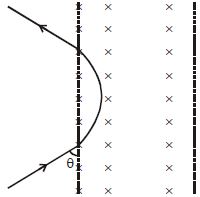
- 7View SolutionA positively charged particle enters in a region of uniform. Transverse magnetic field as shown in figure find net deviation in path of the particle.
- 8A teacher in his physics laboratory allotted an experiment to determine the resistance $(G)$ of a galvanometer. Students took the observations for $\frac{1}{3}$ deflection in the galvanometer. Which of the below is true for measuring value of $G$ $?$View Solution
- 9When equal current is passed through two coils, equal magnetic field is produced at their centres. If the ratio of number of turns in the coils is $8: 15$, then the ratio of their radii will beView Solution
- 10Two very long, straight, parallel conductors $A$ and $B$ carry current of $5\,A$ and $10\,A$ respectively and are at a distance of $10\,cm$ from each other. The direction of current in two conductors is same. The force acting per unit length between two conductors is: $\left(\mu_0=4 \pi \times 10^{-7}\right.$ SI unit)View Solution