Question
| ‘A’ Group | B’ Group |
| 1. Muscle | (a) Perichondrium |
| 2. Bone | (b) Sarcolemma |
| 3. Nerve cell | (c) Periosteum |
| 4. Cartilage | (d) Neurilemma |
| ‘A’ Group | B’ Group |
| 1. Muscle | (a) Perichondrium |
| 2. Bone | (b) Sarcolemma |
| 3. Nerve cell | (c) Periosteum |
| 4. Cartilage | (d) Neurilemma |
| ‘A’ Group | B’ Group |
| 1. Muscle | (c) Periosteum |
| 2. Bone | (a) Perichondrium |
| 3. Nerve cell | (b) Sarcolemma |
| 4. Cartilage | (d) Neurilemma |
Generate a complete, print-ready paper with questions like this in minutes — across 16+ boards, with answer keys.
| Column $I$ | Column $II$ |
| $1. \ G:$ Phase | $(a) \ 1-3$ Hours |
| $2. \ G_i$ Phase | $(b) \ 2-5$ Hours |
| $3. \ M$ Phase | $(c) \ 6-8$ Hours |
| $4. \ S$ Phase | $(d) \ 8$ Hours |
| ‘A’ Group | ‘B’ Group |
| 1. Muscle | (a) Perichondrium |
| 2. Bone | (b) Sarcolemma |
| 3. Nerve cell | (c) Periosteum |
| 4. Cartilage | (d) Neurilemma |
| Column I | Column II |
| 1. Herbarium | (a) It is a place having a collection of preserved plants and animals |
| 2. Key | (b) A list that enumerates methodically all the species found in an area with brief description aiding identification |
| 3. Museum | (c) It is a place where dried and pressed plant specimens mounted on sheets are kept |
| 4. Catalogue | (d) A booklet containing a list of characters and their alternates which are helpful in identification of various taxa. |
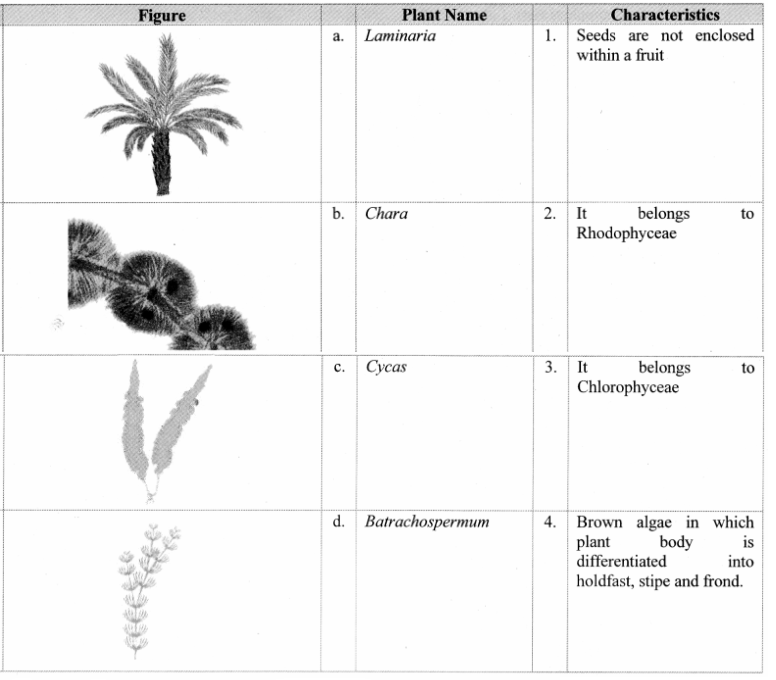
| Column – I | Column – II |
| 1. Saprophyte | (a) Symbiotic association of fungi with plants roots |
| 2. Parasite | (b) Decomposition of dead |
| 3. Lichens | (c) Living on living plants or animals |
| 4. Mycorrhiza | (d) Symbiotic association of algae and fungi |
| Column I | Column II |
| 1. Protoxylem | (a) Xylem with larger vessels |
| 2. Endarch Xylem | (b) Protoxylem arranged towards pith |
| 3. Metaxylem | (c) Metaxylem arranged towards pith |
| 4. Exarch xylem | (d) First formed xylem vessels |
| Column I | Column II |
| 1. Cuboidal epithelium | a. Fallopian tube |
| 2. Squamous epithelium | b. Kidney |
| 3. Ciliated epithelium | c. Intestine |
| 4. Columnar epithelium | d. Endothelium |
| Column I | Column II |
| 1. Bryophyta | (a) 70 genera and 1000 living species |
| 2. Pteridophyta | (b) 32 genera and 80 species |
| 3. Gymnospermae | (c) 960 genera and 25000 species |
| (d) 400 genera and 11000 species |
| Column I | Column II |
| 1. Halophiles | (a) Hot springs |
| 2. Thermoacidophiles | (b) Aquatic environment |
| 3. Methanogens | (c) Guts of ruminants |
| 4. Cyanobacteria | (d) Salty areas |