Write the principle of working of a potentiometer. Describe briefly, with the help of a circuit diagram, how a potentiometer is used to determine the internal resistance of a given cell.
CBSE DELHI - SET 1 2010
Download our app for free and get started
Working principle: When constant current flows through a wire of uniform cross section, then potential difference across the wire is directly proportional to the length. $\text{V}\propto l$
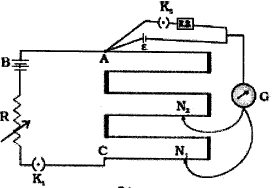
With key $K_2$ open, balance is obtained at length $l_1 (AN_1).$
Then, $\varepsilon = \Phi l_{1}(\Phi = \text{ potential gradient)}$
When key $K_2$ is closed, the cell sends a current $(I)$ through the resistance box $(R).$
If $V$ is the terminal potential difference of the cell and balance is obtained at length $l_2 (AN_2),$
$\text{V} = \Phi l_{2}$ But $\frac{\varepsilon}{\text{V}} = \frac{\text{I}(\text{R} + \text{r})}{\text{IR}} = \bigg(1 + \frac{\text{r}}{\text{R}}\bigg)$
$\therefore\bigg(1 + \frac{\text{r}}{\text{R}}\bigg) = \frac{l_{1}}{l_{2}}$ $\Rightarrow\text{r} = \frac{(l_{1} - l_{2})}{l_{2}}\text{R}.$
With key $K_2$ open, balance is obtained at length $l_1 (AN_1).$
Then, $\varepsilon = \Phi l_{1}(\Phi = \text{ potential gradient)}$
When key $K_2$ is closed, the cell sends a current $(I)$ through the resistance box $(R).$
If $V$ is the terminal potential difference of the cell and balance is obtained at length $l_2 (AN_2),$
$\text{V} = \Phi l_{2}$ But $\frac{\varepsilon}{\text{V}} = \frac{\text{I}(\text{R} + \text{r})}{\text{IR}} = \bigg(1 + \frac{\text{r}}{\text{R}}\bigg)$
$\therefore\bigg(1 + \frac{\text{r}}{\text{R}}\bigg) = \frac{l_{1}}{l_{2}}$ $\Rightarrow\text{r} = \frac{(l_{1} - l_{2})}{l_{2}}\text{R}.$

Download our appand get started for free
Experience the future of education. Simply download our apps or reach out to us for more information. Let's shape the future of learning together!No signup needed.*
Similar Questions
- 1What length of a copper wire of cross$-$sectional area $0.01\ mm^2$ will be needed to prepare a resistance of $1\text{k}\Omega?$ Resistivity of copper $=1.7\times10^{-8}\Omega\text{-m}.$View Solution
- 2View SolutionElectrons are continuously in motion within a conductor but there is no current in it unless some source of potential is applied across its ends. Give reason.
- 3View Solution
- Three resistors $2\ \Omega,\ 4\ \Omega\ \text{and}\ 5\ \Omega$ are combined in parallel. What is the total resistance of the combination?
- If the combination is connected to a battery of emf 20 V and negligible internal resistance, determine the current through each resistor, and the total current drawn from the battery.
- 4A resistance $\text{R}=4\Omega$ is connected to one of the gaps in a meter bridge, which uses a wire of length 1m. An unknown resistance $\text{x}>4\Omega$ is connected in the other gap as shown in the figure. The balance point is noticed at ‘l’ cm from the positive end of the battery. On interchanging R and X, it is found that the balance point further shifts by 20cm (away from the end A). Neglecting the end correction calculate the value of unknown resistance ‘X’ used.View Solution
- 5Two heating elements of resistances $R_{1}$ and $R_{2}$ when operated at a constant supply of voltage, $V$, Consume power $P_1$ and $P_2$ respectively. Deduce the expressions for the power of their combination when they are, in turn, connected in $(i)$ series and $(ii)$ parallel across the same voltage supply.View Solution
- 6View SolutionHow many time constants will elapse before the power delivered by a battery drops to half of its maximum value in an RC circuit?
- 7The earth’s surface has a negative surface charge density of $10^{-9} Cm^{-2}.$ The potential difference of $400 kV$ between the top of the atmosphere and the surface results $($due to the low conductivity of the lower atmosphere$)$ in a current of only $1800 A$ over the entire globe. If there were no mechanism of sustaining atmospheric electric field, how much time $($roughly$)$ would be required to neutralise the earth’s surface? $($This never happens in practice because there is a mechanism to replenish electric charges, namely the continual thunderstorms and lightning in different parts of the globe$). ($Radius of earth $= 6.37 \times 10^6 m.)$View Solution
- 8View SolutionThe graph shown here shows the variation of terminal potential difference V, across a combination of three cells in series to a resistor, versus current i:
- Calculate the emf of each cell.
- For what current i, will the power dissipation of the circuit be maximum?
- 9A wire $AB$ is carrying a steady current of $12 A$ and is lying on the table. Another wire $CD$ carrying $5A$ is held directly above $AB$ at a height of $1 mm.$ Find the mass per unit length of the wire $CD$ so that it remains suspended at its position when left free. Give the direction of the current flowing in $CD$ with respect to that in $AB.$ $[$Take the value of $g = 10 ms^{–2}]$View Solution
- 10View SolutionA cylindrical metallic wire is stretched to increase its length by 10%. Calculate the percentage increase in its resistance.