MCQ
A hollow sphere is filled with water through a small hole in it. It is then hung by a long thread and made to oscillate. As the water slowly flows out of the hole at the bottom, the period of oscillation will
  • A
    Continuously decrease
  • B
    Continuously increase
  • C
    First decrease and then increase to original value
  • First increase and then decrease to original value

Answer

Correct option: D.
First increase and then decrease to original value
d
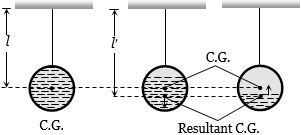
(d) The given system is like a simple pendulum, whose effective length $(l)$ is equal to the distance between point of suspension and $C.G.$ (Centre of Gravity) of the hanging body.

When water slowly flows out the sphere, the $C.G.$ of the system is lowered, and hence $l$ increases, which in turn increases time period (as $T \propto \sqrt l $). 

After some time weight of water left in sphere become less than the weight of sphere itself, so the resultant $C.G.$ gets clear the $C.G.$ of sphere itself i.e. $l$ decreases and hence $T$ increases. 

Finally when the sphere becomes empty, the resulting $C.G.$ is the $C.G.$ of sphere 

i.e. length becomes equal to the original length and hence the time period becomes equal to the same value as when it was full of water.  
Need a full question paper?

Generate a complete, print-ready paper with questions like this in minutes — across 16+ boards, with answer keys.

Start Generating Free

Similar questions

The period of oscillation of a simple pendulum is $T =2 \pi \sqrt{\frac{ L }{ g }} .$ Measured value of $ L $ is $1.0\, m$ from meter scale having a minimum division of $1 \,mm$ and time of one complete oscillation is $1.95\, s$ measured from stopwatch of $0.01 \,s$ resolution. The percentage error in the determination of $g$ will be ..... $\%.$
A rectangular block is $5 cm × 5 cm × 10cm$  in size. The block is floating in water with $ 5 cm $ side vertical. If it floats with $10 cm $ side vertical, what change will occur in the level of water?
Which of the following graphs best represents the motion of a raindrop?
A body is projected vertically upward with speed $10 \,m / s$ and other at same time with same speed in downward direction from the top of a tower. The magnitude of acceleration of first body w.r.t. second is ...... $m / s ^2$ $\left\{\right.$ take $\left.g=10 \,m / s ^2\right\}$
Two blocks $1$ and $2$ of equal mass $m$ are connected by an ideal string (see figure below) over a frictionless pulley. The blocks are attached to the ground by springs having spring constants $k_1$ and $k_2$ such that $k_1 > k_2$. Initially, both springs are unstretched. Block $1$ is slowly pulled down a distance $x$ and released. Just after the release the possible values of the magnitudes of the accelerations of the blocks $a_1$ and $a_2$ can be
Which one of the following physical quantities is not a fundamental quantity?
A body is pulled along a rough horizontal surface with a velocity $6\,m/s$. If the body comes to rest after travelling $9\,m$ , then coefficient of sliding friction, is- (Take $g = 10\,m/s^2$ )
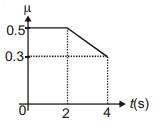
A block is projected with speed $20 \,m / s$ on a rough horizontal surface. The coefficient of friction $(\mu)$ between the surfaces varies with time $(t)$ as shown in figure. The speed of body at the end of $4$ second will be ............ $m / s$ ( $g=$ $10 \,m / s ^2$ )
$A$ ladder of length $L$ is slipping with its ends against a vertical wall and a horizontal floor. At a certain moment, the speed of the end in contact with the horizontal floor is $v$ and the ladder makes an angle $\alpha = 30^o$ with the horizontal. Then the speed of the ladder’s center must be
Equation of a progressive wave is given by $y = a\,\sin \pi \,\left[ {\frac{t}{2} - \frac{x}{4}} \right]\,,$ where $t$ is in seconds and $x$ is in meters. The distance through which the wave moves in $8 sec$ is .... $(m)$ (in meter)