Figure shows a transparent hemisphere of radius 3.0cm made of a material of refractive index 2.0.
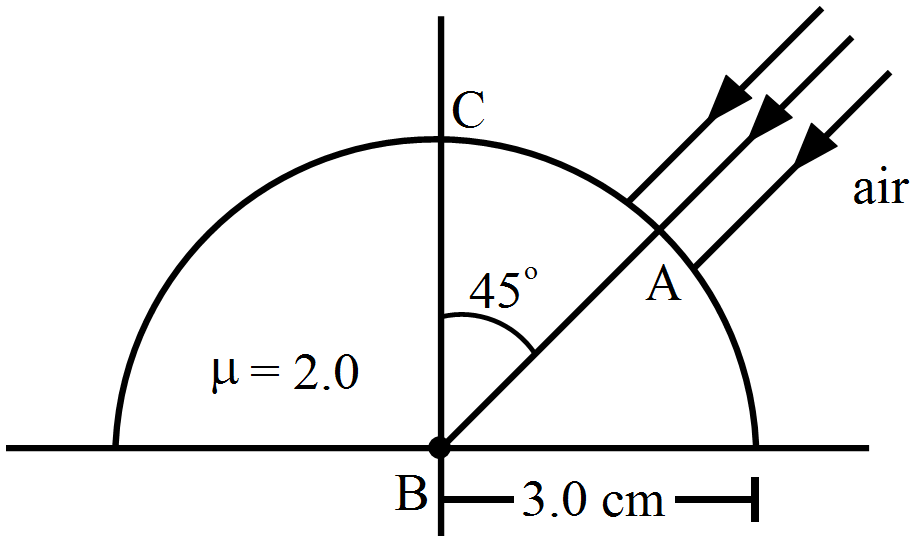
- A narrow beam of parallel rays is incident on the hemisphere as shown in the figure. Are the rays totally reflected at the plane surface?
- Find the image formed by the refraction at the first surface.
- Find the image formed by the reflection or by the refraction at the plane surface.
- Trace qualitatively the final rays as they come out of the hemisphere.
Download our app for free and get started
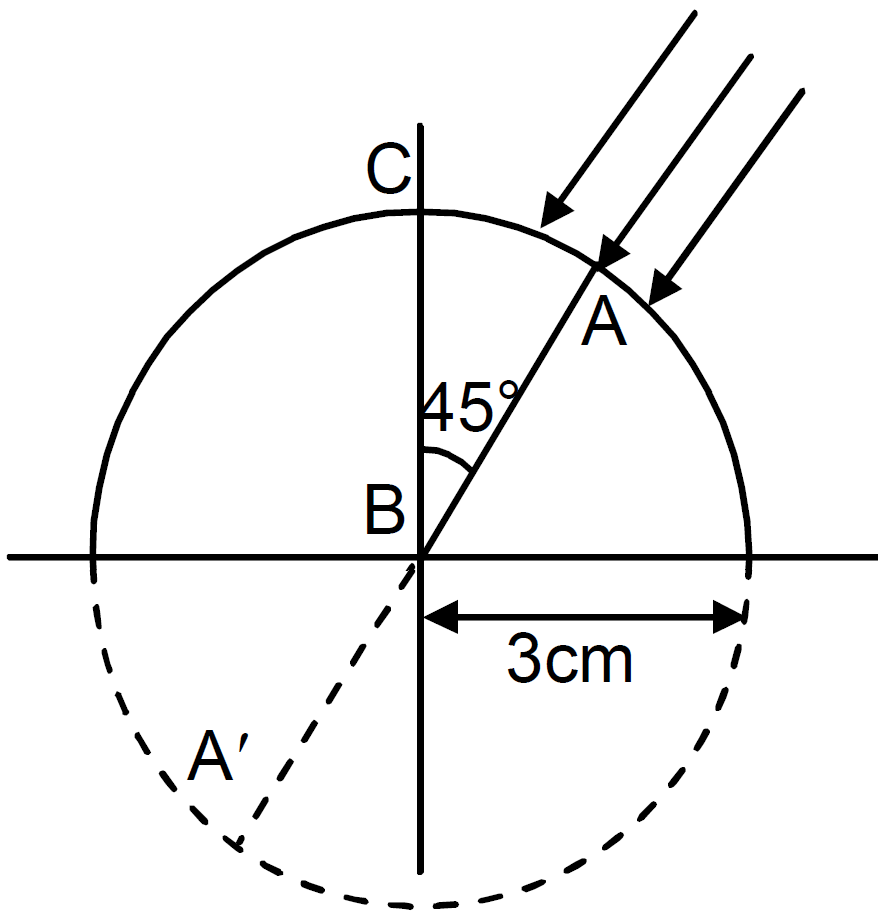
Given, $\mu_2=2.0$
So, critical angle $=\sin^{-1}\Big(\frac{1}{\mu_2}\Big)=\sin^{-1}\Big(\frac{1}{2}\Big)=30^{\circ}$
- As angle of incidence is greater than the critical angle, the rays are totally reflected internally.
- Here, $\frac{\mu_2}{\text{v}}-\frac{\mu_1}{\text{u}}=\frac{\mu_2-\mu_1}{\text{R}}$
$\Rightarrow \ \frac{2}{\text{v}}=\frac{1}{3}\Rightarrow \text{v}=6\text{cm}$
$\Rightarrow$ If the sphere is completed, image is formed diametrically opposite of A.
- Image is formed at the mirror in front of A by internal reflection.

Download our appand get started for free
Experience the future of education. Simply download our apps or reach out to us for more information. Let's shape the future of learning together!No signup needed.*
Similar Questions
- 1View SolutionA professor reads a greeting card received on his 50th birthday with +2.5D glasses keeping the card 25cm away. Ten years later, he reads his farewell letter with the same glasses but he has to keep the letter 50cm away. What power of lens should he now use?
- 2View Solution
- Draw a labelled ray diagram to obtain the real image formed by an astronomical telescope in normal adjustment position. Defineits magnifying power.
- You are given three lenses of power 0.5 D, 4 D and 10 D to design a telescope.
- Which lenses should he used as objective and eyepiece? Justify your answer.
- Why is the aperture of the objective preferred to be large?
- 3View Solution
- Obtain lens makers formula using the expression
Here the ray of light propagating from a rare medium of refractive index $(n_1)$ to a denser medium of refractive index $(n_2)$ is incident on the convex side of spherical refracting surface of radius of curvature R.- Draw a ray diagram to show the image formation by a concave mirror when the object is kept between its focus and the pole. Using this diagram, derive the magnification formula for the image formed.
- 4A right angled prism of refractive index n has a plane of refractive index $n_1$ so that $n_1 < n$, cemented to its diagonal face. The assembly is in air. A ray is incident on AB.View Solution
- Calculate the angle of incidence at AB for which the ray strikes the diagonal face at the critical angle.
- Assuming n = 1.352, calculate the angle of incidence at AB for which the refracted ray passes through the diagonal face undeviated.
- 5View Solution
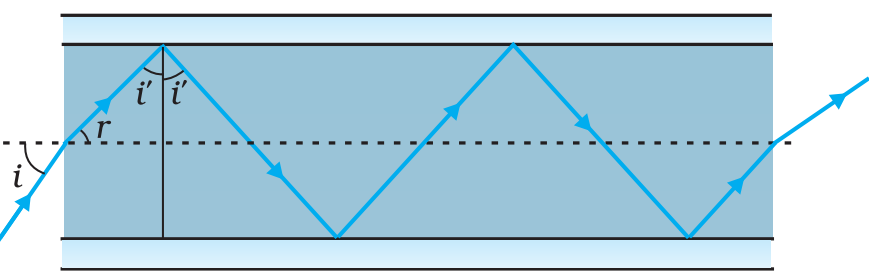
- a cross - section of a ‘light pipe’ made of a glass fibre of refractive. The outer covering of the pipe is made of a material of refractive. What is the range of the angles of the incident rays with the axis of the pipe for which total reflections inside the pipe take place, as shown in the figure.
- What is the answer if there is no outer covering of the pipe?
- 6View SolutionA double convex lens has focal length 25cm. The radius of curvature of one of the surfaces is double of the other. Find the radii, if the refractive index of the material of the lens is 1.5.
- 7View SolutionA compound microscope consists of an objective of focal length 1cm and an eyepiece of focal length 5cm. An object is placed at a distance of 0.5cm from the objective. What should be the separation between the lenses so that the microscope projects an inverted real image of the object on a screen 30cm behind the eyepiece?
- 8View SolutionA compound microscope consists of an objective lens of focal length 2.0 cm and an eyepiece of focal length 6.25 cm separated by a distance of 15 cm. How far from the objective should an object be placed in order to obtain the final image at (a) the least distance of distinct vision (25 cm), and (b) at infinity? What is the magnifying power of the microscope in each case?
- 9View SolutionWill the focal length of a lens for red light be more, same or less than that for blue light?
- 10If light passes near a massive object, the gravitational interaction causes a bending of the ray. This can be thought of as happening due to a change in the effective refrative index of the medium given byView Solution
$\text{n}(\text{r})=1+2\frac{\text{GM}}{\text{rc}^2}$
where r is the distance of the point of consideration from the centre of the mass of the massive body, G is the universal gravitational constant, M the mass of the body and c the speed of light in vacuum. Considering a spherical object find the deviation of the ray from the original path as it grazes the object.