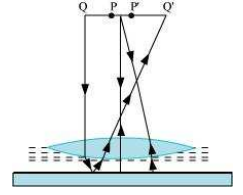
equiconvex lens (of refractive index 1.50) in contact with a liquid layer on top of a plane mirror. A small needle with its tip on the principal axis is moved along the axis until its inverted image is found at the position of the needle. The distance of the needle from the lens is measured to be 45.0 cm. The liquid is removed and the experiment is repeated. The new distance is measured to be 30.0 cm. What is the refractive index of the liquid?
Exercise
Download our app for free and get started
Focal length of the convex lens, $f_1 = 30$ cm
The liquid acts as a mirror. Focal length of the liquid $= f_2$
Focal length of the system (convex lens + liquid), $f = 45$ cm
For a pair of optical systems placed in contact, the equivalent focal length is given as:
$\frac{1}{\text{f}}=\frac{1}{\text{f}_1}+\frac{1}{\text{f}_2}$
$\frac{1}{\text{f}_2}=\frac{1}{\text{f}}-\frac{1}{\text{f}_1}$
$=\frac{1}{45}-\frac{1}{30}=-\frac{1}{90}$
$\therefore \ \text{f}_2=-90 \ \text{cm}$
Let the refractive index of the lens be $µ_1$ and the radius of curvature of one surface be R.
Hence, the radius of curvature of the other surface is - R.
R can be obtained using the relation:
$\frac{1}{\text{f}_1}=(\mu-1)\Big(\frac{1}{\text{R}}+\frac{1}{\text{R}}\Big)$
$\frac{1}{30}=(1.5-1)\Big(\frac{2}{\text{R}}\Big)$
$\therefore \ \text{R}=30\times(0.5)\times2=30\text{cm}$
Let $µ_2$ be the refractive index of the liquid.
Radius of curvature of the liquid on the side of the plane mirror = ∞
Radius of curvature of the liquid on the side of the lens, R= - 30 cm
The value of $µ_2$ can be calculated using the relation:
$\frac{1}{\text{f}_2}=(\mu_2-1)\Big(\frac{1}{\text{R}_1}-\frac{1}{\text{R}_2}\Big)$
$-\frac{1}{90}=(\mu_2-1)\Big(\frac{1}{-30}-\frac{1}{\infty}\Big)$
$\frac{1}{90}=(\mu_2-1)\Big(\frac{1}{30}\Big)$
$\mu_2-1=\frac{30}{90}$
$\mu_2=\frac{1}{3}+1=\frac{4}{3}$
$=1.33$
The liquid acts as a mirror. Focal length of the liquid $= f_2$
Focal length of the system (convex lens + liquid), $f = 45$ cm
For a pair of optical systems placed in contact, the equivalent focal length is given as:
$\frac{1}{\text{f}}=\frac{1}{\text{f}_1}+\frac{1}{\text{f}_2}$
$\frac{1}{\text{f}_2}=\frac{1}{\text{f}}-\frac{1}{\text{f}_1}$
$=\frac{1}{45}-\frac{1}{30}=-\frac{1}{90}$
$\therefore \ \text{f}_2=-90 \ \text{cm}$
Let the refractive index of the lens be $µ_1$ and the radius of curvature of one surface be R.
Hence, the radius of curvature of the other surface is - R.
R can be obtained using the relation:
$\frac{1}{\text{f}_1}=(\mu-1)\Big(\frac{1}{\text{R}}+\frac{1}{\text{R}}\Big)$
$\frac{1}{30}=(1.5-1)\Big(\frac{2}{\text{R}}\Big)$
$\therefore \ \text{R}=30\times(0.5)\times2=30\text{cm}$
Let $µ_2$ be the refractive index of the liquid.
Radius of curvature of the liquid on the side of the plane mirror = ∞
Radius of curvature of the liquid on the side of the lens, R= - 30 cm
The value of $µ_2$ can be calculated using the relation:
$\frac{1}{\text{f}_2}=(\mu_2-1)\Big(\frac{1}{\text{R}_1}-\frac{1}{\text{R}_2}\Big)$
$-\frac{1}{90}=(\mu_2-1)\Big(\frac{1}{-30}-\frac{1}{\infty}\Big)$
$\frac{1}{90}=(\mu_2-1)\Big(\frac{1}{30}\Big)$
$\mu_2-1=\frac{30}{90}$
$\mu_2=\frac{1}{3}+1=\frac{4}{3}$
$=1.33$

Download our appand get started for free
Experience the future of education. Simply download our apps or reach out to us for more information. Let's shape the future of learning together!No signup needed.*
Similar Questions
- 1View Solution
- Draw a labelled ray diagram to show the formation of image in an astronomical telescope for a distant object.
- Write three distinct advantages of a reflecting type telescope over a refracting type telescope.
- A convex lens of focal length 10 cm is placed coaxially 5 cm away from a concave lens of focal length 10 cm. If an object is placed 30 cm in front of the convex lens, find the position of the final image formed by the combined system.
- 2View SolutionA point object is placed at a distance of 15cm from a convex lens. The image is formed on the other side at a distance of 30cm from the lens. When a concave lens is placed in contact with the convex lens, the image shifts away further by 30cm. Calculate the focal lengths of the two lenses.
- 3View SolutionA diverging lens of focal length 20cm and a converging lens of focal length 30cm are placed 15cm apart with their principal axes coinciding. Where should an object be placed on the principal axis so that its image is formed at infinity?
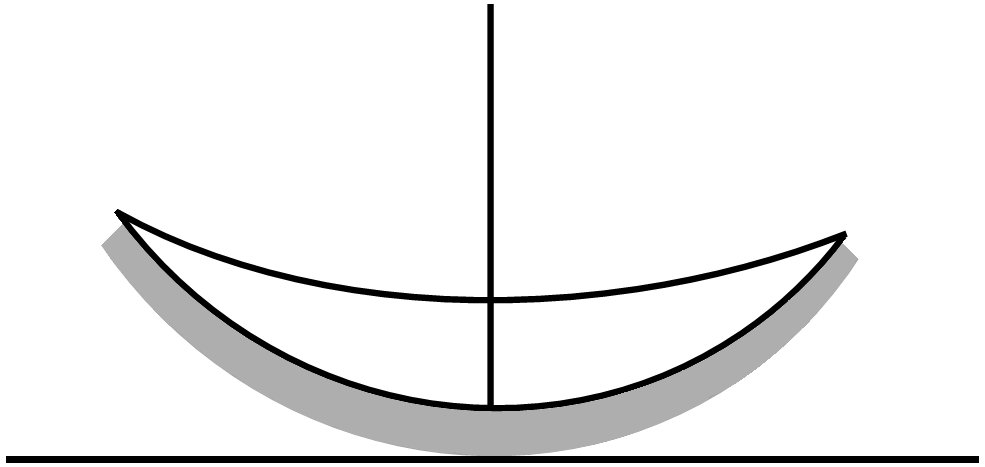
- 4The convex surface of a thin concavo-convex lens of glass of refractive index 1.5 has a radius of curvature 20cm. The concave surface has a radius of curvature 60cm. The convex side is silvered and placed on a horizontal surface as shown in figure.View Solution
- Where should a pin be placed on the axis so that its image is formed at the same place?
- If the concave part is filled with water $\Big(\mu=\frac{4}{3}\Big),$ find the distance through which the pin should be moved so that the image of the pin again coincides with the pin.
- 5View Solution
- For a ray of light travelling from a denser medium of refractive index $n_1$ to a rarer medium of refractive index $n_2$ prove that $\frac{\text{n}_{2}}{\text{n}_{1}} = \sin \text{i}_{c} ,$ where $i_c$ is the critical angle of incidence for the media.
- Explain with the help of a diagram, how the above principle is used for transmission of video signals using optical fibres.
- 6View Solution
- Draw a labelled ray diagram to obtain the real image formed by an astronomical telescope in normal adjustment position. Defineits magnifying power.
- You are given three lenses of power 0.5 D, 4 D and 10 D to design a telescope.
- Which lenses should he used as objective and eyepiece? Justify your answer.
- Why is the aperture of the objective preferred to be large?
- 7View Solution
- Draw the ray diagram of an astronomical telescope when the final image is formed at infinity. Write the expression for the resolving power of the telescope.
- An astronomical telescope has an objective lens of focal length 20m and eyepiece of focal length 1cm.
- Find the angular magnification of the telescope.
- If this telescope is used to view the Moon, find the diameter of the image formed by the objective lens. Given the diameter of the Moon is $3.5 \times 10^6m$ and radius of lunar orbit is $3.8 \times 10^8m.$
- 8View Solution
- Obtain lens makers formula using the expression
Here the ray of light propagating from a rare medium of refractive index $(n_1)$ to a denser medium of refractive index $(n_2)$ is incident on the convex side of spherical refracting surface of radius of curvature R.- Draw a ray diagram to show the image formation by a concave mirror when the object is kept between its focus and the pole. Using this diagram, derive the magnification formula for the image formed.
- 9View SolutionIn many experimental set-ups the source and screen are fixed at a distance say D and the lens is movable. Show that there are two positions for the lens for which an image is formed on the screen. Find the distance between these points and the ratio of the image sizes for these two points.
- 10A biconvex thick lens is constructed with glass $(\mu=1.50)$ Each of the surfaces has a radius of 10cm and the thickness at the middle is 5cm. Locate the image of an object placed far away from the lens.View Solution