A convex lens has a focal length of 10cm. Find the location and nature of the image if a point object is placed on the principal axis at a distance of:
- 9.8cm
- 10.2cm from the lens.
Download our app for free and get started
Given that, f = 10cm
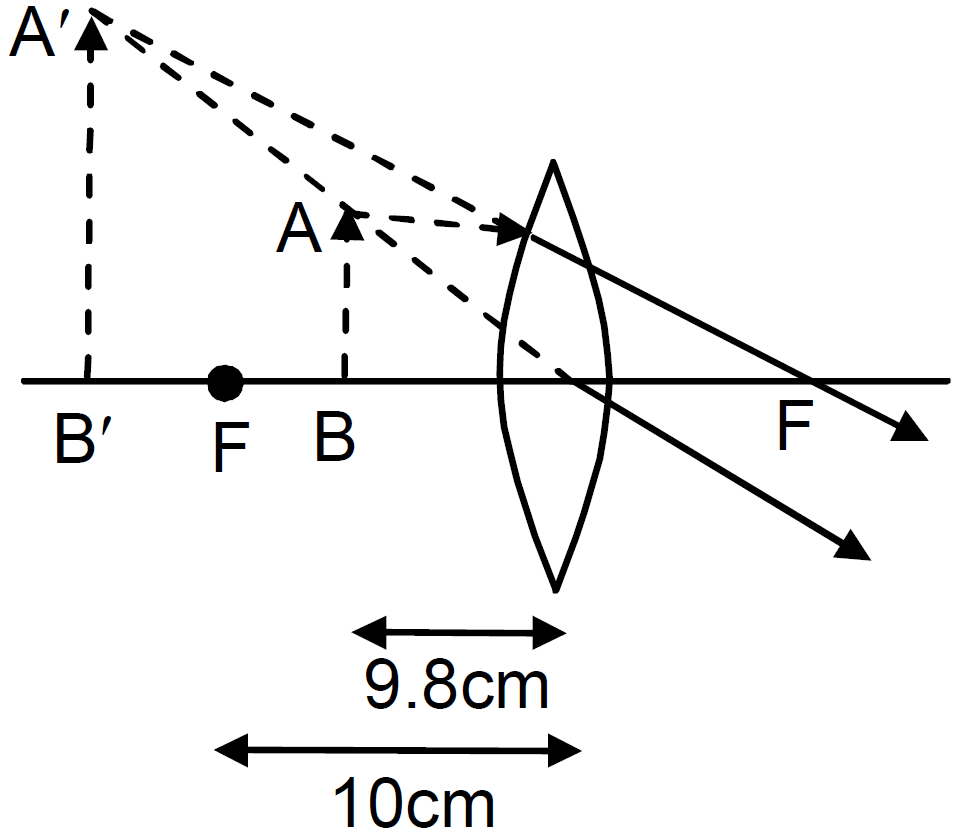
$\Rightarrow\text{v}=-490\text{cm}$
So, $\text{m}=\frac{\text{v}}{\text{u}}=\frac{-490}{-9.8}=50\text{cm}$
So, the image is erect and virtual.
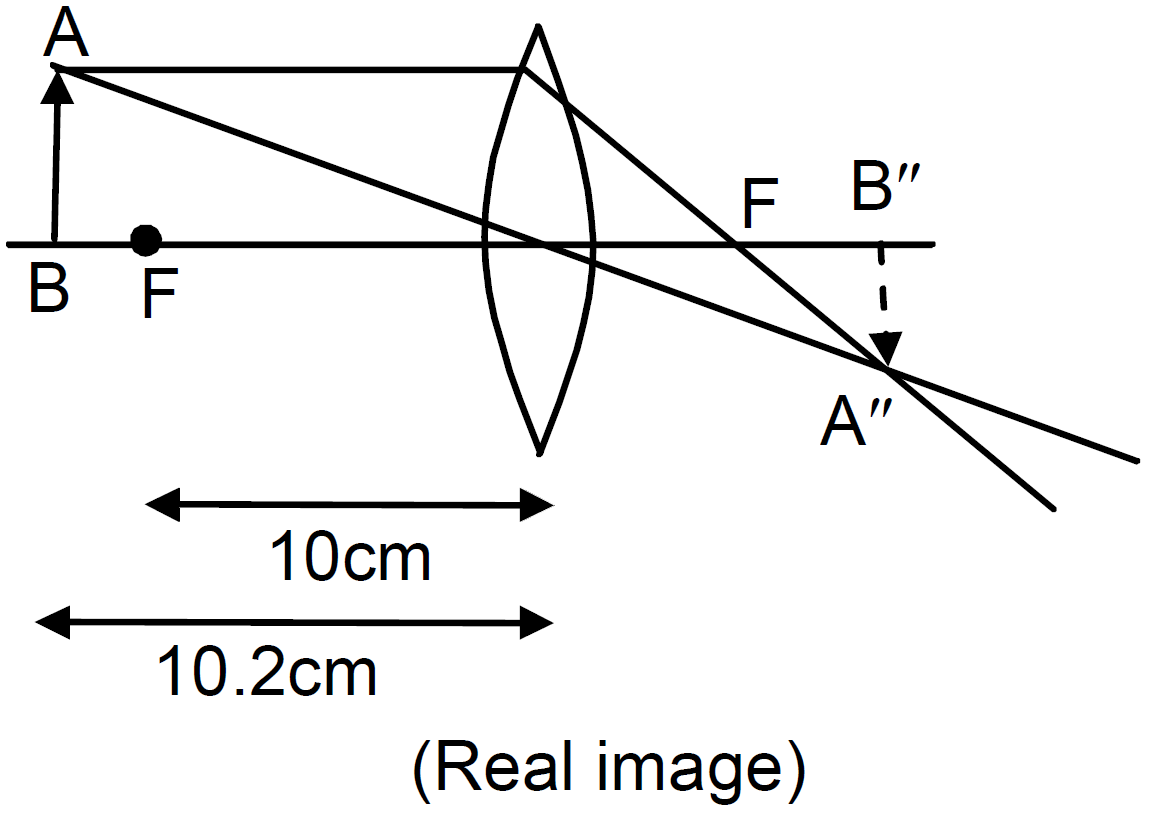
$\Rightarrow\text{v}=510\text{cm}$
So, $\text{m}=\frac{\text{v}}{\text{u}}=\frac{510}{-9.8}$
The image is real and inverted.
- When u = -9.5cm
$\Rightarrow\text{v}=-490\text{cm}$
So, $\text{m}=\frac{\text{v}}{\text{u}}=\frac{-490}{-9.8}=50\text{cm}$
So, the image is erect and virtual.
- When u = -10.2cm
$\Rightarrow\text{v}=510\text{cm}$
So, $\text{m}=\frac{\text{v}}{\text{u}}=\frac{510}{-9.8}$
The image is real and inverted.

Download our appand get started for free
Experience the future of education. Simply download our apps or reach out to us for more information. Let's shape the future of learning together!No signup needed.*
Similar Questions
- 1View Solution
- Draw the ray diagram showing refraction of light through a glass prism and hence obtain the relation between the refractive index $\mu$ of the prism, angle of prism and angle of minimum deviation.
- Determine the value of the angle of incidence for a ray of light travelling from a medium of refractive index $\mu_1=\sqrt{2}$ into the medium of refractive index $\mu_2=1$, so that it just grazes along the surface of separation.
- 2View SolutionWill the focal length of a lens for red light be more, same or less than that for blue light?
- 3A card sheet divided into squares each of size $1\ mm^2$ is being viewed at a distance of 9 cm through a magnifying glass (a converging lens of focal length 9 cm) held close to the eye.View Solution
- What is the magnification produced by the lens? How much is the area of each square in the virtual image?
- What is the angular magnification (magnifying power) of the lens?
- Is the magnification in (a) equal to the magnifying power in (b)? Explain.
- 4View Solution
- Derive the mathematical relation between refractive indices $n_1$ and $n_2 $ of two radii and radius of curvature R for refraction at a convex spherical surface. Consider the object to be a point since lying on the principle axis in rarer medium of refractive index $n_1$ and a real image formed in the denser medium of refractive index $n_{2}$.Hence, derive lens maker's formula.
- Light from a point source in air falls on a convex spherical glass surface of refractive index 1.5 and radius of curvature 20 cm. The distance of light source from the glass surface is 100 cm. At what position is the image formed?
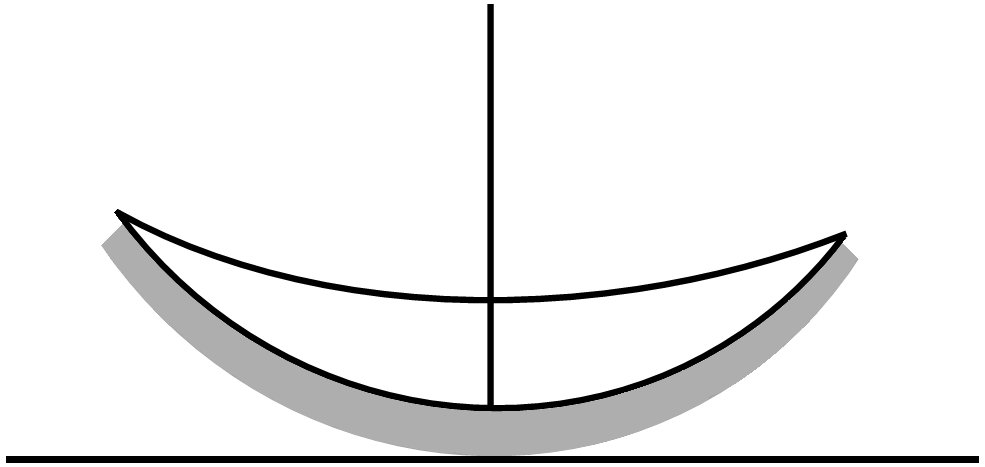
- 5The convex surface of a thin concavo-convex lens of glass of refractive index 1.5 has a radius of curvature 20cm. The concave surface has a radius of curvature 60cm. The convex side is silvered and placed on a horizontal surface as shown in figure.View Solution
- Where should a pin be placed on the axis so that its image is formed at the same place?
- If the concave part is filled with water $\Big(\mu=\frac{4}{3}\Big),$ find the distance through which the pin should be moved so that the image of the pin again coincides with the pin.
- 6A thin prism of angle $6.0^\circ,\omega=0.07$ and $\mu_\text{y}=1.50$ is combined with another thin prism having $\omega=0.08$ and $\mu_\text{y}=1.60.$ The combination produces no deviation in the mean ray.View Solution
- Find the angle of the second prism.
- Find the net angular dispersion produced by the combination when a beam of white light passes through it.
- If the prisms are similarly directed, what will be the deviation in the mean ray
- Find the angular dispersion in the situation described in (c).
- 7View Solution
- Draw a ray diagram to show the image formation by a combination of two thin convex lenses in contact. Obtain the expression for the power of this combination in terms of the focal lengths of the lenses.
- A ray of light passing from air through an equilateral glass prism undergoes minimum deviation when the angle of incidence is $\frac{3}{4}^{th}$ of the angle of prism. Calculate the speed of light in the prism.
- 8View Solution
- State Huygen’s principle. Using this principle draw a diagram to show how a plane wave front incident at the interface of the two media gets refracted when it propagates from a rarer to a denser medium. Hence verifiy Snell’s law of refraction.
- When monochromatic light travels from a rarer to a denser medium, explain the following, giving reasons:
- Is the frequency of reflected and refracted light same as the frequency of incident light?
- Does the decrease in speed imply a reduction in the energy carried by light wave?
- 9View SolutionOne day Chetan’s mother developed a severe stomach ache all of a sudden. She was rushed to the doctor who suggested for an immediate endoscopy test and gave an estimate of expenditure for the same. Chetan immediately contacted his class teacher and shared the information with her. The class teacher arranged for the money and rushed to the hospital. On realising that Chetan belonged to a below average income group family, even the doctor offered concession for the test fee. The test was conducted successfully.
Answer the following questions based on the above information:- Which principle in optics is made use of in endoscopy?
- Briefly explain the values reflected in the action taken by the teacher.
- In what way do you appreciate the response of the doctor on the given situation?
- 10View Solution
- Draw a ray diagram to show refraction of a ray of monochromatic light passing through a glass prism.
- Explain briefly how the phenomenon of total internal reflection is used in fibre optics.