A lens forms a real image 3cm high of an object 1cm high. If the separation of object and image is 15cm, find the focal length of the lens.
Download our app for free and get started
Given, Height of image (h') = -3cm (negative because image is real) Height of object = 1cm Let us first define the sign convention, Since the object distance is always negative, let it be -u. Since the focal length is positive for a convex lens, let it be +f.$\text{Magnification}=\frac{\text{h}'}{\text{h}}=\frac{\text{v}}{\text{u}}$
$\frac{\text{v}}{\text{u}}=-3$
$\therefore\ \text{v}=-3\text{u}$
Since object distance (u) is always negative, and the ratio $\frac{\text{v}}{\text{u}}$ here is negative, v must be positive i.e., it is on the right side of the lens. Now, we have object distance + image distance = 15 v + (-u) = 15 (Using sign convention)$-3\text{u}-\text{u}=15$
$-4\text{u}=15$
$\text{u}=\frac{-15}{4}$
Applying the lens formula,$\frac{1}{\text{f}}=\frac{1}{\text{v}}-\frac{1}{\text{u}}$
$\frac{1}{\text{f}}=\frac{1}{-3\text{u}}-\frac{1}{\text{u}}$
$\frac{1}{\text{f}}=\frac{-4}{3\text{u}}$
$\text{f}=\frac{3\text{u}}{-4}$
$\text{f}=\frac{3\times\frac{-15}{4}}{4}=\frac{45}{16}$
$\text{f}=2.18\text{cm}$
Hence, the focal length of the lens is +2.18cm.
$\frac{\text{v}}{\text{u}}=-3$
$\therefore\ \text{v}=-3\text{u}$
Since object distance (u) is always negative, and the ratio $\frac{\text{v}}{\text{u}}$ here is negative, v must be positive i.e., it is on the right side of the lens. Now, we have object distance + image distance = 15 v + (-u) = 15 (Using sign convention)$-3\text{u}-\text{u}=15$
$-4\text{u}=15$
$\text{u}=\frac{-15}{4}$
Applying the lens formula,$\frac{1}{\text{f}}=\frac{1}{\text{v}}-\frac{1}{\text{u}}$
$\frac{1}{\text{f}}=\frac{1}{-3\text{u}}-\frac{1}{\text{u}}$
$\frac{1}{\text{f}}=\frac{-4}{3\text{u}}$
$\text{f}=\frac{3\text{u}}{-4}$
$\text{f}=\frac{3\times\frac{-15}{4}}{4}=\frac{45}{16}$
$\text{f}=2.18\text{cm}$
Hence, the focal length of the lens is +2.18cm.

Download our appand get started for free
Experience the future of education. Simply download our apps or reach out to us for more information. Let's shape the future of learning together!No signup needed.*
Similar Questions
- 1When an object is placed at a distance of 50cm from a concave spherical mirror, the magnification produced is,$-\frac{1}{2}$ Where should the object be placed to get a magnification of, $-\frac{1}{5}?$View Solution
- 2View SolutionAt what distance should an object be placed from a convex lens of focal length 18 cm to obtain an image at 24 cm from it on the other side. What will be the magnification produced in this case?
- 3View SolutionIf the image formed by a lens for all positions of an object placed in front of it is always erect and diminished, what is the nature of this lens? Draw a ray diagram to justify your answer. If the numerical value of the power of this lens is 10 D, what is its focal length in the Cartesian system?
- 4View SolutionA converging lens of focal length 5cm is placed at a distance of 20cm from a screen. How far from the lens should an object be placed so as to form its real image on the screen?
- 5View SolutionGive three examples of materials that refract light rays. What happens to the speed of light rays when they enter these materials?
- 6View SolutionDraw ray-diagrams to show the formation of images when the object is placed in front of a concave mirror (converging mirror):
- Between its pole and focus.
- Between its centre of curvature and focus Describe the nature, size and position of the image formed in each case.
- 7View SolutionExplain with the help of a labelled ray diagram, why a pencil partly immersed in water appears to be bent at the water surface. State whether the bending of pencil will increase or decrease if water is replaced by another liquid which is optically more dense than water. Give reason for your answer.
- 8View SolutionWhen an object is placed 10cm in front of lens A, the image is real, inverted, magnified and formed at a great distance. When the same object is placed 10cm in front of lens B, the image formed is real, inverted and same size as the object:
- What is the focal length of lens A?
- What is the focal length of lens B?
- What is the nature of lens A?
- What is the nature of lens B?
- 9View SolutionA converging mirror forms a real image of height 4cm of an object of height 1cm placed 20cm away from the mirror:
- Calculate the image distance.
- What is the focal length of the mirror?
- 10a. What is the focal length of the lens used in sunglasses?View Solution
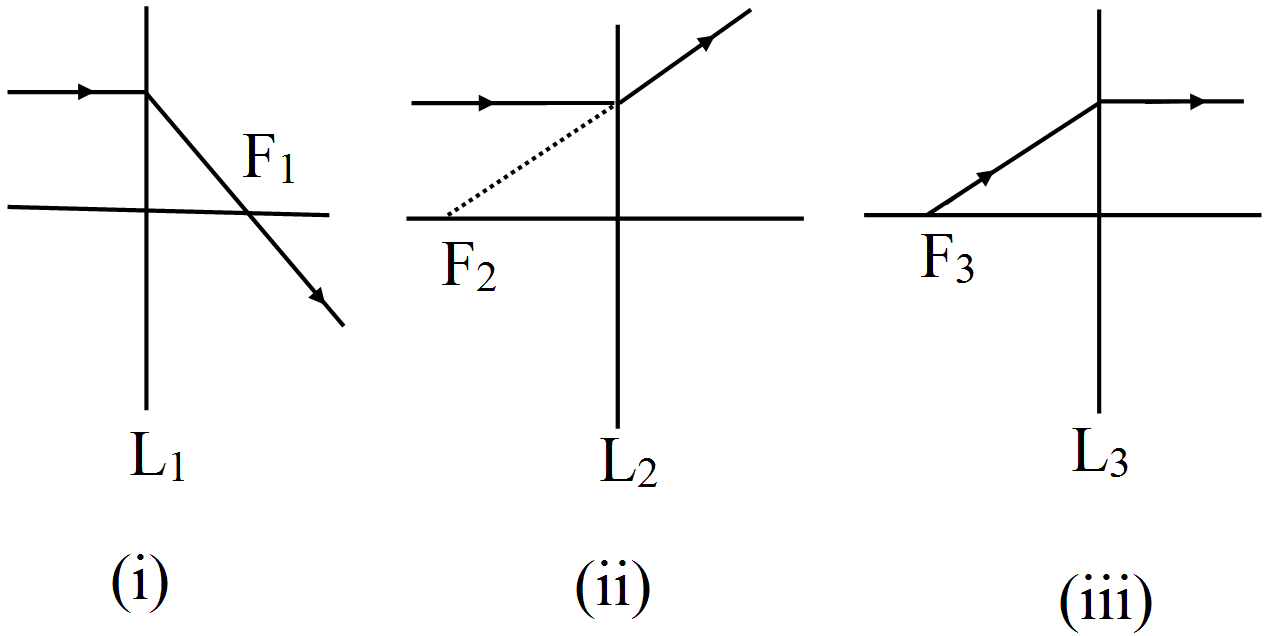
b. The following figures show the path of light rays through three lenses marked $L_1, L_2$, and $L_3$ and their focal points $F_1, F_2$, and $F_3$, respectively. Identify the nature of lenses.