Question
Balance the following equations in basic medium by ion-electron method and oxidation number methods and identify the oxidising agent and the reducing agent.$N_2H_4(l) + ClO_3^-(aq) \rightarrow NO(g) + Cl^-(g)$

Answer

Oxidation number method:Total increase in O.N. of N = 2 × 4 = 8
Total decreases in O.N. of Cl = 1 × 6 = 6
Therefore, to balance increase/ decrease in O.N. multiply $N_2H_4$ by 3 and $ClO_3^-$
by 4, we have,
$3\text{N}_2\text{H}_4(\text{l})+4\text{ClO}_3^-(\text{aq})\rightarrow\text{NO(g)}+\text{Cl}^-(\text{aq})$
To balance N and Cl atoms, multiply NO by 6 and $Cl^-$ by 4, we have,
$3\text{N}_2\text{H}_4(\text{l})+4\text{ClO}_3^-(\text{aq})\rightarrow6\text{NO(g)}+4\text{Cl}^-(\text{aq})$
Balance O atoms by adding $6H_2O$,
$3\text{N}_2\text{H}_4(\text{l})+4\text{ClO}_3^-(\text{aq})\rightarrow6\text{NO(g)}+4\text{Cl}^-(\text{aq})+6\text{H}_2\text{O}(\text{l})\ ....(\text{i})$
H atoms get automatically balanced and thus eq. (i) represents the correct balanced equation.
Ion electron method:
Oxidation half reaction: $\stackrel{{-2}}{\ \ \ \ \ \ \ \ \ \ \ \hbox{N}_2\text{H}_4(\text{l})}\rightarrow\stackrel{{+2}}{\ \ \ \ \ \ \hbox{NO(g)}}$
Balance N atoms, $\text{N}_2\text{H}_4(\text{l})\rightarrow2\text{NO(g)}$
Balance O.N. by adding electrons,
$\text{N}_2\text{H}_4(\text{l})\rightarrow2\text{NO(g)}+8\text{e}^-$
Balance charge by adding $8OH^-$ ions,
$\text{N}_2\text{H}_4(\text{l})+8\text{OH}^{-}(\text{aq})\rightarrow2\text{NO(g)}+8\text{e}^-$
Balance O atoms by adding $6H_2O$,
$\text{N}_2\text{H}_4(\text{l})+8\text{OH}^{-}(\text{aq})\rightarrow2\text{NO(g)}+6\text{H}_2\text{O(l)}+8\text{e}^-\ ....(\text{ii})$
Thus, eq. (ii) represents the correct balanced oxidation half equation.
Reduction half reaction
$\stackrel{{+5}}{\ \ \ \ \ \ \ \ \ \ \ \hbox{ClO}^-_3(\text{aq})}\rightarrow\stackrel{{-1}}{\ \ \ \ \ \ \ \ \hbox{Cl}^{-}{(\text{aq})}}$
Balance O.N. by adding electrons,
$\text{ClO}_3^-(\text{aq})+6\text{e}^-\rightarrow\text{Cl}^-(\text{aq})$
Balance charge by adding $OH^-$ ions,
$\text{ClO}_3^-(\text{aq})+6\text{e}^-\rightarrow\text{Cl}^-(\text{aq})+6\text{OH}^-(\text{aq})$
Balance O atoms by adding $3H_2O$,
$\text{ClO}_3^-(\text{aq})+3\text{H}_2\text{O(l)}+6\text{e}^-\rightarrow\text{Cl}^-(\text{aq})+6\text{OH}^-(\text{aq})\ .....(\text{iii})$
Thus, eq. (iii) represents the correct balanced reduction half equation.
To cancel out electrons gained and lost, multiply eq. (ii) by 3 and eq. (iii) by 4 and add, we have,
$3\text{N}_2\text{H}_4(\text{l})+4\text{ClO}_3^-(\text{aq})\rightarrow6\text{NO(g)}+4\text{Cl}^{-}(\text{aq})+6\text{H}_2\text{O(l)}\ .....(\text{iv})$
Thus, eq. (iv) represents the correct balanced equation.

Need a full question paper?

Generate a complete, print-ready paper with questions like this in minutes — across 16+ boards, with answer keys.

Start Generating Free

Similar questions

8 Arrange benzene, n-hexane and ethyne in decreasing order of acidic behaviour. Also give reason for this behaviour.
Explain redox reactions on the basis of electron transfer. Give suitable examples.
When conc $\text{H}_2\text{SO}_4$ was added into unknown salt present in a test tube, a brown gas ‘A’ was evolved. The gas intensified when copper turnings were also added into this test tube. On cooling, the gas ‘A’ changed into a colourless gas 'B'.
  1. Identify A and B.
  2. Wrtie the equations for the reactions involved.
Define electronegativity. How it is different from electron gain enthalpy? Explain the periodic trend of electronegativity in periodic table.
The solubility product constant of $\mathrm{Ag}_2 \mathrm{CrO}_4$ and AgBr are $1.1 \times 10^{-12}$ and $5.0 \times 10^{-13}$ respectively. Calculate the ratio of the molarities of their saturated solutions.
At 1127 K and 1 atmosphere pressure, a gaseous mixture of CO and $CO _2$ in equilibrium with solid carbon has 90.55\% CO by mass.
$
C(s)+CO_2(g) \rightleftharpoons 2 CO(g)
$
Calculate $K _{ c }$ for the reaction at the above temperature.
Balance the following ionic equations. $\text{Cr}_2\text{O}^{2-}_7+\text{Fe}^{2+}+\text{H}^+\xrightarrow{ \ \ \ \ \ \ \ \ }\text{Cr}^{3+}+\text{Fe}^{3+}+\text{H}_2\text{O}$
Determine the empirical formula of an oxide of iron, which has $69.9\%$ iron and $30.1\%$ dioxygen by mass.
Calculate the degree of ionization of 0.05 M acetic acid if its $pK _{ a }$ value is 4.74 . How is the degree of dissociation affected when its solution also contains
a. 0.01 M
b. 0.1 M HCl ?
Attempt any five of the following:
1. If $Qc < Kc$, when we continuously remove the product, what would be the direction of the reaction?
2. Explain the reason for the extraordinary stability of benzene in spite of the presence of three double bonds in it.
3. What effect does branching of an alkene chain has on its boiling point?
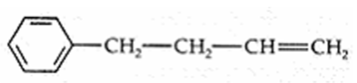
4. Write the IUPAC name:
Image
5. How will you demonstrate that double bonds of benzene are somewhat different from that of olefines?
6. Why do alkynes not show geometrical isomerism?
7. Write an IUPAC name:
Image