A long solenoid has $200$ $turns$ per $cm$ and carries a current $i$. The magnetic field at its centre is $6.28 \times 10^{-2} $ $\frac{{Wb}}{{{m^2}}}$ Another long solenoid has $100$ $turns$ per $cm$ and it carries a current $\frac{I}{3}\;$ . The value of the magnetic field at its centre is
AIEEE 2006, Medium
Download our app for free and get started
$\frac{B_{2}}{B_{1}}=\frac{\mu_{0} n_{2} i_{2}}{\mu_{0} n_{1} i_{1}} \Rightarrow \frac{B_{2}}{6.28 \times 10^{-2}}=\frac{100 \times \frac{i}{3}}{200 \times i}$
$\Rightarrow B_{2}=\frac{6.28 \times 10^{-2}}{6}=1.05 \times 10^{-2} \,\mathrm{Wb} / \mathrm{m}^{2}$

Download our appand get started for free
Experience the future of education. Simply download our apps or reach out to us for more information. Let's shape the future of learning together!No signup needed.*
Similar Questions
- 1A particle of mass $m$ and charge $q$ moves with a constant velocity $v$ along the positive $x$ direction. It enters a region containing a uniform magnetic field $B$ directed along the negative $z$ direction, extending from $x = a$ to $x = b$. The minimum value of $v$ required so that the particle can just enter the region $x > b$ isView Solution
- 2A galvanometer $G$ deflects full scale when a potential difference of $0.50 $ $V$ is applied. The internal resistance of the galvanometer $r_g$ is $25$ $ohms$. An ammeter is constructed by incorporating the galvanometer and an additional resistance $R_S$. The ammeter deflects full scale when a measurement of $2.0$ $A$ is made. The resistance $R_S$ is closest to : ................. $\Omega$View Solution
- 3Two long straight wires are placed along $x$-axis and $y$-axis. They carry current $I_1$ and $I_2$ respectively. The equation of locus of zero magnetic induction in the magnetic field produced by them isView Solution
- 4If $n$ represents the actual number of deflections in a converted galvanometer of resistance $G$ and shunt resistance $S$. Then the total current I when its figure of merit is $K$ will beView Solution
- 5The resistance of a galvanometer is $25\, ohm$ and it requires $50\,\mu A$ for full deflection. The value of the shunt resistance required to convert it into an ammeter of $5\, amp$ isView Solution
- 6A wire carrying $I$ is shaped as shown. Section $AB$ is a quarter circle of radius $r.$ The magnetic field at $C$ is directedView Solution
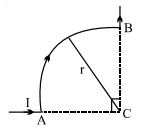
- 7The ($\tau -\theta$) graph for a coil isView Solution
- 8A particle of mass $m$ carrying charge $q$ is accelerated by a potential difference $V$. It enters perpendicularly in a region of uniform magnetic field $B$ and executes circular arc of radius $R$, then $\frac{q}{m}$ equalsView Solution
- 9In the adjoining circuit diagram, the readings of ammeter and voltmeter are $2\, A$ and $120 \,V$, respectively. If the value of $R$ is $75\, \Omega$, then the voltmeter resistance will be $\Omega$View Solution
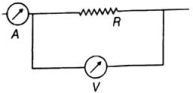
- 10Two straight horizontal parallel wires are carrying the same current in the same direction, $d$ is the distance between the wires. You are provided with a small freely suspended magnetic needle. At which of the following positions will the orientation of the needle be independent of the magnitude of the current in the wiresView Solution