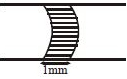
A long solenoid is fabricated to closely winding wire of radius $0.5\,mm$ over a cylindrical frame so that the successive turns nearly touch each other, the magnetic field at the centre of solenoid if it carries a current of $5\,A$
Medium


Download our appand get started for free
Experience the future of education. Simply download our apps or reach out to us for more information. Let's shape the future of learning together!No signup needed.*
Similar Questions
- 1A galvanometer gives full scale reading of $50\ mA$ , when a $p.d.$ , across its terminals is $0.15\ V$ . It can be used as an ammeter of range $0 - 100\ A$ by connecting a shunt resistance ofView Solution
- 2View SolutionMagnetic effect of current was discovered by
- 3A charge $Q$ is moving $\overrightarrow{dl}$ distance in the magnetic field $\overrightarrow{ B }$. Find the value of work done by $\overrightarrow{ B }$.View Solution
- 4A wire of length $L$ $metre$ carrying a current of $I$ $ampere$ is bent in the form of a circle. Its magnitude of magnetic moment will beView Solution
- 5Given below are two statements: One is labelled as Assertion $(A)$ and the other is labelled as Reason $(R).$View Solution
Assertion $(A)$ : In an uniform magnetic field, speed and energy remains the same for a moving charged particle.
Reason $(R)$ : Moving charged particle experiences magnetic force perpendicular to its direction of motion.
- 6A particle of mass $'m'$ and carrying a charge $'q'$ enters with a velocity $'v'$ perpendicular to a uniform magnetic field. The time period of rotation of the particleView Solution
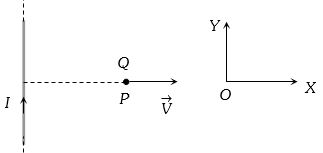
- 7A very long straight wire carries a current $I$. At the instant when a charge $ + Q$ at point $P$ has velocity $\overrightarrow V $, as shown, the force on the charge isView Solution
- 8A long straight wire in the horizontal plane carries a current of $50\, A$ in north to south direction. Give the magnitude and direction of $B$ at a point $2.5\,m$ east of the wireView Solution
- 9View SolutionA charged particle is released from rest in a region of steady and uniform electric and magnetic fields which are parallel to each other. The particle will move in a
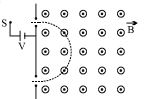
- 10A mass spectrometer is a device which select particle of equal mass. An iron with electric charge $q > 0$ and mass $m$ starts at rest from a source $S$ and is accelerated through a potential difference $V$. It passes $\rho$ through a hole into a region of constant magnetic field $\vec B\,$ perpendicular to the plane of the paper as shown in the figure. The particle is deflected by the magnetic field and emerges through the bottom hole at a distance $d$ from the top hole. The mass of the particle isView Solution