MCQ
A machine which is $75$ percent efficient, uses $12 $ joules of energy in lifting up a $1\, kg$ mass through a certain distance. The mass is then allowed to fall through that distance. The velocity at the end of its fall is (in $m{s^{ - 1}})$
  • A
    $\sqrt {24} $
  • B
    $\sqrt {32} $
  • $\sqrt {18} $
  • D
    $\sqrt 9 $

Answer

Correct option: C.
$\sqrt {18} $
c
(c)Potential energy of a body $= 75J$ of $ 12 \%$ 
$mgh = 9 \,J$

==> $h = \frac{9}{{1 \times 10}} = 0.9m$
Now when this mass allow to fall then it acquire velocity
$v = \sqrt {2gh} = \sqrt {2 \times 10 \times 0.9} = \sqrt {18} $m/s.

Need a full question paper?

Generate a complete, print-ready paper with questions like this in minutes — across 16+ boards, with answer keys.

Start Generating Free

Similar questions

For a ball falling in a liquid with constant velocity, ratio of resistance force due to the liquid to that due to gravity is:
The thermal conductivity of a material in $CGS$ system is $0.4$ . In steady state, the rate of flow of heat $10 cal/sec-cm2$ , then the thermal gradient will be ....... $^oC/cm$
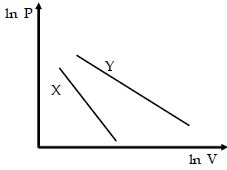
For two different gases $X$ and $Y,$ having degrees of freedom $f_1$ and $f_2$ and molar heat capacities at constant volume $C_{v_1}$ and $C_{v_2}$ respectively, for adiabatic process , the $\ln P$ versus $\ln V$ graph is plotted as shown :-
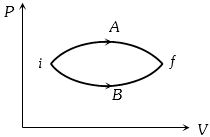
In the figure given two processes $A$ and $B$ are shown by which a thermo-dynamical system goes from initial to final state $F.$ If $\Delta {Q_A}$ and $\Delta {Q_B}$ are respectively the heats supplied to the systems then
The equation $\overrightarrow {\phi \,} (x,\,t) = \overrightarrow {j\,} \sin \,\left( {\frac{{2\pi }}{\lambda }v\,t} \right)\cos \,\left( {\frac{{2\pi }}{\lambda }x} \right)$ represents
Acceleration of a particle, executing $SHM$, at it’s mean position is
Two particles start simultaneously from the same point and move along two straight lines, one with uniform velocity $v$ and other with a uniform acceleration $a.$ If $\alpha$ is the angle between the lines of motion of two particles then the least value of relative velocity will be at time given by
The energy of a given sample of an ideal gas depends only on its:
The kinetic energy of the satellite in a circular orbit with speed vis given as:
A uniform solid sphere of mass $m$ and radius $r$ rolls without slipping down a inclined  plane, inclined at an angle $45^o$ to the horizontal. Find the magnitude of minimum  frictional coefficient at which slipping is absent-