A pin of length 2.00cm is placed perpendicular to the principal axis of a converging lens. An inverted image of size 1.00cm is formed at a distance of 40.0cm from the pin. Find the focal length of the lens and its distance from the pin.
Download our app for free and get started
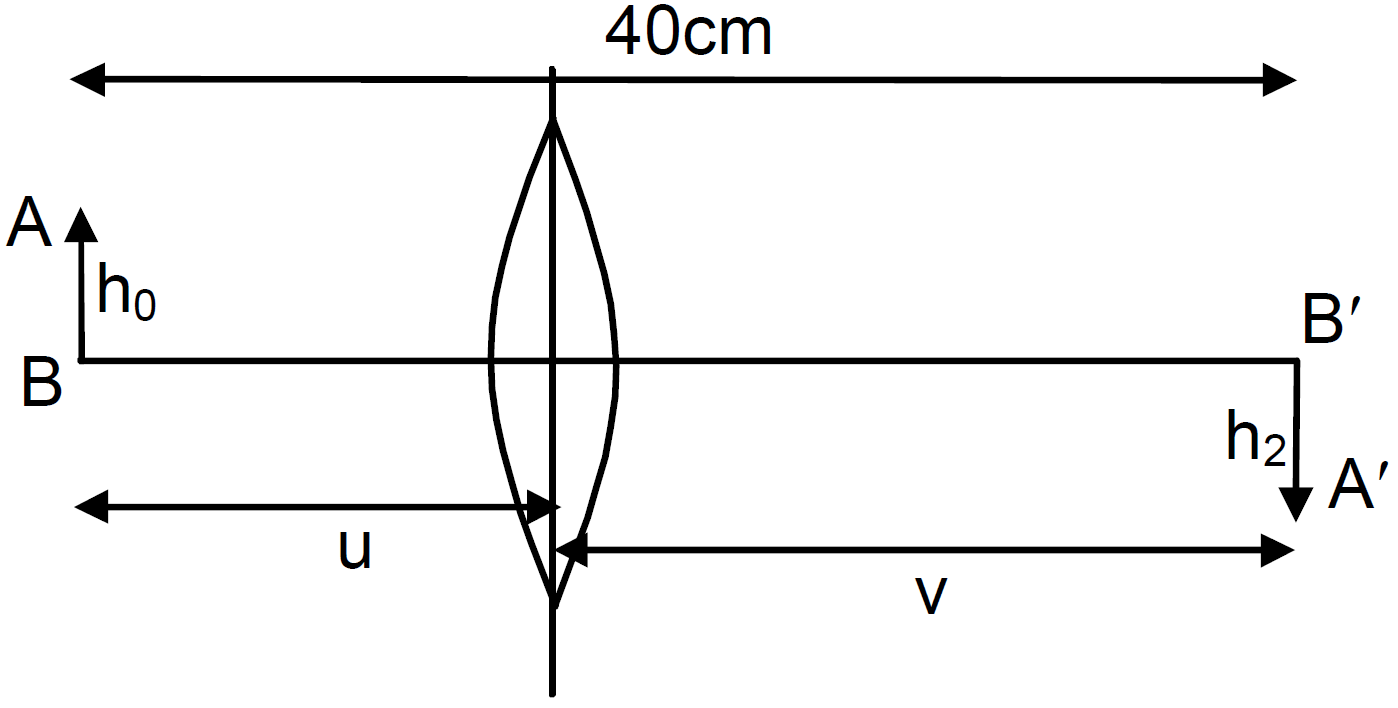
Given that,
(-u) + v = 40cm = distance between object and image
$h_0 = 2cm, h_i = 1cm$
Since $\frac{\text{h}_\text{i}}{\text{h}_0}=\frac{\text{v}}{-\text{u}}=$ magnification
$\Rightarrow \frac{1}{2}=\frac{\text{v}}{-\text{u}}\Rightarrow\text{u}=-2\text{v} \ ...(1)$
Now, $\Rightarrow\frac{1}{\text{v}}-\frac{1}{\text{u}}=\frac{1}{\text{f}}\Rightarrow\frac{1}{\text{v}}+\frac{1}{2\text{v}}=\frac{1}{\text{f}}$
$\Rightarrow\frac{3}{2\text{v}}=\frac{1}{\text{f}}\Rightarrow\text{f}=\frac{2\text{v}}{3} \ ...(2)$
Again, $(-\text{u})+\text{v}=40$
$\Rightarrow3\text{v}=40\Rightarrow\text{v}=\frac{40}{3}\text{cm}$
$\therefore \ \text{f}=\frac{2\times40}{3\times3}=8.89\text{cm}=$ focal length
From eqn. (1) and (2)
$u = -2v = -3f = -3(8.89) = 26.7cm =$ object distance.

Download our appand get started for free
Experience the future of education. Simply download our apps or reach out to us for more information. Let's shape the future of learning together!No signup needed.*
Similar Questions
- 1A right angled prism of refractive index n has a plane of refractive index $n_1$ so that $n_1 < n$, cemented to its diagonal face. The assembly is in air. A ray is incident on AB.View Solution
- Calculate the angle of incidence at AB for which the ray strikes the diagonal face at the critical angle.
- Assuming n = 1.352, calculate the angle of incidence at AB for which the refracted ray passes through the diagonal face undeviated.
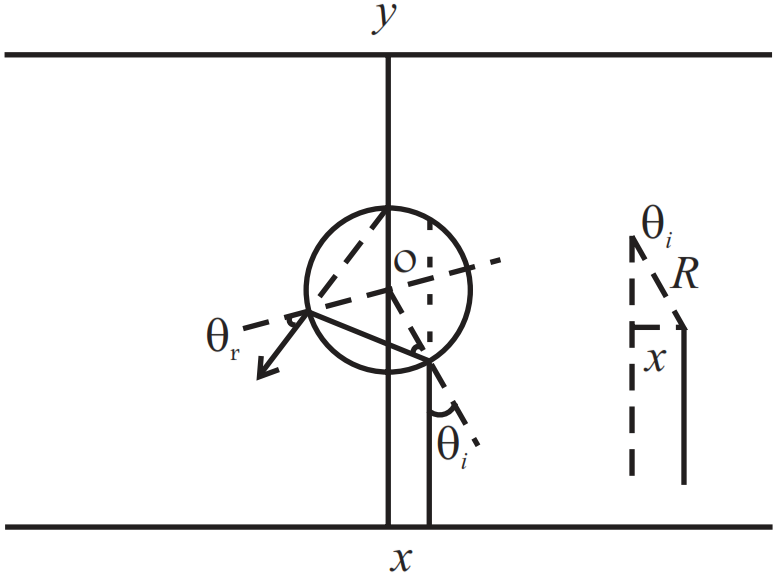
- 2View SolutionAn infinitely long cylinder of radius R is made of an unusual exotic material with refractive index -1 (Fig). The cylinder is placed between two planes whose normals are along the y direction. The center of the cylinder O lies along the y-axis. A narrow laser beam is directed along the y direction from the lower plate. The laser source is at a horizontal distance x from the diameter in the y direction. Find the range of x such that light emitted from the lower plane does not reach the upper plane.
- 3A thin prism of angle $6.0^\circ,\omega=0.07$ and $\mu_\text{y}=1.50$ is combined with another thin prism having $\omega=0.08$ and $\mu_\text{y}=1.60.$ The combination produces no deviation in the mean ray.View Solution
- Find the angle of the second prism.
- Find the net angular dispersion produced by the combination when a beam of white light passes through it.
- If the prisms are similarly directed, what will be the deviation in the mean ray
- Find the angular dispersion in the situation described in (c).
- 4View SolutionA concave mirror forms an image of 20cm high object on a screen placed 5.0m away from the mirror. The height of the image is 50cm. Find the focal length of the mirror and the distance between the mirror and the object.
- 5A gravitational lens may be assumed to have a varying width of the formView Solution
$\text{w}(\text{b})=\text{k}_1\text{ In }\Big(\frac{\text{k}_2}{\text{b}}\Big)\ \ \text{b}_\text{min}<\text{b}<\text{b}_\text{max}$
$=\text{k}_1\text{ In }\Big(\frac{\text{k}_2}{\text{b}_\text{min}}\Big)\ \ \text{b}<\text{b}_\text{min}$
Show that an observer will see an image of a point object as a ring about the center of the lens with an angular radius
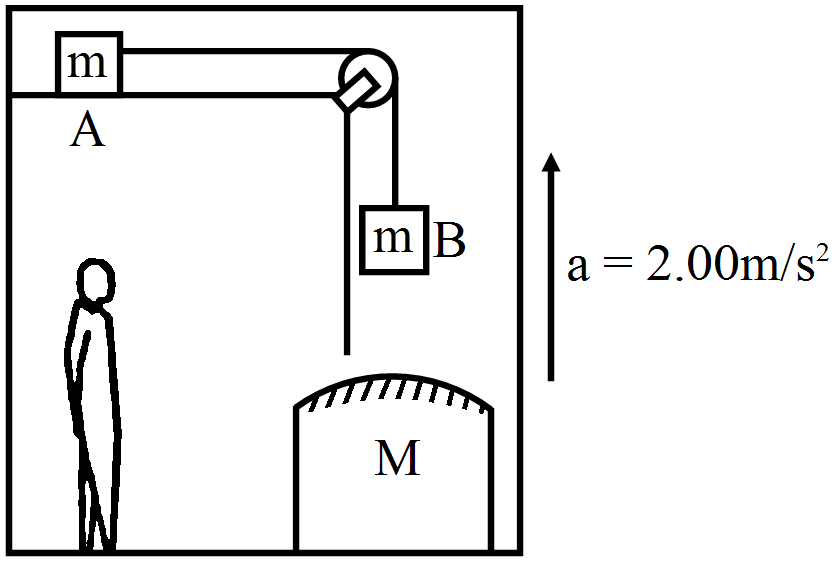
$\beta=\sqrt{\frac{(\text{n}-1)\text{k}_1\frac{\text{u}}{\text{v}}}{\text{u}+\text{v}}}$ - 6Consider the situation shown in figure. The elevator is going up with an acceleration of $2.00m/s^2$ and the focal length of the mirror is 12.0cm. All the surfaces are smooth and the pulley is light. The mass-pulley system is released from rest (with respect to the elevator) at t = 0 when the distance of B from the mirror is 42.0cm. Find the distance between the image of the block B and the mirror at $t = 0.200s$. Take $g = 10m/s^2$.View Solution
- 7View SolutionWhat is the focal length of a convex lens of focal length 30cm in contact with a concave lens of focal length 20 cm? Is the system a converging or a diverging lens? Ignore thickness of the lenses.
- 8View SolutionA compound microscope consists of an objective lens of focal length 2.0 cm and an eyepiece of focal length 6.25 cm separated by a distance of 15 cm. How far from the objective should an object be placed in order to obtain the final image at (a) the least distance of distinct vision (25 cm), and (b) at infinity? What is the magnifying power of the microscope in each case?
- 9View SolutionDraw the labelled ray diagram for the formation of image by a compound microscope.Derive the expression for the total magnification of a compound microscope. Explain why both the objective and the eyepiece of a compound microscope must have short focal lengths.
- 10View SolutionDefine magnifying power of a telescope. Write its expression.
A small telescope has an objective lens of focal length 150 cm and an eye piece of focal length 5 cm. If this telescope is used to view a 100m high tower 3 km away, find the height of the final image when it is formed 25 cm away from the eye piece.