MCQ
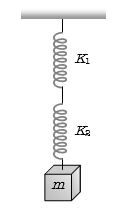
A mass $M$ is suspended by two springs of force constants $K_1$ and $K_2$ respectively as shown in the diagram. The total elongation (stretch) of the two springs is
  • A
    $\frac{{Mg}}{{{K_1} + {K_2}}}$
  • $\frac{{Mg\,({K_1} + {K_2})}}{{{K_1}{K_2}}}$
  • C
    $\frac{{Mg\,{K_1}{K_2}}}{{{K_1} + {K_2}}}$
  • D
    $\frac{{{K_1} + {K_2}}}{{{K_1}{K_2}Mg}}$
Answer

Correct option: B.
$\frac{{Mg\,({K_1} + {K_2})}}{{{K_1}{K_2}}}$
b
(b)For series combination ${k_{eq}} = \frac{{{k_1}{k_2}}}{{{k_1} + {k_2}}}$
$F = {k_{eq}}x \Rightarrow mg = \left( {\frac{{{k_1}{k_2}}}{{{k_1} + {k_2}}}} \right)x$$ \Rightarrow x = \frac{{mg({k_1} + {k_2})}}{{{k_1}{k_2}}}$

Need a full question paper?

Generate a complete, print-ready paper with questions like this in minutes — across 16+ boards, with answer keys.

Start Generating Free

Similar questions

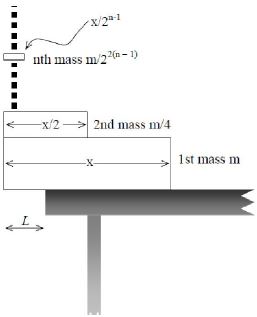
Infinite numbers of blocks are placed on $a$ table edge as shown in the diagram. What is the minimum value of $L$ so that the blocks are just going to topple over the table ?
A firecracker exploding on the surface of a lake is heard as two sounds a time interval $t$ apart by a man on a boat close to water surface. Sound travels with a speed $u$ in water and a speed $v$ in air. The distance from the exploding firecracker to the boat is
Using equipartition of energy, the specific heat (in $J\, kg^{-1}\, K^{-1}$ ) of aluminium at room temperature can be estimated to be ( atomic weight of aluminium $= 27$)
Which law states that effect of pressure is same for all portion
Consider the situation of the previous problem. The force on the central charge due to the shell is:
In Jager's method, at the time of bursting of the bubble
Consider a gas enclosed in a box. A molecule of mass $m,$ having a velocity $-2i +3j +4k$ collides with a wall parallel to the $xz$ plane. What will be its velocity after collision and its change in momentum$?\  i, j\ \&\ k$ are unit vectors along the $x, y\ \&\ z$ axis.
Center of mass of a system of three particles of masses $1, 2, 3\, kg$ is at the point $(1\, m, 2\, m, 3\, m)$ and center of mass of another group of two particles of masses $2 \,kg$ and $3\, kg$ is at point $(-1 \,m, 3\, m, -2\, m)$ . Where a $5\, kg$ particle should be placed, so that center of mass of the system of all these six particles shifts to center of mass of the first system?
Two particles are executing simple harmonic motion of the same amplitude $A$ and frequency $\omega$ along the $x-$axis. Their mean position is separated by distance $X_0(X_0 > A).$ If the maximum separation between them is $(X_0 + A)$, the phase difference between their motion is:
Water is flowing through a tube of non-uniform cross-section. Ratio of the radius at entry and exit end of the pipe is $3$ : $2$. Then the ratio of velocities at entry and exit of liquid is