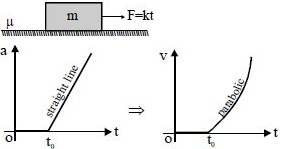
A metal block is resting on a rough wooden surface. A horizontal force applied to the block is increased uniformly. Which of the following curves correctly represents velocity of the block ?
- A
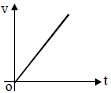
- B
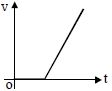
- C
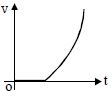
- D
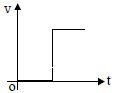
Medium


Download our appand get started for free
Experience the future of education. Simply download our apps or reach out to us for more information. Let's shape the future of learning together!No signup needed.*
Similar Questions
- 1A body of $5 \,kg$ weight kept on a rough inclined plane of angle $30^{\circ}$ starts sliding with a constant velocity. Then the coefficient of friction is (assume $g=10 \,ms ^{-2}$ )View Solution
- 2View SolutionA car when passes through a convex bridge exerts a force on it which is equal to
- 3A chain of length $L$ rests on a rough table. If $\mu $ be the coefficient of friction, the maximum friction of the chain that can hang over the table will beView Solution
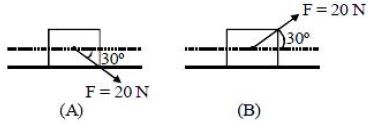
- 4A block of mass $5\, kg$ is $(i)$ pushed in case $(A)$ and $(ii)$ pulled in case $(B)$, by a force $F = 20\, N$, making an angle of $30^o$ with the horizontal, as shown in the figures. The coefficient of friction between the block and floor is $\mu = 0.2$. The difference between the accelerations of the block, in case $(B)$ and case $(A)$ will be $....... ms^{-2}$ .$(g = 10\, ms^{-2})$View Solution
- 5A $1.0 kg$ block of wood sits on top of an identical block of wood, which sits on top of a flat level table made of plastic. The coefficient of static friction between the wood surfaces is $\mu_1$, and the coefficient of static friction between the wood and plastic is $\mu_2$. Ahorizontal force $F$ is applied to the top block only, and this force is increased until the top block starts to move. The bottom block will move with the top block if and only ifView Solution
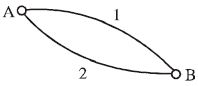
- 6A small body slips, subject to the force of friction, from point $A$ to point $B$ along two curved surfaces of equal radius, first along route $1,$ then along route $2$. Friction does not depend on the speed and the coefficient of friction on both routes is the same. In which case will the body’s speed at $B$ be greater?View Solution
- 7A block rests on a rough inclined plane making an angle of $30^o$ with the horizontal. The coefficient of static friction between the block and the plane is $0.8.$ If the frictional force on the block is $10\, N$, the mass of the block (in $kg$) is : (taken $g = 10 \,m/s^2)$View Solution
- 8The upper portion of an inclined plane of inclination $\alpha $ is smooth and the lower portion is rough. A particle slides down from rest from the top and just comes to rest at the foot. If the ratio of the smooth length to rough length is $m : n$ , the coefficient of friction isView Solution
- 9A conveyor belt is moving at a constant speed of $2\, m s^{-1}$. A box is gently dropped on it. The coefficient of friction between them is $\mu = 0.5.$ The distance that the box will move relative to belt before coming to rest on it, taking $g = 10\, m s^{-2},$ is ........... $m$View Solution
- 10Two masses $M$ and $m$ are attached to a vertical axis by weightless threads of combined length $l$. They are set in rotational motion in a horizontal plane about this axis with constant angular velocity $\omega $. If the tensions in the threads are the same during motion, the distance of $M$ from the axis isView Solution