A microammeter has a resistance of $100\,\Omega $ and full scale range of $50\,\mu A$. It can be used as a voltmeter or as a higher range ammeter provided a resistance is added to it. Pick the correct range and resistance combination
Medium


Download our appand get started for free
Experience the future of education. Simply download our apps or reach out to us for more information. Let's shape the future of learning together!No signup needed.*
Similar Questions
- 1A particle of specific charge $(q/m)$ is projected from the origin of coordinates with initial velocity $[ui - vj]$. Uniform electric magnetic fields exist in the region along the $+y$ direction, of magnitude $E$ and $B.$ The particle will definitely return to the origin once ifView Solution
- 2A rectangular region $A B C D$ contains a uniform magnetic field $B_0$ directed perpendicular to the plane of the rectangle. A narrow stream of charged particles moving perpendicularly to the side $AB$ enters this region and is ejected through the adjacent side $B C$ suffering a deflection through $30^{\circ}$. In order to increase this deflection to $60^{\circ}$, the magnetic field has to beView Solution
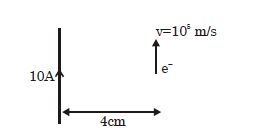
- 3An $e^-$ is moving parallel to a long current carrying wire as shown. Force on electron isView Solution
- 4View SolutionAssertion : Cyclotron is a device which is used to accelerate the positive ion.
Reason : Cyclotron frequency depends upon the velocity
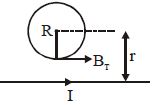
- 5In following diagram there is a straight wire carrying a current $I.$ Consider a circular path with radius $(R)$ near it. It $\vec B_T$ is the tangential component of magnetic field then find the value of integral $\int {{{\vec B}_T}.\overrightarrow {dl} } $View Solution
- 6A magnet of magnetic moment $50\,\hat i\,A{\rm{ - }}{m^2}$ is placed along the $x-$ axis in a magnetic field $\overrightarrow B = (0.5\,\hat i + 3.0\hat j)\,T.$ The torque acting on the magnet isView Solution
- 7A galvanometer coil has $500$ turns and each turn has an average area of $3 \times 10^{-4}\, m ^{2}$. If a torque of $1.5\,Nm$ is required to keep this coil parallel to magnetic field when a current of $0.5\, A$ is flowing through it, the strength of the field (in $T )$ isView Solution
- 8At what distance on the axis, from the centre of a circular current carrying coil of radius $r$, the magnetic field becomes $1 / 8$ th of the magnetic field at centre?View Solution
- 9The radius of a circular loop is $r$ and a current $i$ is flowing in it. The equivalent magnetic moment will beView Solution
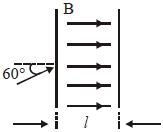
- 10The figure shows a region of length $'l'$ with a uniform magnetic field of $0.3\, T$ in it and a proton entering the region with velocity $4 \times 10^{5}\, ms ^{-1}$ making an angle $60^{\circ}$ with the field. If the proton completes $10$ revolution by the time it cross the region shown, $l$ is close to....... $m$View Solution
(mass of proton $=1.67 \times 10^{-27} \,kg ,$ charge of the proton $\left.=1.6 \times 10^{-19}\, C \right)$