MCQ
A mixture of ideal gases $7\,\, kg$ of nitrogen and $11 \,\,kg$ of $CO_2$. Then

(Take $\gamma$ for nitrogen and $CO_2$ as $1.4$ and $1.3$ respectively)

  • A
    equivalent molecular weight of the mixture is $36.$
  • B
    $\gamma$ for the mixture is $47/35.$
  • C
    $\gamma$ for the mixture is $5/2$
  • Both $(A)$ and $(B)$

Answer

Correct option: D.
Both $(A)$ and $(B)$
d
$n_{N_{2}}=\frac{7 \mathrm{kg}}{28}=0.25 \mathrm{k}$ moles

$f_{N_{2}}=\frac{2}{\gamma-1}=\frac{2}{1.4-1}=5$

$n_{\mathrm{CO}_{2}}=\frac{11 \mathrm{kg}}{44}=0.25 \mathrm{kmoles}$

$f_{C O_{2}}=\frac{2}{1.3-1}=\frac{2}{0.3}=\frac{20}{3}$

$\therefore$ Equivalent molecular weight

$=\frac{\mathrm{n}_{1} \mathrm{M}_{1}+\mathrm{n}_{2} \mathrm{M}_{2}}{\mathrm{n}_{1}+\mathrm{n}_{2}}=\frac{\mathrm{m}_{1}+\mathrm{m}_{2}}{\mathrm{n}_{1}+\mathrm{n}_{2}}$

$=\frac{7+11}{0.25+0.25}=36 \mathrm{gm}$

$\gamma_{\operatorname{mix}} \neq \frac{n_{1} \gamma_{1}+n_{2} \gamma_{2}+\ldots . .}{n_{1}+n_{2}+\ldots . .}$

$f_{\operatorname{mix}}=\frac{n_{1} f_{1}+n_{2} f_{2}+\ldots .}{n_{1}+n_{2}}$

$=\frac{\left(0.25 \times 5+0.25 \times \frac{20}{3}\right)}{0.25+0.25 \times \frac{20}{3}}=\frac{35}{6}$

$\therefore \gamma_{\operatorname{mix}}=1+\frac{2}{f_{\operatorname{mix}}}$

$=1+\frac{2}{35 / 6}=\frac{47}{35}=1.34$
Need a full question paper?

Generate a complete, print-ready paper with questions like this in minutes — across 16+ boards, with answer keys.

Start Generating Free

Similar questions

A wave travelling in the $+ve$ $x-$ direction having displacement along $y-$ direction as $1\,\, m,$ wavelength $2\pi\,\, m$ and frequency of $\frac{1}{\pi}$ $Hz$ is represented by
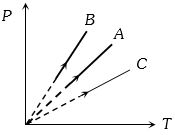
Pressure versus temperature graph of an ideal gas at constant volume $V$ of an ideal gas is shown by the straight line $A$. Now mass of the gas is doubled and the volume is halved, then the corresponding pressure versus temperature graph will be shown by the line
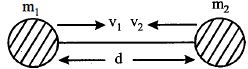
Two hypothetical planets of masses $m_1$ and $m_2$ are at rest when they are infinite distance apart. Because of the gravitational force they move towards each other along the line joining their centres . What is their speed when their separation is $'d'$ ? (Speed of $m_1$ is $v_1$ and that of $m_2$ is $v_2$ )
Which of the following statements about kinetic theory of gases is wrong
Mark the wrong statement
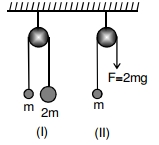
The pulley arrangements shown in figure are identical the mass of the rope being negligible. In case $I$, the mass $m$ is lifted by attaching a mass $2 m$ to the other end of the rope. In case II, the mass $m$ is lifted by pulling the other end of the rope with cosntant downward force $F=2 mg$, where $g$ is acceleration due to gravity. The acceleration of mass in case $I$ is
A bomb is dropped from an aeroplane moving horizontally at constant speed. When air resistance is taken into consideration, the bomb
A thermodynamic process in which temperature $T$ of the system remains constant though other variable $P$ and $V$ may change, is called
An electric heater supplies heat to a system at a rate of $100\;W.$ If system performs work at a rate of $75$ Joules per second. At what rate (in $J/s$) is the internal energy increasing?
Instead of pulling a stretched string from the middle point if one of its end is touched at the middle point and is pulled at distance of 1/4th then the frequency of vibration is higher than that of the first wave.