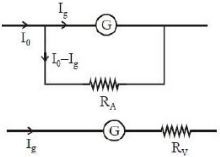
When galvanometer is used an ammeter shunt is used in parallel with galvanometer.
$\therefore \quad \mathrm{I}_{g} \mathrm{G}=\left(\mathrm{I}_{0}-\mathrm{I}_{g}\right) \mathrm{R}_{\mathrm{A}}$
$\therefore \quad R_{A}=\left(\frac{I_{g}}{I_{0}-I_{g}}\right) G$
When galvanometer is used as a voltmeter, resistance is used in series with galvanometer.
$\mathrm{I}_{g}\left(\mathrm{G}+\mathrm{R}_{\mathrm{v}}\right)=\mathrm{V}=\mathrm{GI}_{0}\left(\text { given } \mathrm{V}=\mathrm{GI}_{0}\right)$
$\therefore R_{v}=\frac{\left(I_{0}-I_{g}\right) G}{I_{g}}$
$\therefore \quad {{\text{R}}_{\text{A}}}{{\text{R}}_{\text{v}}} = {{\text{G}}^2}\& \frac{{{{\text{R}}_{\text{A}}}}}{{{{\text{R}}_{\text{v}}}}} = {\left( {\frac{{{{\text{I}}_g}}}{{{{\text{I}}_0} - {{\text{I}}_g}}}} \right)^2}$