A non-conducting ring of radius $0.5\,m$ carries a total charge of $1.11 \times {10^{ - 10}}\,C$ distributed non-uniformly on its circumference producing an electric field $\vec E$ everywhere in space. The value of the line integral $\int_{l = \infty }^{l = 0} {\, - \overrightarrow E .\overrightarrow {dl} } \,(l = 0$ being centre of the ring) in volt is
IIT 1997, Medium
Download our app for free and get started
(a) $\int_{\, - \infty }^{\,0} { - \overrightarrow E \, \cdot \overrightarrow {dl} } $ $=$ potential at centre of non-conducting ring
$ = \frac{1}{{4\pi {\varepsilon _0}}} \times \frac{q}{r} = \frac{{9 \times {{10}^9} \times 1.11 \times {{10}^{ - 10}}}}{{0.5}} = 2\,volt$
$ = \frac{1}{{4\pi {\varepsilon _0}}} \times \frac{q}{r} = \frac{{9 \times {{10}^9} \times 1.11 \times {{10}^{ - 10}}}}{{0.5}} = 2\,volt$

Download our appand get started for free
Experience the future of education. Simply download our apps or reach out to us for more information. Let's shape the future of learning together!No signup needed.*
Similar Questions
- 1$N$ identical spherical drops charged to the same potential $V$ are combined to form a big drop. The potential of the new drop will beView Solution
- 2Three long concentric conducting cylindrical shells have radii $R, 2R$ and $2\sqrt 2 $ $ R$ . Inner and outer shells are connected to each other. The capacitance across middle and inner shells per unit length is:View Solution
- 3An electric charge $10^{-8}\ C$ is placed at the point $ (4\,m, 7\,m, 2\,m)$. At the point $(1\,m, 3\,m, 2\,m)$, the electricView Solution
- 4The potential $V$ is varying with $x$ and $y$ as $V\, = \,\frac{1}{2}\,\left( {{y^2} - 4x} \right)\,volt.$ The field at ($1\,m, 1\,m$ ) isView Solution
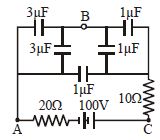
- 5In the figure below, what is the potential difference between the points $A$ and $B$ and between $B$ and $C$ respectively in steady stateView Solution
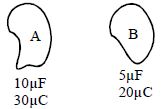
- 6When two isolated conductors $A$ and $B$ are connected by a conducting wire positive charge will flow from :-View Solution
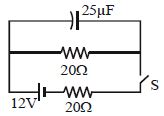
- 7The switch $S$ shown in figure is kept closed for a long time and then opened at $t = 0$, then the current in the middle $20\, \Omega$ resistor at $t = 0.25\, ms$ is :-View Solution
- 8The radius of nucleus of silver (atomic number $=$ $47$) is $3.4 \times {10^{ - 14}}\,m$. The electric potential on the surface of nucleus is $(e = 1.6 \times {10^{ - 19}}\,C)$View Solution
- 9If initial charge on all the capacitors were zero, work done by the battery in the circuit shown is ........... $mJ$View Solution
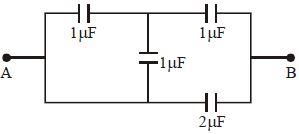
- 10The equivalent capacitance between points $A$ and $B$ of the circuit shown will beView Solution