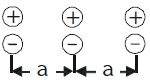
Three identical small electric dipoles are arranged parallel to each other at equal separation a as shown in the figure. Their total interaction energy is $U$. Now one of the end dipole is gradually reversed, how much work is done by the electric forces.
Diffcult
Download our app for free and get startedPlay store
Potential energy of a dipole $\mathrm{U}=-\mathrm{p} \overrightarrow{\mathrm{E}}$

Interaction energy and two adjecent dipoles

$\mathrm{u}_{1}=\frac{\mathrm{kp}^{2}}{\mathrm{a}^{3}} \uparrow \uparrow, \mathrm{u}_{2}=-\frac{\mathrm{kp}^{2}}{\mathrm{a}^{3}} \uparrow \downarrow$

interaction energy of the two end dipoles

$\mathrm{u}_{3}=\frac{\mathrm{kp}^{2}}{8 \mathrm{a}^{3}} \uparrow \uparrow ; \quad \mathrm{u}_{4}=-\frac{\mathrm{kp}^{2}}{8 \mathrm{a}^{3}} \uparrow \downarrow$

Total interaction energy in $\mathrm{I}$ configuration

$U_{1}=U=2 u_{1}+u_{3}=\frac{17 k p^{2}}{8 a^{3}}$          .........$(i)$

Total interaction energy in $\mathrm{II}$ configuration

$\mathrm{U}_{2}=\mathrm{u}_{1}+\mathrm{u}_{2}+\mathrm{u}_{4}=\frac{-\mathrm{kp}^{2}}{8 \mathrm{a}^{3}}$         ........$(ii)$

Work done electric forces

$=U_{1}-U_{2}=\frac{18}{8} \frac{\mathrm{kp}^{2}}{\mathrm{a}^{3}}=\frac{18}{17} \mathrm{U}$
art

Download our app
and get started for free

Experience the future of education. Simply download our apps or reach out to us for more information. Let's shape the future of learning together!No signup needed.*

Similar Questions

  • 1
    In the circuit shown, charge on the $5\, \mu F$ capacitor is$........\mu C$
    View Solution
  • 2
    A parallel plate capacitor of capacitance $2\; F$ is charged to a potential $V$. The energy stored in the capacitor is $E_1$. The capacitor is now connected to another uncharged identical capacitor in parallel combination. The energy stored in the combination is $E _2$. The ratio $E _2 / E _1$ is
    View Solution
  • 3
    Two charges of magnitude $+ q$ and $-\,3q$ are placed $100\,cm$ apart. The distance from $+ q$ between the charges where the electrostatic potential is zero is.......$cm$
    View Solution
  • 4
    A parallel plate condenser with oil between the plates (dielectric constant of oil $K = 2$) has a capacitance $C$. If the oil is removed, then capacitance of the capacitor becomes
    View Solution
  • 5
    Aspherical shell with an inner radius $'a'$ and an outer radius $'b' $ is made of conducting material. Apoint charge $+Q$ is placed at the centre of the spherical shell and a total charge $- q $ is placed on the shell.

    Assume that the electrostatic potential is zero at an infinite distance from the spherical shell. The electrostatic potential at a distance $R$ $(a < R < b)$ from the centre of the shell is (where $K = $ $\frac{1}{{4\pi {\varepsilon _0}}}$)

    View Solution
  • 6
    From a supply of identical capacitors rated $8\  \mu F$, $250\  V$, the minimum number of capacitors required to form a composite $16$ $\mu F$, $1000$ $V$ is :
    View Solution
  • 7
    Two parallel plate capacitor with different plate seperation but the same capacitance are connected in series to a battery. Both capacitors are filled with air. The quantity that is $NOT$ the same for both the capacitors when they are fully charged is
    View Solution
  • 8
    Two equal capacitors are first connected in series and then in parallel. The ratio of the equivalent capacities in the two cases will be
    View Solution
  • 9
    Which of the following figure shows the correct equipotential surfaces of a system of two positive charges?
    View Solution
  • 10
    Two point charges $-q$ and $+q$ are located at points $(0, 0, -a)$ and $(0, 0, a),$ respectively. The potential at a point $(0, 0, z)$ where $z > a$ is
    View Solution