MCQ
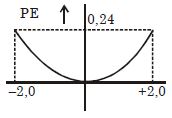
A particle executing $S.H.M.$ its potential energy $V/S$ displacement graph is given  by The value of restoring force constant is ..... $N/m$
  • $12$
  • B
    $24$
  • C
    $6$
  • D
    $48$

Answer

Correct option: A.
$12$
a
Here $\frac{1}{2} \mathrm{KA}^{2}=24$

$A=2$

Need a full question paper?

Generate a complete, print-ready paper with questions like this in minutes — across 16+ boards, with answer keys.
Start Generating Free

Similar questions

An astronaut of mass $m$ is working on a satellite or biting the earth at a distance $h$ from the earth's surface. The radius of the earth is $R$, while its mass is $M$. The gravitational pull $F_G$ on the astronaut is
What is the minimum energy required to launch a satellite of mass $m$ from the surface of a planet of mass $M$ and radius $R$ in a circular orbit at an altitude of $2R$?
The wavelength of maximum intensity of radiation emitted by a star is $289.8 \,nm$. The radiation intensity for the star is : (Stefan’s constant $5.67 \times {10^{ - 8}}W{m^{ - 2}}{K^{ - 4}}$, constant $b = 2898\mu mK)$
A particle is fastened at the end of a string and is whirled in a vertical circle with the other end of the string being fixed. The motion of the particle is:
Inter atomic forces are:
An aeroplane moving horizontally with a speed of $720 \,km/h$ drops a food pocket, while flying at a height of $396.9\, m$. the time taken by a food pocket to reach the ground and its horizontal range is (Take $g = 9.8 m/sec^{2}$)
The figure shows the $P-V$ plot of an ideal gas taken through a cycle $ABCDA.$ The part $ABC$ is a semicircle and $CDA$ is half of an ellipse. Then,
A motor cycle starts from rest and accelerates along a straight path at $2 \;m / s ^{2}$. At the starting point of the motor cycle there is a stationary electric siren. How far has the motor cycle gone when the driver hears the frequency of the siren at $94 \%$ of its value when the motor cycle was at rest?

(Speed of sound $=330 ms ^{-1}$)

Two particles having position vectors $\overrightarrow {{r_1}} = (3\hat i + 5\hat j)$ metres and $\overrightarrow {{r_2}} = ( - 5\hat i - 3\hat j)$ metres are moving with velocities ${\overrightarrow v _1} = (4\hat i + 3\hat j)\,m/s$ and ${\overrightarrow v _2} = (\alpha \,\hat i + 7\hat j)$ $m/s.$ If they collide after $2$  seconds, the value of $'\alpha '$ is
In figure, two blocks $M$ and $m$ are tied together with an inextensible and light string. The mass $M$ is placed on a rough horizontal surface with coefficient of friction $\mu$ and the mass $m$ is hanging vertically against a smooth vertical wall. The pulley is frictionless. Choose the correct statement $(s)$