Question
A particle falling vertically from a height hits a plane surface inclined to horizontal at an angle with speed $v_0$ and rebounds elastically as shown in the figure. Find the distance along the plane where it will hit the second time.
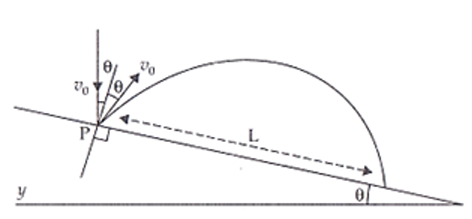
Image
Hint:
i. After rebound, particle still has speed $V_0$ to start.
ii. Work out angle particle speed has with horizontal after it rebounds.
iii. Rest is similar to if particle is projected up the incline.]
Answer

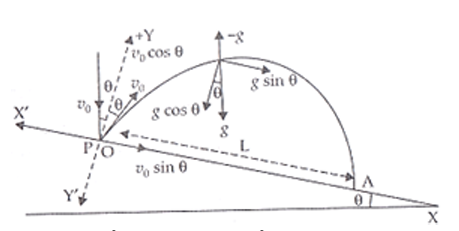
From the figure resolving the components of $v_0$ and $g$, we get
Image
$v_x=v_0 \sin \theta$ and $v_y=v_0 \cos \theta$
$g_x=g \cos \theta, g_y=g \sin \theta$ acting vertically downwards
Consider the motion of particle from O to A in new YOY' axis.
$
y=u_y t+\frac{1}{2} a_y t^2
$
Where, $z=0, \quad v_y=v_0 \cos \theta, \quad a_y=-g \sin \theta$
$
\begin{aligned}
& \therefore t=T \quad(\text { time of flight }), y=0 \\
& \Rightarrow 0=v_0 \cos \theta T-\frac{1}{2} g \sin \theta T^2 \\
& \Rightarrow T=\frac{2 v_0 \cos \theta}{g \cos \theta} \\
& T=\frac{2 v_0}{g}
\end{aligned}
$
Now consider the motion along OX axis.
$
\begin{aligned}
& x=L, u_x=v_0 \sin \theta, a_x=g \sin \theta, t=T=\frac{2 v_0}{g} \\
& x=u_x t+\frac{1}{2} a_x t^2 \\
& L=\left[\frac{2 v_5}{g}\right] v_0 \sin \theta+\frac{1}{2} g \sin \theta\left[\frac{2 v_0}{g}\right]^2 \\
& L=\frac{2 v_0^2}{g} \sin \theta+\frac{1}{2} g \sin \theta \cdot \frac{4 v_0^2}{g^2} \\
& =\frac{2 v_0^2}{g}[\sin \theta+\sin \theta]=\frac{4 v_0^2}{g} \sin \theta \\
& \Rightarrow L=\frac{4 v_0^2}{g} \sin \theta
\end{aligned}
$
Hence the value of L is $\frac{4 v_0^2}{g} \sin \theta$.

Need a full question paper?

Generate a complete, print-ready paper with questions like this in minutes — across 16+ boards, with answer keys.

Start Generating Free

Similar questions

A three-wheeler starts from rest, accelerates uniformly with 1m s–2 on a straight road for 10s, and then moves with uniform velocity. Plot the distance covered by the vehicle during the nth second (n = 1, 2, 3….) versus n. What do you expect this plot to be during accelerated motion : a straight line or a parabola?
(i) What is escape velocity? Prove that the velocity required to escape from earth's gravity is 11.2 km/s. Find the value of escape velocity for the moon.
(ii) Calculate the value of escape velocity required to make an object situated at a height h above the earth's surface
One end of a V-tube containing mercury is connected to a suction pump and the other end to atmosphere. The two arms of the tube are inclined to horizontal at an angle of 45 PHA° each. A small pressure difference is created between two columns when the suction pump is removed. Will the column of mercury in V-tube execute simple harmonic motion? Neglect capillary and viscous forces.Find the time period of oscillation.
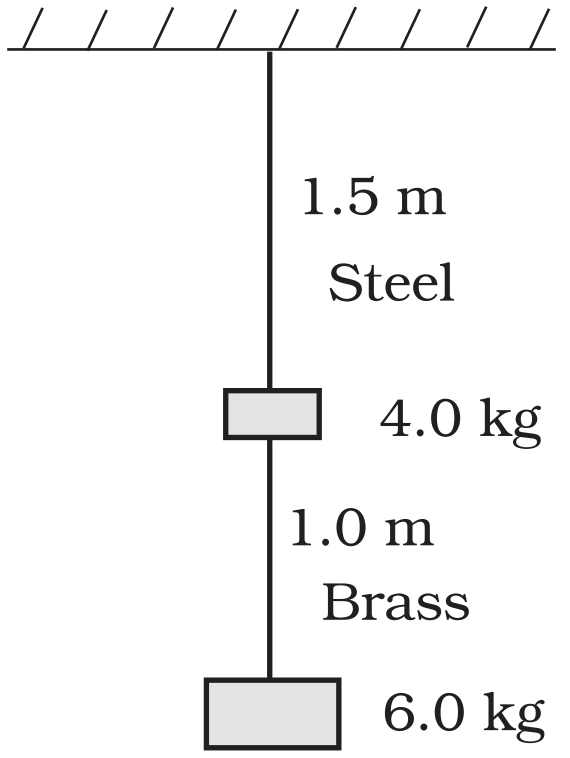
Two wires of diameter 0.25cm, one made of steel and the other made of brass are loaded as shown in Fig. The unloaded length of steel wire is 1.5m and that of brass wire is 1.0m. Compute the elongations of the steel and the brass wires.

What is the excess pressure inside a bubble of soap solution of radius 5.00mm, given that the surface tension of soap solution at the temperature (20°C) is 2.50 × 10⁻² Nm–1? If an air bubble of the same dimension were formed at depth of 40.0cm inside a container containing the soap solution (of relative density 1.20), what would be the pressure inside the bubble? (1 atmospheric pressure is 1.01 × 10⁵Pa).
Establish the following vector inequalities geometrically or otherwise:
$|\text{a}-\text{b}|\le|\text{a}|+|\text{b}|$
When does the equality sign above apply?
Explain why
A spinning cricket ball in air does not follow a parabolic trajectory.
The track shown in figure is frictionless. The block B of mass 2m is lying at rest and the block A of mass m is pushed along the track with some speed. The collision between A and B is perfectly elastic. With what velocity should the block A be started to get the sleeping man awakened?

The descending pulley shown in figure has a radius 20cm and moment of inertia 0.20kg-m2. The fixed pulley is light and the horizontal plane frictionless. Find the acceleration of the block if its mass is 1.0kg.

36. You are given, the following data about a group of particles, where n represents the number of molecules with speed vi
ni
2
4
8
6
3
vi(ms-1)
1.0
2.0
3.0
4.0
5.0
Calculate:
  1. Average speed.
  2. Rms speed.
  3. Most probable speed.