MCQ
A particle is executing a simple harmonic motion. Its maximum acceleration is $\alpha$ and maximum velocity is $\beta$. Then, its time period of vibration will be
  • $\frac{{2\pi \beta }}{\alpha }$
  • B
    $\frac{{{\beta ^2}}}{{{\alpha ^2}}}$
  • C
    $\frac{\alpha }{\beta }$
  • D
    $\frac{{{\beta ^2}}}{\alpha }$

Answer

Correct option: A.
$\frac{{2\pi \beta }}{\alpha }$
a
If $A$ and $\omega$ be amplitude and angular frequency of vibration, then

${\alpha=\omega^{2} A} ......... (i)$

${\text { and } \beta=\omega A} ......... (ii)$

Dividing eqn. $(i)$ by eqn. $(ii),$ we get

$\frac{\alpha}{\beta}=\frac{\omega^{2} A}{\omega A}=\omega$

$\therefore$ Time period of vibration is

$T=\frac{2 \pi}{\omega}=\frac{2 \pi}{(\alpha / \beta)}=\frac{2 \pi \beta}{\alpha}$

Need a full question paper?

Generate a complete, print-ready paper with questions like this in minutes — across 16+ boards, with answer keys.

Start Generating Free

Similar questions

A ball of mass ${m_1}$ and another ball of mass ${m_2}$ are dropped from equal height. If time taken by the balls are ${t_1}$ and ${t_2}$ respectively, then
The absolute zero is the temperature at which
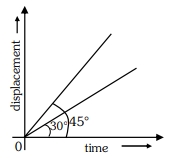
The displacement-time graphs of two moving particles make angles of $30^{\circ}$ and $45^{\circ}$ with the $x$-axis as shown in the figure. The ratio of their respective velocity is :
Which of the following quantities increase when wavelength is increased? Consider only the magnitudes.
  1. The power of a converging lens.
  2. The focal length of a converging lens.
  3. The power of a diverging lens.
  4. The focal length of a diverging lens.
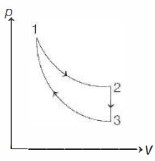
The three processes in a thermodynamic cycle shown in the figure are : Process $1 \rightarrow 2$ is isothermal; Process $2 \rightarrow 3$ is isochoric (volume remains constant); Process $3 \rightarrow 1$ is adiabatic. The total work done by the ideal gas in this cycle is $10 \,J$. The internal energy decreases by $20 \,J$ in the isochoric process. The work done by the gas in the adiabatic process is $-20 \,J$. The heat added to the system in the isothermal process is .............. $J$
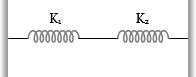
The effective spring constant of two spring system as shown in figure will be
A bag (mass $M$) hangs by a long thread and a bullet (mass $m$) comes horizontally with velocity $v$ and gets caught in the bag. Then for the combined (bag $+$ bullet) system
A cyclist riding the bicycle at a speed of $14\sqrt 3  ms^{-1}$takes a turn around a circular road of radius  $20\sqrt 3 $ m without skidding. Given $g = 9.8 ms^{-2},$ what is his inclination to the vertical ....... $^o$
When a mass $M$ is attached to the spring of force constant $k$, then the spring stretches by $l$. If the mass oscillates with amplitude $l$, what will be maximum potential energy stored in the spring
A block of ice of mass $120\,g$ at temperature $0^{\circ} C$ is put in $300\,gm$ of water at $25^{\circ} C$. The $xg$ of ice melts as the temperature of the water reaches $0^{\circ} C$. The value of $x$ is

[Use: Specific heat capacity of water $=4200$

$J\,kg ^{-1} K ^{-1}$, Latent heat of ice $\left.=3.5 \times 10^{5} J\,kg ^{-1}\right]$