A particle of mass $2 \,kg$, executing $SHM$ has amplitude $20 \,cm$ and time period $1 \,s$. Its maximum speed is ......... $m / s$
Easy
Download our app for free and get started
(c)
$V_{\max }=A \omega$
$=20\,cm \times \frac{2 \pi}{T}$
$=0.2\,m \times \frac{2 \pi}{1 s }$
$=1.256\,m / s$

Download our appand get started for free
Experience the future of education. Simply download our apps or reach out to us for more information. Let's shape the future of learning together!No signup needed.*
Similar Questions
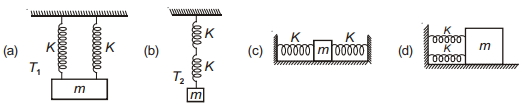
- 1A mass $m$ is attached to two springs of same force constant $K$, as shown in following four arrangements. If $T_1, T_2, T_3$ and $T_4$ respectively be the time periods of oscillation in the following arrangements, in which case time period is maximum?View Solution
- 2A mass $m$ attached to free end of a spring executes SHM with a period of $1\; s$. If the mass is increased by $3\; kg$ the period of oscillation increases by one second, the value of mass $m$ is $..............kg$.View Solution
- 3The length of a spring is $l$ and its force constant is $k$. When a weight $W$ is suspended from it, its length increases by $x$. If the spring is cut into two equal parts and put in parallel and the same weight $W$ is suspended from them, then the extension will beView Solution
- 4View SolutionIn a simple harmonic oscillation, what fraction of total mechanical energy is in the form of kinetic energy, when the particle is midway between mean and extreme position.
- 5A particle is executing simple harmonic motion $(SHM)$ of amplitude $A,$ along the $x-$ axis, about $x = 0.$ When its potential energy $(PE)$ equals kinetic energy $(KE),$ the position of the particle will beView Solution
- 6An object of mass $0.5\, {kg}$ is executing simple harmonic motion. Its amplitude is $5\, {cm}$ and time period (T) is $0.2\, {s} .$ What will be the potential energy of the object at an instant $t=\frac{T}{4}$ s starting from mean position. Assume that the initial phase of the oscillation is zero. (In ${J}$)View Solution
- 7On the superposition of two harmonic oscillations represented by ${x_1} = a\,\sin \,\left( {\omega t + {\phi _1}} \right)$ and ${x_2} = a\,\sin \,\left( {\omega t + {\phi _2}} \right)$ a resulting oscillation with the same time period and amplitude is obtained. The value of ${\phi _1} - {\phi _2}$ is .... $^o$View Solution
- 8View SolutionA hollow sphere is filled with water through a small hole in it. It is then hung by a long thread and made to oscillate. As the water slowly flows out of the hole at the bottom, the period of oscillation will
- 9You are holding a shallow circular container of radius $R$, filled with water to a height $h ( h < < R )$. When yon walk with speed $v$, it is seen that water starts spilling over. This happens due to the resonance of the periodic impulse given to the container (due to walking) with the oscillation of the water in the container. If the time period of water oscillating in the container is inversely proportional to $\sqrt{ h }$, then $v$ is proportional toView Solution
- 10A block of rectangular size of mass $m$ and area of cross-section $A$, floats in a liquid of density $\rho$. If we give a small vertical displacement from equilibrium, it undergoes $S H M$ with time period $T$, thenView Solution