A particle of mass $m = 1.67 \times 10^{-27}\, kg$ and charge $q = 1.6 \times 10^{-19} \, C$ enters a region of uniform magnetic field of strength $1$ $tesla$ along the direction shown in the figure. the particle leaves the magnetic field at point $D,$ then the distance $CD$ is :-
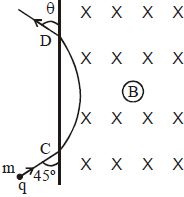
Diffcult


Download our appand get started for free
Experience the future of education. Simply download our apps or reach out to us for more information. Let's shape the future of learning together!No signup needed.*
Similar Questions
- 1The magnetic field due to a current carrying circular loop of radius $3\, cm$ at a point on the axis at a distance of $4\, cm$ from the centre is $54\, \mu T$. What will be its value at the centre of the loop.......$\mu T$View Solution
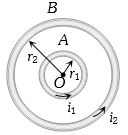
- 2$A$ and $B$ are two concentric circular conductors of centre $O$ and carrying currents ${i_1}$ and ${i_2}$ as shown in the adjacent figure. If ratio of their radii is $1 : 2$ and ratio of the flux densities at $O$ due to $A$ and $B$ is $1 : 3$, then the value of ${i_1}/{i_2}$ isView Solution
- 3A current loop consists of two identical semicircular parts each of radius $R,$ one lying in the $x-y$ plane and the other in $x-z$ plane. If the current in the loop is $i.$ The resultant magnetic field due to the two semicircular parts at their common centre isView Solution
- 4What is the magnetic field at a distance $R$ from a coil of radius $r$ carrying current $I$ ?View Solution
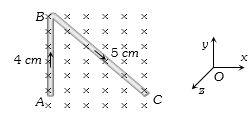
- 5A uniform conducting wire $ABC$ has a mass of $10\,g$. A current of $2\,A$ flows through it. The wire is kept in a uniform magnetic field $B = 2T.$ The acceleration of the wire will beView Solution
- 6A rectangular coil $20\,cm \times 20\,cm$ has $100$ $turns$ and carries a current of $1\, A$. It is placed in a uniform magnetic field $B =0.5\, T$ with the direction of magnetic field parallel to the plane of the coil. The magnitude of the torque required to hold this coil in this position is........$N-m$View Solution
- 7Two parallel wires in free space are $10\, cm$ apart and each carries a current of $10\, A$ in the same direction. The force one wire exerts on the other per metre of length isView Solution
- 8A galvanometer gives full scale reading of $50\ mA$ , when a $p.d.$ , across its terminals is $0.15\ V$ . It can be used as an ammeter of range $0 - 100\ A$ by connecting a shunt resistance ofView Solution
- 9A galvanometer has a resistance of $50\ \Omega$ and it allows maximum current of $5 \mathrm{~mA}$. It can be converted into voltmeter to measure upto $100 \mathrm{~V}$ by connecting in series a resistor of resistanceView Solution
- 10Through two parallel wires $A$ and $B$, $10$ and $2$ $ampere$ of currents are passed respectively in opposite direction. If the wire $A$ is infinitely long and the length of the wire $B$ is $ 2\, m$, the force on the conductor $B$, which is situated at $10\, cm$ distance from $A$ will beView Solution