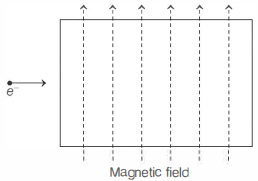
An electron and a proton enter region of uniform magnetic field in a direction at right angles to the field with the same kinetic energy. They describe circular paths of radius ${r_e}$ and ${r_p}$ respectively. Then
Medium
Download our app for free and get started
(b) $r = \frac{{\sqrt {2mK} }}{{qB}}i.e.\;\;r \propto \frac{{\sqrt m }}{q}$
Here kinetic energy $K$ and $B$ are same.
Here kinetic energy $K$ and $B$ are same.
$\therefore \;\frac{{{r_e}}}{{{r_p}}} = \sqrt {\frac{{{m_e}}}{{{m_p}}}} \times \frac{{{q_p}}}{{{q_e}}} \Rightarrow \frac{{{r_e}}}{{{r_p}}} = \sqrt {\frac{{{m_e}}}{{{m_p}}}} \;\;(\because \;{q_e} = {q_p})$
Since $m_e < m_p$, therefore $ r_e < r_p$

Download our appand get started for free
Experience the future of education. Simply download our apps or reach out to us for more information. Let's shape the future of learning together!No signup needed.*
Similar Questions
- 1View SolutionAn electron is travelling horizontally towards east. A magnetic field in vertically downward direction exerts a force on the electron along
- 2Biot-Savart, law indicates that the moving electrons (velocity $v$) produce a magnetic field $B$ such thatView Solution
- 3An ammeter of $100$ $\Omega$ resistance gives full deflection for the current of $10^{-5} \,amp$. Now the shunt resistance required to convert it into ammeter of $1\, amp$. range, will beView Solution
- 4An electron beam passes through a magnetic field of $2 \times 10^{-3}\,Wb/m^2$ and an electric field of $1.0 \times 10^4\,V/m$ both acting simultaneously. The path of electron remains undeviated. The speed of electron if the electric field is removed, and the radius of electron path will be respectivelyView Solution
- 5In bio savart law direction of magnetic field is shown by $d\vec B = \frac{{{\mu _0}}}{{4\pi }}\frac{{I\overrightarrow {dl} \times \vec r}}{{{r^3}}}$View Solution
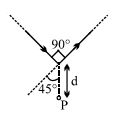
- 6Find the magnetic field at $P$ due to the arrangement shownView Solution
- 7The magnetic moment of an electron $(e)$ revolving in an orbit around nucleus with an orbital angular momentum is given by :View Solution
- 8Equal current $i$ is flowing in three infinitely long wires along positive $x, y$ and $z$ directions. The magnitude field at a point $(0, 0, -a)$ would be:View Solution
- 9View SolutionMark out the correct options.
- 10View SolutionAn electron enters a chamber in which a uniform magnetic field is present as shown below. An electric field of appropriate magnitude is also applied, so that the electron travels undeviated without any change in its speed through the chamber. We are ignoring gravity. Then, the direction of the electric field is