MCQ
A particle starts simple harmonic motion from the mean position. Its amplitude is $a$ and total energy $E$. At one instant its kinetic energy is $3E/4.$ Its displacement at that instant is
  • A
    ${y}={a}$
  • $y=\frac{a}{2}$
  • C
    $y=\frac{a \sqrt{3}}{2}$
  • D
    $y=\frac{a}{\sqrt{2}}$

Answer

Correct option: B.
$y=\frac{a}{2}$
b
(b) $\frac{K}{E} = \frac{{\frac{1}{2}m{\omega ^2}({a^2} - {y^2})}}{{\frac{1}{2}m{\omega ^2}{a^2}}}$

$= \frac{{{a^2} - {y^2}}}{{{a^2}}} $

$= 1 - \frac{{{y^2}}}{{{a^2}}}$

So, $\frac{{\left( {\frac{{3E}}{4}} \right)}}{E} = 1 - \frac{{{y^2}}}{{{a^2}}}$

$\Rightarrow \frac{{{y^2}}}{{{a^2}}} = 1 - \frac{3}{4} = \frac{1}{4}$

$ \Rightarrow y = \frac{a}{2}$.

Need a full question paper?

Generate a complete, print-ready paper with questions like this in minutes — across 16+ boards, with answer keys.

Start Generating Free

Similar questions

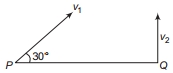
A projectile $A$ is thrown at an angle $30^{\circ}$ to the horizontal from point $P$. At the same time another projectile $B$ is thrown with velocity $v_2$ upwards from the point $Q$ vertically below the highest point $A$ would reach. For $B$ to collide with $A$, the ratio $\frac{v_2}{v_1}$ should be
The variation of acceleration due to gravity $g$ with distance $d$ from centre of the earth is best represented by ($R =$ Earth's radius)
Diatomic molecules like hydrogen have energies due to both translational as well as rotational motion. From the equation in kinetic theory $\text{PV} = \frac{2}{3} E,E$ is:
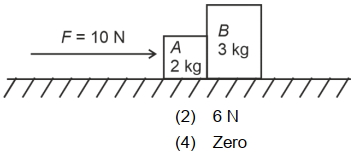
A horizontal force $10 \mathrm{~N}$ is applied to a block $A$ as shown in figure. The mass of blocks $A$ and $B$ are $2 \mathrm{~kg}$ and $3 \mathrm{~kg}$ respectively. The blocks slide over a frictionless surface. The force exerted by block $A$ on block $B$ is :
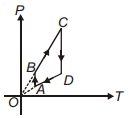
A $P-T$ graph is shown for a cyclic process. Select correct statement regarding this
The bulk modulus of an ideal gas at constant temperature
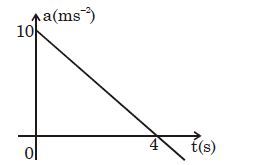
The acceleration time graph of a particle moving along a straight line is shown. At what time particle acquires its initial velocity........$s$
Three particles, located initially on the vertices of an equilateral triangle of side $L,$ start moving with a constant tangential acceleration towards each other in a cyclic manner, forming spiral loci that coverage at the centroid of the triangle. The length of one such spiral locus will be
$50$ tuning forks are arranged in increasing order of their frequencies such that each gives $4 \,beats/sec$ with its previous tuning fork. If the frequency of the last fork is octave of the first, then the frequency of the first tuning fork is  ... $Hz$
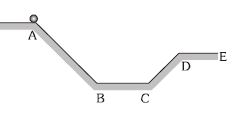
In the picture shown, a ball standing from rest rolls down a ramp $AB$, goes along at the horizontal bottom $BC$, and then backs up a smaller ramp $CD$, thereafter rolls on horizontal plane $DE$. Ignore friction and air resistance.Which of the following figure shows variation in speed with time ?