A pencil when dipped in water in a glass tumbler appears to be bent at the interface of air and water. Will the pencil appear to be bent to the same extent, if instead of water we use liquids like, kerosene or turpentine. Support your answer with reason.
Download our app for free and get started
We know that pencil appears to be bent at the interface of air and water because of refraction of light. The degree of refraction depends on refractive index of a given liquid. Refractive indices of kerosene, water and other liquids would be different. Hence, degree of bend would be different in case of different liquids.

Download our appand get started for free
Experience the future of education. Simply download our apps or reach out to us for more information. Let's shape the future of learning together!No signup needed.*
Similar Questions
- 1View SolutionA concave mirror and a convex lens are held separately in water. What changes, if any, do you expect in the focal length of either?
- 2View SolutionIf the object is moved further away from the mirror, what changes are there in the position and size of the image?
- 3View SolutionA student focuses the image of a well illuminated distant object on a screen using a convex lens. After that he gradually moves the object towards the lens and each time focuses its image on the screen by adjusting the lens.
- In which direction-towards the screen or away from the screen, does he move the lens?
- What happens to the size of the image-does it decrease or increase?
- What happens to the image on the screen when he moves the object very close to the lens?
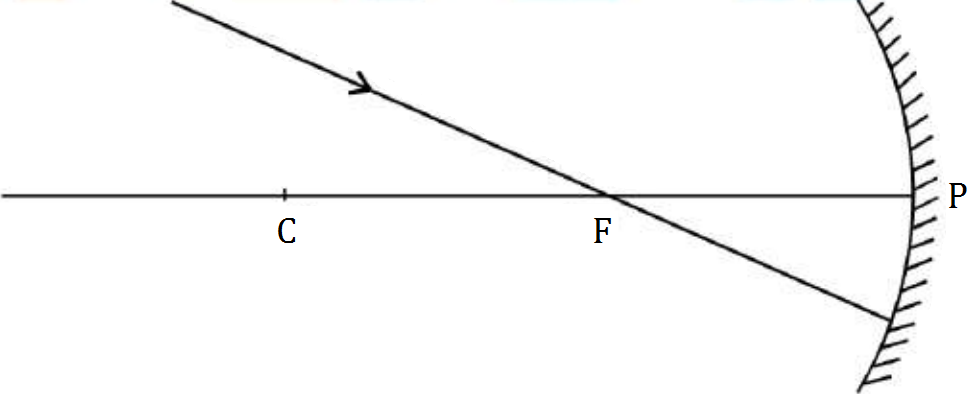
- 4Redraw the following diagram on your answer-sheet and show the path of the reflected ray. Also mark the angle of incidence $(\angle\text{i})$ and the angle of reflection $(\angle\text{r})$ on the diagram.View Solution
- 5View SolutionWith the help of a labelled diagram, explain how a concave lens diverges a beam of parallel light rays.
- 6View SolutionExplain with the help of a diagram, why the convex lens is also called a converging lens.
- 7Light travels through air at 300 million $ms ^{-1}$. On entering water it slows down to 225 million $ms ^{-1}$. Calculate the refractive index of water.View Solution
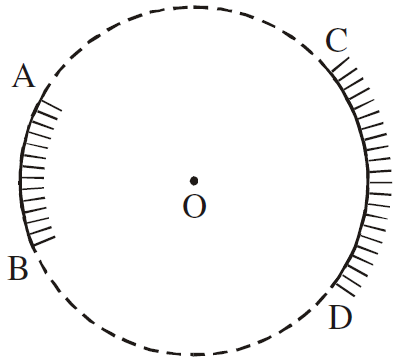
- 8AB and CD, two spherical mirrors, form parts of a hollow spherical ball with its centre at O as shown in the diagram. If arc $\text{AB}=\frac{1}{2}$ arc CD, what is the ratio of their focal lengths? State which of the two mirrors will always form virtual image of an object placed in front of it and why.View Solution
- 9View SolutionA lens is cut into two equal halves: Along the principal axis.
What will be the focallength of each half? - 10View SolutionTo find-the image-distance for varying object-distances in case of a convex lens, a student obtains on a screen a sharp image of a bright object placed very far from the lens. After that he gradually moves the object towards the lens and each time focuses its image of the screen.
- In which direction - towards or away from the lens, does he move the screen to focus the object?
- What happens to the size of the image - does it increase or decrease?
- What happen when he moves the object very close to the lens?