Question

✓
Answer
In a word ALLAHABAD, we have
So, the total number of words $=\frac{9!}{4!2!}=\frac{9 \times 8 \times 7 \times 6 \times 5}{2 \times 1}=7560$
i. There are 4 vowels and all are alike i.e., 4 A's.
Also, there are 4 even places which are 2nd, 4th, 6th and 8th. So, these 4 even places can be occupied by 4 vowels in $\frac{4!}{4!}=1$ way. Now, we are left with 5 places in which 5 letters, of which two are alike (2 L's) and other distinct, can be arranged in $\frac{5!}{2!}$ ways.
Hence, the total number of words in which vowels occupy the even places $=\frac{5!}{2!} \times \frac{4!}{4!}=\frac{5!}{2!}=60$
ii. Considering both L together and treating them as one letter. We have,
Then, 8 letters can be arranged in $\frac{81}{4!}$ ways.
So, the number of words in which both $L$ come together $=\frac{8!}{4}=8 \times 7 \times 6 \times 5=1680$
Hence, the number of words in which both L do not come together
$=$ Total number of words - Number of words in which both $L$ come together
=7560-1680=5880
Hence, the total number of words in which both L do not come together is 5880
| Letters | A | L | H | B | D | Total |
| Number | 4 | 2 | 1 | 1 | 1 | 9 |
i. There are 4 vowels and all are alike i.e., 4 A's.
Also, there are 4 even places which are 2nd, 4th, 6th and 8th. So, these 4 even places can be occupied by 4 vowels in $\frac{4!}{4!}=1$ way. Now, we are left with 5 places in which 5 letters, of which two are alike (2 L's) and other distinct, can be arranged in $\frac{5!}{2!}$ ways.
Hence, the total number of words in which vowels occupy the even places $=\frac{5!}{2!} \times \frac{4!}{4!}=\frac{5!}{2!}=60$
ii. Considering both L together and treating them as one letter. We have,
| Letters | A | LL | H | B | D | Total |
| Number | 4 | 1 | 1 | 1 | 1 | 8 |
So, the number of words in which both $L$ come together $=\frac{8!}{4}=8 \times 7 \times 6 \times 5=1680$
Hence, the number of words in which both L do not come together
$=$ Total number of words - Number of words in which both $L$ come together
=7560-1680=5880
Hence, the total number of words in which both L do not come together is 5880
Need a full question paper?
Generate a complete, print-ready paper with questions like this in minutes — across 16+ boards, with answer keys.
Explore more
Similar questions
To find the limits of trigonometric functions, we use the following theorems
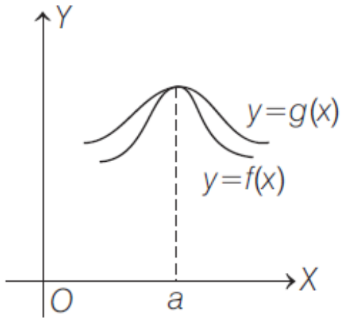
Theorem 1: Let $f$ and $g$ be two real valued functions with the same domain such that $f(x) \leq g(x)$ for all $x$ in the domain of definition. For some real number $a$, if both $\lim _{x \rightarrow a} f(x)$ and $\lim _{x \rightarrow a} g(x)$ exist, then
$
\lim _{x \rightarrow a} f(x) \leq \lim _{x \rightarrow a} g(x) .
$
This is shown in the figure
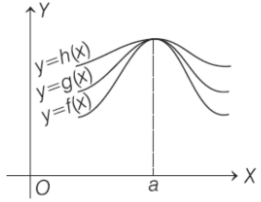
Theorem 2 (Sandwich theorem) : Let $f, g$ and $h$ be real functions such that $f(x) \leq g(x) \leq h(x)$ for all $x$ in the common domain of definition. For some real number $a$, if $\lim _{x \rightarrow a} f(x)=l=\lim _{x \rightarrow a} h(x)$, then $\lim _{x \rightarrow a} g(x)=l$.
This is shown in the figure
Theorem 3 : Three important limits are
(i) $\lim _{x \rightarrow 0} \frac{\sin x}{x}=1$
(ii) $\lim _{x \rightarrow 0} \frac{\frac{x}{1-\cos x}}{x}=0$
(iii) $\lim _{x \rightarrow 0} \frac{\tan ^x x}{x}=1$
Based on above information, answer the following questions.
(i) $\lim _{x \rightarrow 0} \frac{\sin 3 x}{5 x}$ is equal to
(a) $\frac{1}{5}$ (b) $\frac{2}{5}$ (c) $\frac{3}{5}$ (d) $\frac{4}{5}$
(ii) $\lim _{\theta \rightarrow b} \frac{\tan (\theta-b)}{\theta-b}$ is equal to
(a) 0 (b) 1 (c) 2 (d) 3
(iii) $\lim _{x \rightarrow 0} \frac{\tan 2 x-\sin 2 x}{x^3}$ is equal to
(a) 4 (b) 3 (c) 2 (d) 1
(iv) $\lim _{x \rightarrow 0} \frac{2 \sin x-\sin 2 x}{x^3}$ is equal to
(a) 0 (b) 1 (c) 2 (d) 3
(v) $\lim _{x \rightarrow \frac{\pi}{4}} \frac{\sin x-\cos x}{x-\frac{\pi}{4}}$ is equal to
(a) $\sqrt{2}$ (b) 3 (c) 1 (d) $\sqrt{3}$
→Theorem 1: Let $f$ and $g$ be two real valued functions with the same domain such that $f(x) \leq g(x)$ for all $x$ in the domain of definition. For some real number $a$, if both $\lim _{x \rightarrow a} f(x)$ and $\lim _{x \rightarrow a} g(x)$ exist, then
$
\lim _{x \rightarrow a} f(x) \leq \lim _{x \rightarrow a} g(x) .
$
This is shown in the figure
Theorem 2 (Sandwich theorem) : Let $f, g$ and $h$ be real functions such that $f(x) \leq g(x) \leq h(x)$ for all $x$ in the common domain of definition. For some real number $a$, if $\lim _{x \rightarrow a} f(x)=l=\lim _{x \rightarrow a} h(x)$, then $\lim _{x \rightarrow a} g(x)=l$.
This is shown in the figure
Theorem 3 : Three important limits are
(i) $\lim _{x \rightarrow 0} \frac{\sin x}{x}=1$
(ii) $\lim _{x \rightarrow 0} \frac{\frac{x}{1-\cos x}}{x}=0$
(iii) $\lim _{x \rightarrow 0} \frac{\tan ^x x}{x}=1$
Based on above information, answer the following questions.
(i) $\lim _{x \rightarrow 0} \frac{\sin 3 x}{5 x}$ is equal to
(a) $\frac{1}{5}$ (b) $\frac{2}{5}$ (c) $\frac{3}{5}$ (d) $\frac{4}{5}$
(ii) $\lim _{\theta \rightarrow b} \frac{\tan (\theta-b)}{\theta-b}$ is equal to
(a) 0 (b) 1 (c) 2 (d) 3
(iii) $\lim _{x \rightarrow 0} \frac{\tan 2 x-\sin 2 x}{x^3}$ is equal to
(a) 4 (b) 3 (c) 2 (d) 1
(iv) $\lim _{x \rightarrow 0} \frac{2 \sin x-\sin 2 x}{x^3}$ is equal to
(a) 0 (b) 1 (c) 2 (d) 3
(v) $\lim _{x \rightarrow \frac{\pi}{4}} \frac{\sin x-\cos x}{x-\frac{\pi}{4}}$ is equal to
(a) $\sqrt{2}$ (b) 3 (c) 1 (d) $\sqrt{3}$
In a class test of class XI, a teacher asked to students to consider $\mathbf{A}+\mathbf{B}=\frac{\pi}{4}$, where $\mathbf{A}$ and $\mathbf{B}$ are acute angles.
Based on the above information, answer the following questions.
(i) Find the value of $(1+\tan A)(1+\tan B)$ ?
(ii) Find the value of $(\cot \mathbf{A}-1)(\cot \mathbf{B}-1)$ ?
(iii) Find the value of
$
\sin (A+B)-\cos (A+B)+\tan (A+B) .
$
→Based on the above information, answer the following questions.
(i) Find the value of $(1+\tan A)(1+\tan B)$ ?
(ii) Find the value of $(\cot \mathbf{A}-1)(\cot \mathbf{B}-1)$ ?
(iii) Find the value of
$
\sin (A+B)-\cos (A+B)+\tan (A+B) .
$
Method to Find the Sets When Cartesian Product is Given For finding these two sets, we write first element of each ordered pair in first set say $A$ and corresponding second element in second set $B ($say$).$ Number of Elements in Cartesian Product of Two Sets If there are p elements in set $A$ and $g$ elements in set $B,$ then there will be $pq$ elements in $A . B$ i.e. if $n(A) = p$ and $n(B) = q,$ then $n(A . B) = pq.$
Based on the above two topic, answer the following questions.
→Based on the above two topic, answer the following questions.
- If $A . B = \{(a, 1), (b, 3), (a, 3), (b, 1), (a, 2), (b, 2)\}.$ Then, $A$ and $B$ are:
- $\{1, 3, 2\}, \{a, b\}$
- $\{a, b\}, \{1, 3\}$
- $\{a, b\}, \{1, 3, 2\}$
- None of these
- If the set $A$ has $3$ elements and set $B$ has $4$ elements, then the number of elements in $A . B$ is:
- $3$
- $4$
- $7$
- $12$
- $A$ and $B$ are two sets given in such a way that $A . B$ contains $6$ elements. If three elements of $A . B$ are $(1, 3), (2, 5)$ and $(3, 3)$, then $A, B$ are:
- $\{1, 2, 3\}, \{3, 5\}$
- $\{3, 5,\}, \{1, 2, 3\}$
- $\{1, 2\}, \{3, 5\}$
- $\{1, 2, 3\}, \{5\}$
- The remaining elements of $A . B$ in $(iii)$ is:
- $(5, 1), (3, 2), (3, 5)$
- $(1, 5), (2, 3), (3, 5)$
- $(1, 5), (3, 2), (5, 3)$
- None of the above
- The cartesian product $P . P$ has $16$ elements among which are found $(a, 1)$ and $(b, 2).$ Then, the set $P$ is:
- $\{a, b\}$
- $\{1, 2\}$
- $\{a, b,1, 2\}$
- $\{0, b, 1, 2, 4\}$
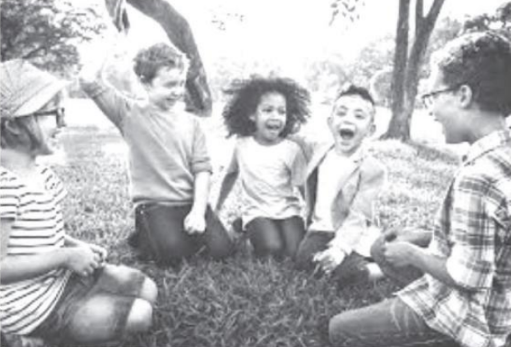
Five students Ajay, Shyam, Yojana, Rahul and Akansha are sitting in a playground in a line.
Based on the above information, answer the following questions.
(i) Total number of ways of sitting arrangement of five students is
(a) 120 (b) 60 (c) 24 (d) None of these
(ii) Total number of arrangement of sitting, if Ajay and Yojana sit together, is
(a) 60 (b) 48 (c) 72 (d) 120
(iii) Total number of arrangement 'Yojana and Rahul sitting at extreme position' is
(a) 24 (b) 36 (c) 48 (d) 12
(iv) Total number of arrangement, if shyam is sitting in the middle, is
(a) 24 (b) 12 (c) 6 (d) 36
(v) Total number of arrangement sitting Yojana and Rahul not sit together, is
(a) 72 (b) 120 (c) 60 (d) 144
Based on the above information, answer the following questions.
(i) Total number of ways of sitting arrangement of five students is
(a) 120 (b) 60 (c) 24 (d) None of these
(ii) Total number of arrangement of sitting, if Ajay and Yojana sit together, is
(a) 60 (b) 48 (c) 72 (d) 120
(iii) Total number of arrangement 'Yojana and Rahul sitting at extreme position' is
(a) 24 (b) 36 (c) 48 (d) 12
(iv) Total number of arrangement, if shyam is sitting in the middle, is
(a) 24 (b) 12 (c) 6 (d) 36
(v) Total number of arrangement sitting Yojana and Rahul not sit together, is
(a) 72 (b) 120 (c) 60 (d) 144
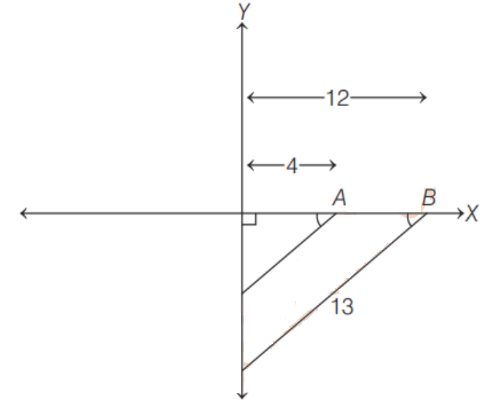
Rajiv constructs two right angled triangles in the fourth quadrant in such a way that the measure of triangle gives $\cos A=\frac{4}{5}$ and $\cos B=\frac{12}{13}$, where $\frac{3 \pi}{2} < A$ and $B > 2 \pi$.
Based on the above information, answer the following questions.
(i) Find the value of $\cos (A+B)$
(ii) Find the value of $\sin (A-B)$
(iii) Find the value of $\tan (\mathbf{A}+\mathbf{B})$
→Based on the above information, answer the following questions.
(i) Find the value of $\cos (A+B)$
(ii) Find the value of $\sin (A-B)$
(iii) Find the value of $\tan (\mathbf{A}+\mathbf{B})$
Method to Find the Sets When Cartesian Product is Given
For finding these two sets, we write first element of each ordered pair in first set say $A$ and corresponding second element in second set $B\ ($say$)$.
Number of Elements in Cartesian Product of Two Sets
If there are $p$ elements in set $A$ and $q$ elements in set $B$, then there will be pq elements in $A \times B$ i.e. if $n(A)=p$ and $n(B)=q$, then $n(A \times B)=p q$.
$i$. The Cartesian product $A \times A$ has $9$ elements among which are found $(-1,0)$ and $(0,1)$. Find the set $A$ and the remaining elements of $A \times A. (1)$
$ii. A$ and $B$ are two sets given in such a way that $A \times B$ contains $6$ elements. If three elements of $A \times B$ are $(1, 3 ), (2,5)$ and $(3, 3),$ then find the remaining elements of $A \times B. (1)$
$iii$. If the set $A$ has $3$ elements and set $B$ has $4$ elements, then find the number of elements in $A \times B$. $(2)$
OR
If $A \times B=\{(a, 1),(b, 3),(a, 3),(b, 1),(a, 2),(b, 2)\}$. Find $A$ and $B .(2)$
→For finding these two sets, we write first element of each ordered pair in first set say $A$ and corresponding second element in second set $B\ ($say$)$.
Number of Elements in Cartesian Product of Two Sets
If there are $p$ elements in set $A$ and $q$ elements in set $B$, then there will be pq elements in $A \times B$ i.e. if $n(A)=p$ and $n(B)=q$, then $n(A \times B)=p q$.
$i$. The Cartesian product $A \times A$ has $9$ elements among which are found $(-1,0)$ and $(0,1)$. Find the set $A$ and the remaining elements of $A \times A. (1)$
$ii. A$ and $B$ are two sets given in such a way that $A \times B$ contains $6$ elements. If three elements of $A \times B$ are $(1, 3 ), (2,5)$ and $(3, 3),$ then find the remaining elements of $A \times B. (1)$
$iii$. If the set $A$ has $3$ elements and set $B$ has $4$ elements, then find the number of elements in $A \times B$. $(2)$
OR
If $A \times B=\{(a, 1),(b, 3),(a, 3),(b, 1),(a, 2),(b, 2)\}$. Find $A$ and $B .(2)$
The school organised a farewell party for $100$ students and school management decided three types of drinks will be distributed in farewell party ie. Milk $(M),$ Coffee $(C)$ and Tea $(T)$. Organiser reported that $10$ students had all the three drinks $M, C, T. 20$ students had $M$ and $C; 30$ students had $C$ and $T; 25$ students had $M$ and $T. 12$ students.had $M$ only; $5$ students had $C$ only; $8$ students had $T$ only.
Based on the above information, answer the following questions.
→Based on the above information, answer the following questions.
- The number of students who did not take any drink, is
- $20$
- $30$
- $10$
- $25$
- The number of students who prefer Milk is
- $47$
- $45$
- $53$
- $50$
- The number of students who prefer Coffee is
- $47$
- $53$
- $45$
- $50$
- The number of students who prefer Tea is
- $51$
- $53$
- $50$
- $47$
- The number of students who prefer Milk and Coffee but not tea is
- $12$
- $10$
- $15$
- $20$
The logarithmic function expressed as $\log _e R^{+} \rightarrow R$ and given by $\log _e x=y$ iff $e^y=x$. The graph of the function is given below :
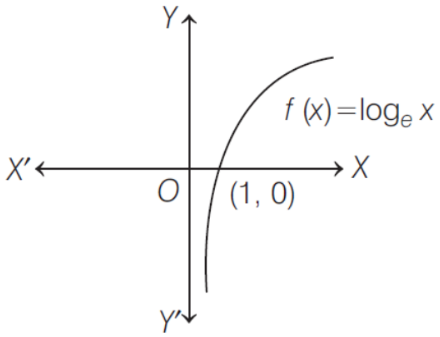
(i) Domain of $f(x)=(0, \infty)$ or $R^{+}$
(ii) Range of $f(x)=(-\infty, \infty)$ or $R$
To find the limit of functions involving logarithmic function, we use the following theorem Theorem $\lim _{x \rightarrow 0} \frac{\log _e(1+x)}{x}=1$
Based on above information, answer the following questions.
(i) $\lim _{x \rightarrow 0} \frac{\log _e(1+5 x)}{x}$ is equal to
(a) 5 (b) 4 (c) 3 (d) 1
(ii) $\lim _{x \rightarrow 0} \frac{\log _e(1+6 x)-5 x^2}{x}$ is equal to
(a) 1 (b) 2 (c) 3 (d) 6
(iii) $\quad \lim _{x \rightarrow 0} \frac{\sqrt{1+x}-1}{\log (1+x)}$ is equal to
(a) 1 (b) $\frac{1}{2}$ (c) $\frac{1}{3}$ (d) $\frac{3}{2}$
(iv) $\quad \lim _{x \rightarrow 5} \frac{\log x-\log 5}{x-5}$ is equal to
(a) $\frac{1}{5}$ (b) $\frac{3}{5}$ (c) $\frac{1}{4}$ (d) $\frac{2}{3}$
(v) $\quad \lim _{x \rightarrow 0} \frac{\log (5+x)-\log (5-x)}{x}$ is equal to
(a) $\frac{1}{5}$ (b) $\frac{2}{5}$ (c) $\frac{3}{5}$ (d) $\frac{4}{5}$
→→(i) Domain of $f(x)=(0, \infty)$ or $R^{+}$
(ii) Range of $f(x)=(-\infty, \infty)$ or $R$
To find the limit of functions involving logarithmic function, we use the following theorem Theorem $\lim _{x \rightarrow 0} \frac{\log _e(1+x)}{x}=1$
Based on above information, answer the following questions.
(i) $\lim _{x \rightarrow 0} \frac{\log _e(1+5 x)}{x}$ is equal to
(a) 5 (b) 4 (c) 3 (d) 1
(ii) $\lim _{x \rightarrow 0} \frac{\log _e(1+6 x)-5 x^2}{x}$ is equal to
(a) 1 (b) 2 (c) 3 (d) 6
(iii) $\quad \lim _{x \rightarrow 0} \frac{\sqrt{1+x}-1}{\log (1+x)}$ is equal to
(a) 1 (b) $\frac{1}{2}$ (c) $\frac{1}{3}$ (d) $\frac{3}{2}$
(iv) $\quad \lim _{x \rightarrow 5} \frac{\log x-\log 5}{x-5}$ is equal to
(a) $\frac{1}{5}$ (b) $\frac{3}{5}$ (c) $\frac{1}{4}$ (d) $\frac{2}{3}$
(v) $\quad \lim _{x \rightarrow 0} \frac{\log (5+x)-\log (5-x)}{x}$ is equal to
(a) $\frac{1}{5}$ (b) $\frac{2}{5}$ (c) $\frac{3}{5}$ (d) $\frac{4}{5}$

On her vacation, Priyanka visits four cities. Delhi, Lucknow, Agra, Meerut in a random order.
$i$. What is the probability that she visits Delhi before Lucknow? $(1)$
$ii$. What is the probability she visit Delhi before Lucknow and Lucknow before Agra? $(1)$
$iii.$ What is the probability she visits Delhi first and Lucknow last? $(2)$
OR
What is the probability she visits Delhi either first or second? $(2)$
→$i$. What is the probability that she visits Delhi before Lucknow? $(1)$
$ii$. What is the probability she visit Delhi before Lucknow and Lucknow before Agra? $(1)$
$iii.$ What is the probability she visits Delhi first and Lucknow last? $(2)$
OR
What is the probability she visits Delhi either first or second? $(2)$