A point charge $q$ is placed in a cavity in a metal block. If a charge $Q$ is brought outside the metal, then the electric force experienced by $q$ is
Easy
Download our app for free and get started

Download our appand get started for free
Experience the future of education. Simply download our apps or reach out to us for more information. Let's shape the future of learning together!No signup needed.*
Similar Questions
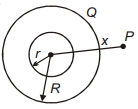
- 1Two concentric hollow conducting spheres of radius $r$ and $R$ are shown. The charge on outer shell is $Q$. What charge should be given to inner sphere so that the potential at any point $P$ outside the outer sphere is zero?View Solution
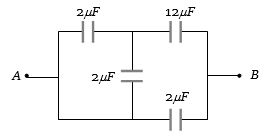
- 2Four capacitors are connected in a circuit as shown in the figure. The effective capacitance in $\mu F$ between points $A$ and $B$ will beView Solution
- 3In the $R-C$ circuit shown in the figure the total energy of $3.6 \times 10^{-3}\ J$ is dissipated in the $10$ $\Omega$ resistor when the switch $S$ is closed. The initial charge on the capacitor is.....$\mu C$View Solution

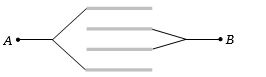
- 4Four plates of equal area $A$ are separated by equal distances $d$ and are arranged as shown in the figure. The equivalent capacity isView Solution
- 5View SolutionA spherical portion has been removed from a solid sphere having a charge distributed uniformly in its volume in the figure. The electric field inside the emptied space is

- 6A capacitor is connected to a $10\,V$ battery. The charge on the plates is $10\,\mu C$ when medium between plates is air. The charge on the plates become $100\,\mu C$ when space between plates is filled with oil. The dielectric constant of oil isView Solution
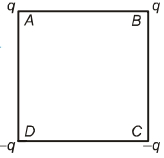
- 7Charges are placed on the vertices of a square as shown Let $\vec E$ be the electric field and $V$ the potential at the centre. If the charges on $A$ and $B$ are interchanged with those on $D$ and $C$ respectively, thenView Solution
- 8View SolutionWhen two identical capacitors are charged individually to different potentials and connected parallel to each other, after disconnecting them from the source :
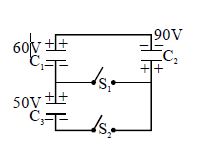
- 9Three charged capacitors, $C_1$ = $17\ μF$, $C_2$ = $34\ μF$, $C_3$ = $41\ μF$and two open switches, $S_1$ and $S_2$ are assembled into a network with initial voltages and polarities, as shown. Final status of the network is attained when the two switches, $S_1$ and $S_2$ are closed. In the figure, the final charge on capacitor $C_3$ in $mC$, is closet to:View Solution
- 10Two points $P$ and $Q$ are maintained at the potentials of $10\ V$ and $- 4\ V$, respectively. The work done in moving $100$ electrons from $P$ to $Q$ isView Solution