MCQ
A product from a chemical industry passes through three states - gas, liquid, solid. The product is initially formed in gaseous state which is then liquefied and finally solidified. For same mass (say 5g) which state has maximum internal energy?
  • A
    Solid
  • B
    Liquid
  • C
    Gas
  • D
    All have equal internal energy

Answer

  1. Gas

Explanation

Internal energy is dependent on the freedom of movement of particles. Since in gaseous state, particles are most free to move, this state has maximum internal energy.

Need a full question paper?

Generate a complete, print-ready paper with questions like this in minutes — across 16+ boards, with answer keys.

Start Generating Free

Similar questions

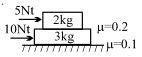
The system shown in figure is released then $a_1$ and $a_2$ is
Which one of the following time-displacement graph represents two moving objects $P$ and $Q$ with zero relative velocity?
A box of mass $m\, kg$ is placed on the rear side of an open truck accelerating at $4\, m/s^2$. The coefficient of friction between the box and the surface below it is $0.4$. The net acceleration of the box with respect to the truck is zero. The value of $m$ is :- $[g = 10\,m/s^2]$
The motion of a simple pendulum excuting $S.H.M$. is represented by following equation.

$Y = A \sin (\pi t +\phi)$, where time is measured in $second$.

The length of pendulum is .............$cm$

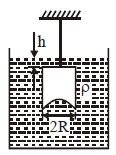
A hemispherical portion of radius $R$ is removed from the bottom of a cylinder of radius $R$. The volume of the remaining cylinder is $V$ and mass $M$. It is suspended by a string in a liquid of density $\rho$, where it stays vertical. The upper surface of cylinder is at a depth $h$ below the liquid surface. The force on the bottom of the cylinder by the liquid is
Ratio between maximum range and square of time of flight in projectile motion is
Free 238U nuclei kept in a train emit alpha particles. When the train is stationary and a uranium nucleus decays, a passenger measures that the separation between the alpha particle and the recoiling nucleus becomes x in time t after the decay. If a decay takes place when the train is moving at a uniform speed v, the distance between the alpha particle and the recoiling nucleus at a time t after the decay, as measured by the passenger will be:
  1. x + vt
  2. x - vt
  3. x
  4. depends on the direction of the train.
A projectile is thrown with velocity $u$ making angle $\theta$ with vertical. It just crosses the tops of two poles each of height $h$ after $1\,s$ and $3\,s$, respectively. The maximum height of projectile is ............ $m$
$x$ and  $y$ displacements of a particle are given as $x(t) = a\,sin\,\omega t$ and $y(t) = a\,sin\,2\omega t.$  Its trajectory will look like 
Three particles, located initially on the vertices of an equilateral triangle of side $L,$ start moving with a constant tangential acceleration towards each other in a cyclic manner, forming spiral loci that coverage at the centroid of the triangle. The length of one such spiral locus will be