A proton beam is going from north to south and an electron beam is going from south to north. Neglecting the earth's magnetic field, the electron beam will deflected (Zero gravity)
Easy


Download our appand get started for free
Experience the future of education. Simply download our apps or reach out to us for more information. Let's shape the future of learning together!No signup needed.*
Similar Questions
- 1In a circuit $5$ percent of total current passes through a galvanometer. If resistance of the galvanometer is $G$ then value of the shunt isView Solution
- 2Two long straight parallel conductors separated by a distance of $0.5\,m$ carry currents of $5\,A$ and $8\,A$ in the same direction. The force per unit length experienced by each other isView Solution
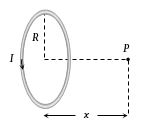
- 3A coil having $N$ $turns$ carry a current $I$ as shown in the figure. The magnetic field intensity at point $P$ isView Solution
- 4Statement $-1$ : Ampere law can be used to find magnetic field due to finite length of a straight current carrying wire.View Solution
Statement $-2$ : The magnetic field due to finite length of a straight current carrying wire is symmetric about the wire.
- 5${10^{ - 3}}amp$ is flowing through a resistance of $1000\,\Omega $. To measure the correct potential difference, the voltmeter is to be used of which the resistance should beView Solution
- 6View SolutionThe current sensitivity of a moving coil galvanometer can be increased by
- 7An ammeter gives full scale deflection when current of $1.0\, A$ is passed in it. To convert it into $10\, A$ range ammeter, the ratio of its resistance and the shunt resistance will beView Solution
- 8Two parallel conductors $A$ and $B$ of equal lengths carry currents $I$ and $10\, I$, respectively, in the same direction. ThenView Solution
- 9In the productView Solution
$\overrightarrow{\mathrm{F}} =\mathrm{q}(\vec{v} \times \overrightarrow{\mathrm{B}})$
$=\mathrm{q} \vec{v} \times\left(\mathrm{B} \hat{i}+\mathrm{B} \hat{j}+\mathrm{B}_{0} \hat{k}\right)$
For $\mathrm{q}=1$ and $\vec{v}=2 \hat{i}+4 \hat{j}+6 \hat{k}$ and
$\overrightarrow{\mathrm{F}}=4 \hat{i}-20 \hat{j}+12 \hat{k}$
What will be the complete expression for $\vec{B}$ ?
- 10A winding wire which is used to frame a solenoid can bear a maximum $10\, A$ current. If length of solenoid is $80\,cm$ and it's cross sectional radius is $3\, cm$ then required length of winding wire is $(B = 0.2\,T)$View Solution