Question
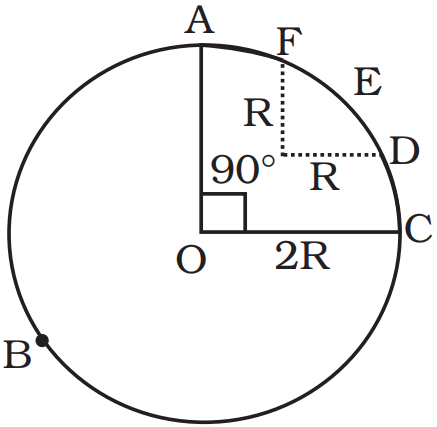
A racing car travels on a track (without banking) ABCDEFA ABC is a circular arc of radius 2 R. CD and FA are straight paths of length R and DEF is a circular arc of radius $R = 100 m$. The co-effecient of friction on the road is $\mu = 0.1.$ The maximum speed of the car is $50m s^{–1}$. Find the minimum time for completing one round.
Answer

The main concept used: The centripetal force to keep the car in circular motion is provided by frictional force inward to centre O.Explanation:
  1. Time taken from $\text{A}\rightarrow\text{B}\rightarrow\text{C}$
$\text{s}_1=$ length of path $=\frac{3}{4}2\pi(2\text{R})=\frac{3}{4}\times4\pi\times100=300\pi\text{m}$
$\text{v}_1=$ the maximum speed of car along the circular path
$\sqrt{\mu\text{r}\text{g}}=\sqrt{0.1\times2\text{R}\times\text{g}}$
$\text{v}_1=\sqrt{0.1\times2\times100\times10}=\sqrt{200}=10\times\sqrt{2\text{m/ s}}=14.14\text{m/}\sec$
$\therefore\ \text{t}_1=\frac{\text{s}_1}{\text{v}_1}=\frac{300\pi}{14.14}=\frac{300\times3.14}{14.14}=66.62\text{s}$
  1. Time from $\text{c}\rightarrow\text{D}$ and $\text{F}\rightarrow\text{A}$
$\text{s}_2=\text{CD}+\text{FA}=\text{R+R}=100+100=200\text{m}$
As path CD and FA are in straight so car will travel with it’s maximum speed $=\text{v}_2=50\text{m/ s}$
$\therefore\ \text{t}_2=\frac{\text{s}_2}{\text{v}_2}=\frac{200}{50}=4\sec$
  1. Time for path $\text{D}\rightarrow\text{E}\rightarrow\text{F}$ is
$\text{s}_3=\frac{1}{4}2\pi\text{R}=\frac{1}{4}\times2\pi\times100=50\pi$
$\text{v}_3=\sqrt{\mu}\text{r}\text{g}=\sqrt{0.1\times\text{R}\times\text{g}}=\sqrt{0.1\times100\times10}=\text{m/ s}$
$\text{t}_3=\frac{\text{s}_3}{\text{v}_3}=\frac{50\pi}{10}=5\sec=5\times3.14=154.70\text{s}$
Total time taken by car $\text{t}_1+\text{t}_2+\text{t}_3$
$\therefore\text{t}=66.62+4+15.70=86.32\sec.$

Need a full question paper?

Generate a complete, print-ready paper with questions like this in minutes — across 16+ boards, with answer keys.

Start Generating Free

Similar questions

The free surface of oil in a tanker, at rest, is horizontal. If the tanker starts accelerating the free surface will be titled by an angle $\theta.$ If the acceleration is a m $s^{-2}$, what will be the slope of the free surface?
Find the components along the x, y, z axes of the angular momentum l of a particle, whose position vector is r with components x, y, z and momentum is p with components px, py and pz. Show that if the particle moves only in the x-y plane the angular momentum has only a z-component.
Draw a graph to show the variation of P.E., K.E. and total energy of a simple harmonic oscillator with displacement.
The left end of a copper rod (length $=20 \mathrm{~cm}$ area of cross section $=0.20 \mathrm{~cm}$ ) is maintained at $20^{\circ} \mathrm{C}$ and the right end is maintained at $80^{\circ} \mathrm{C}$. Neglecting any loss of heat through radiation, find,
  1. The temperature at a point $11cm$ from the left end
  2. The heat current through the rod. Thermal conductivity of copper $=385\text{Wm}^{-1}{^{\circ}}\text{C}^{-1}.$
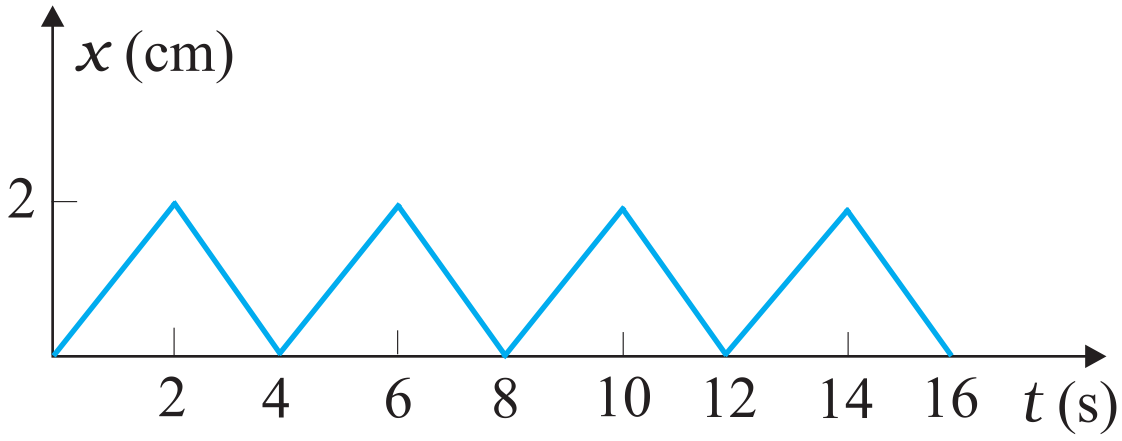
Figure $5.17$ shows the position-time graph of a body of mass $0.04kg$. Suggest a suitable physical context for this motion. What is the time between two consecutive impulses received by the body? What is the magnitude of each impulse?
A professor reads a greeting card received on his 50th birthday with +2.5D glasses keeping the card 25cm away. Ten years later, he reads his farewell letter with the same glasses but he has to keep the letter 50cm away. What power of lens should he now use?
A solid disc and a ring, both of radius 10 cm are placed on a horizontal table simultaneously, with initial angular speed equal to $10 \pi rad s ^{-1}$. Which of the two will start to roll earlier? The co-efficient of kinetic friction is $\mu_k=$
A marble rolls along a table at a constant speed of $1.00 m / s$ and then falls off the edge of the table to the floor 1.00 m below,
i. How long does the marble take to reach the floor?
ii. At what horizontal distance from the edge of the table does the marble land?
iii. What is its velocity as it strikes the floor?
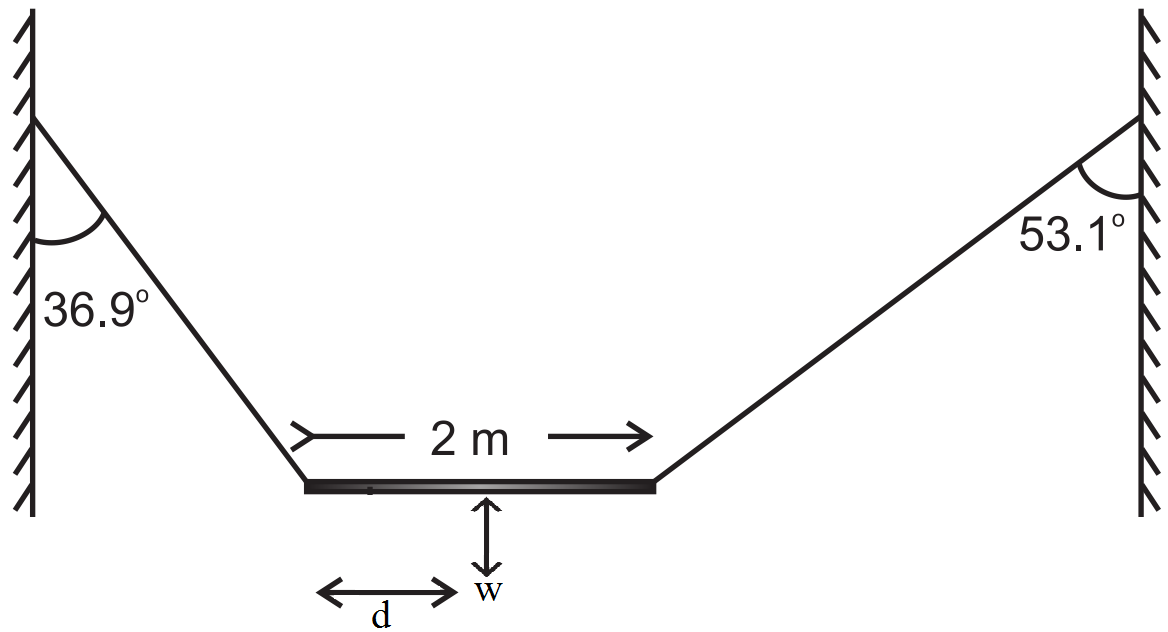
A non-uniform bar of weight W is suspended at rest by two strings of negligible weight as shown in. The angles made by the strings with the vertical are $36.9°$ and $53.1°$ respectively. The bar is $2m$ long. Calculate the distance d of the centre of gravity of the bar from its left end.
A stone hangs in air from one end of a wire which is stretched over a sonometer. The wire is in unison with a certain tuning fork when the bridges of the sonometer are 45cm apart. Now the stone hangs immersed in water at 4°C and the distance between the bridges has to be altered by 9cm to re-establish unison of the wire with the same fork. Calculate the density of the stone.