MCQ
A rectangular block of mass $5\,kg$ attached to a horizontal spiral spring executes simple harmonic motion of amplitude $1\,m$ and time period $3.14\,s$. The maximum force exerted by spring on block is $.......N$.
  • A
    $10$
  • B
    $5$
  • $20$
  • D
    $30$

Answer

Correct option: C.
$20$
c
$\therefore T =3.14=\pi$

$T =\pi=\frac{2 \pi}{\omega} \Rightarrow \omega=2$

$F _{\max }= ma _{\max }$

$= m \left( A \omega^2\right)$

$= mA (2)^2$

$=5 \times 1 \times 4$

$=20\,N$

Need a full question paper?

Generate a complete, print-ready paper with questions like this in minutes — across 16+ boards, with answer keys.
Start Generating Free

Similar questions

The equation of progressive wave is $y = 0.2\sin 2\pi \left[ {\frac{t}{{0.01}} - \frac{x}{{0.3}}} \right]$, where $x$ and $y$ are in metre and $t$ is in second. The velocity of propagation of the wave is .... $m/s$
A solid sphere is thrown up a rough incline. The sphere rolls up without slipping and eventually comes down rolling without slipping. The direction of rolling friction in upward and downward motion respectively is ............
In the relation $P = \frac{\alpha }{\beta }{e^{ - \frac{{\alpha Z}}{{k\theta }}}}$ $P$ is pressure, $Z$ is the distance, $k$ is Boltzmann constant and $\theta$ is the temperature. The dimensional formula of $\beta$ will be
A block of mass $10\, kg$ starts sliding on a surface with an initial velocity of $9.8\, ms ^{-1}$. The coefficient of friction between the surface and bock is $0.5$. The distance covered by the block before coming to rest is: [use $g =9.8\, ms ^{-2}$ ].........$m$
A man projects a coin upwards from the gate of a uniformly moving train. The path of coin for the man will be
A ball falls from a building and covers $5m$ in $10s.$ What is the acceleration?
If at any point on the path of a projectile its velocity is $u$ at inclination $\alpha$ then it will  move at right angles to former direction after time
Two solids $A$ and $B$ of mass $1\, kg$ and $2\, kg$ respectively are moving with equal linear momentum. The ratio of their kinetic energies $(K.E.)_{ A }:( K.E. )_{ B }$ will be $\frac{ A }{1},$ so the value of $A$ will be ..... .
If the light moving in a straight line bends by a small but fixed angle, it may be a case of:
  1. Reflection.
  2. Refraction.
  3. Diffraction.
  4. Dispersion.
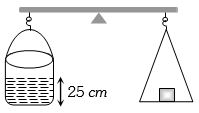
A cylinder containing water up to a height of $25 cm$  has a hole of cross-section $\frac{1}{4}c{m^2}$ in its bottom. It is counterpoised in a balance. What is the initial change in the balancing weight when water begins to flow out