Question
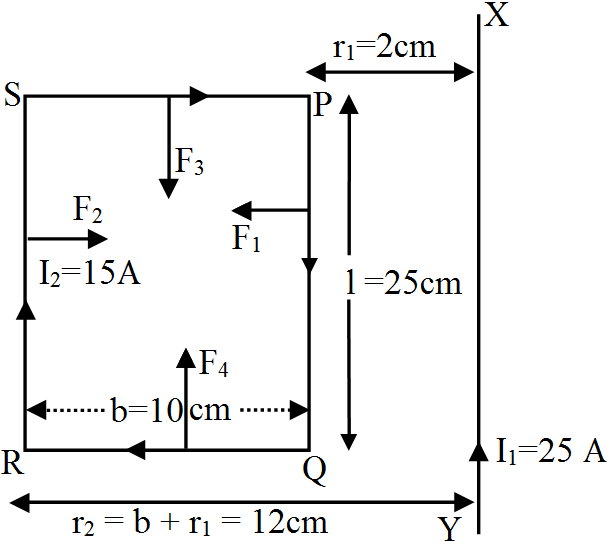
A rectangular loop of sides 25cm and 10cm carrying a current of 15A is placed with its longer side parallel to a long straight conductor 2.0cm apart carrying a current of 25A (fig). What is the net force on the loop?
Answer

Rectangular loop PQRS is placed near a long straight wire as shown.
$l = PQ = RS = 25cm = 0.25m, b = QR = PS = 10cm = 0.10m, r_1 = 2cm = 0.02m, r_2 = 12cm = 0.12m,$​​​​​​​

The currents in PQ and XY are antiparallel, so PQ is repelled away from wire XY. This repulsive force is: $\text{F}_1=\frac{\mu_0\text{I}_1\text{I}_2}{2\pi\text{r}_1}\text{l}$ $=\frac{4\pi\times10^{-7}\times25\times15\times0.25}{2\pi\times0.02}=9.375\times10^{-4}\text{N}$
The currents in XY and RS are in the same direction,
so wire RS is attracted towards wire XY.
​​​​​​​This attractive force is:$\text{F}_1=\frac{\mu_0\text{I}_1\text{I}_2}{2\pi\text{r}_1}\text{l}$
$=\frac{4\pi\times10^{-7}\times25\times15\times0.25}{2\pi\times0.12}$
$=1.563\times10^{-4}\text{N}$ The currents in PS and QR are equal and opposite.
By symmetry they exert equal and opposite forces (F3 and F4) and hence net force on these sides is zero.
$\therefore$ Net force on rectangular loop, $F = F_1 – F_2$​​​​​​​ (repulsive)
$= 9.375 \times 10^{–4} – 1.563 \times 10^{–4} = 7.812 \times 10^{–4} N$ (repulsive)
The net force is directed away from long wire XY.

Need a full question paper?

Generate a complete, print-ready paper with questions like this in minutes — across 16+ boards, with answer keys.

Start Generating Free

Similar questions

What is nature of electromagnetic waves? Explain propagation of wave with the help of a diagram and explain their characteristics in detail.
Sunil and his parents were travelling to their village in their car. On the way his mother noticed some grey coloured panels installed on the roof of a low building. She enquired from Sunil what those panels were and Sunil told his mother that those were solar panels.
  1. What were the values displayed by Sunil and his mother? State one value for each.
  2. In what way would the use of solar panels prove to be very useful?
  3. Name the semiconductor device used in solar panels. Briefly explain with the help of a diagram, how this device works.
In a CE transistor amplifier there is a current and voltage gain associated with the circuit. In other words there is a power gain. Considering power a measure of energy, does the circuit voilate conservation of energy?
A radioactive isotope has a half-life of T years. How long will it take the activity to reduce to
  1. 3.125%,
  2. 1% of its original value?
Derive a mathematical expression for the force per unit length experienced by each of the two long current carrying conductors placed parallel to each other in air. Hence define one ampere of current.Explain why two parallel straight conductors carrying current in the opposite direction kept near each other in air repel?
In an agricultural experiment, a solution containing 1 mole of a radioactive material $\Big(\text{t}_{\frac{1}{2}}=14.3\text{ days}\Big)$ was injected into the roots of a plant. The plant was allowed 70 hours to settle down and then activity was measured in its fruit. If the activity measured was $1\mu\text{Ci},$ what per cent of activity is transmitted from the root to the fruit in steady state?
Establish an expression for force on a current carrying conductor kept in a magnetic field. Explain right hand palm rule for the direction of force.
Add vectors $\overrightarrow{\text{A}},\overrightarrow{\text{B}}$ and $\overrightarrow{\text{C}}$ each having magnitude of 100 unit and inclined to the X-axis at angles 45°, 135° and 315° respectively.
Consider a particle moving in simple harmonic motion according to the equation $\text{x}=2.0\cos(50\pi\text{t}+\tan^{-1}0.75)$ where x is in centimetre and t in second. The motion is started at $t = 0.$
  1. When does the particle come to rest for the first time?
  2. When does the acceleration have its maximum magnitude for the first time?
  3. When does the particle come to rest for the second time?
Find the diameter of the image of the moon formed by a spherical concave mirror of focal length 7.6m. The diameter of the moon is 3450km and the distance between the earth and the moon is $3.8 \times 10^5km.$