Question
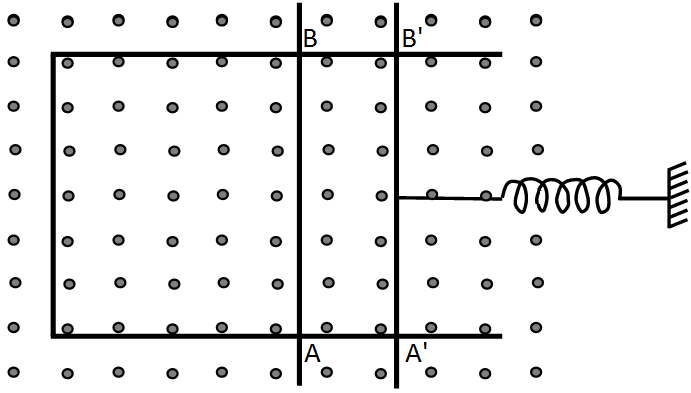
✓
Answer
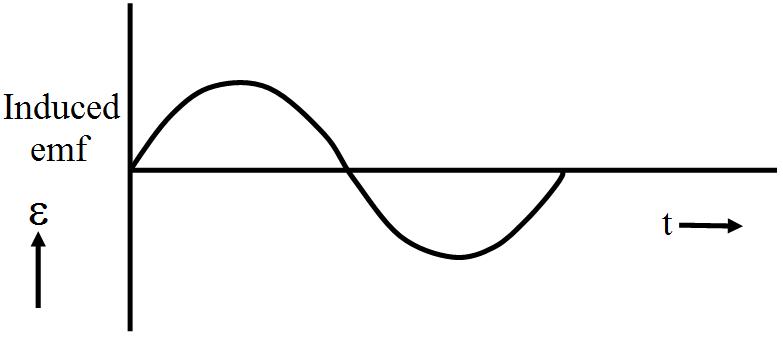
When the spring is stretched and released, the wire AB will execute simple harmonic (sinusoidal) motion, so induced emf will vary periodically. At t = 0, wire is at the extreme position. $\text{v}=0.$ $\text{v}=\text{A}\omega\sin\omega\text{t}$ Induced emf $\varepsilon = \text{Bvl}$ $=\text{BA}\omega\text{l}\sin\omega\text{t}$ Where A = BB′= AA′ is the amplitude of motion and ω is angular frequency.
Need a full question paper?
Generate a complete, print-ready paper with questions like this in minutes — across 16+ boards, with answer keys.
Explore more
Similar questions
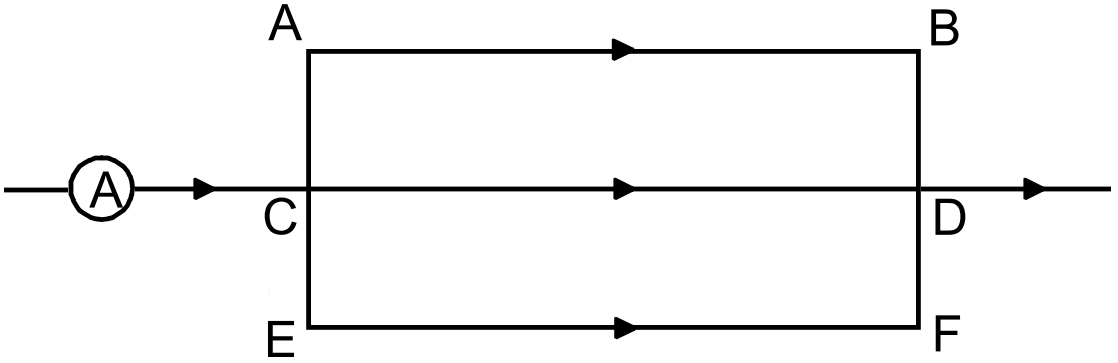
Figure shows a part of an electric circuit. The wires AB, CD and EF are long and have identical resistances. The separation between the neighbouring wires is 1.0cm. The wires AE and BF have negligible resistance and the ammeter reads 30A. Calculate the magnetic force per unit length of AB and CD.
Plot a graph showing the variation of photoelectric current with intensity of light. The work function for the following metals is given:
Na : 2.75 eV and Mo : 4.175 eV.
Which of these will not give photoelectron emission from a radiation of wavelength 3300 Å from a laser beam? What happens if the source of laser beam is brought closer?
Na : 2.75 eV and Mo : 4.175 eV.
Which of these will not give photoelectron emission from a radiation of wavelength 3300 Å from a laser beam? What happens if the source of laser beam is brought closer?
- Find equivalent capacitance between A and B in the combination given below. Each capacitor is of 2 μF capacitance.
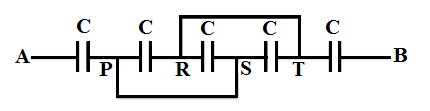
- If a dc source of 7 V is connected across AB, how much charge is drawn from the source and what is the energy stored in the network?
Explain threshold frequency and stopping potential.###Define the following with respect to photoelectric effect :
(i) Work function (ii) Stopping potential
(i) Work function (ii) Stopping potential
A mobile phone is placed on the principal axis of a concave mirror. Show the formation of the image with a suitable ray diagram. Explain why the magnification is not uniform. Does the distortion of the image depend on the position of the phone relative to the mirror?
The work function of caesium is 2.14 eV . Find
(a) The threshold frequency for caesium.
(b) The wavelength of incident light if photocurrent is brought to zero by a stopping potential of $0.60 V .\left( h =6.625 \times 10^{-34} Js \right)$
→(a) The threshold frequency for caesium.
(b) The wavelength of incident light if photocurrent is brought to zero by a stopping potential of $0.60 V .\left( h =6.625 \times 10^{-34} Js \right)$
In a plot of photoelectric current versus anode potential, how does?
- The saturation current vary with anode potential for incident radiations of different frequencies but same intensity?
- The stopping potential vary for incident radiations of different intensities but same frequency?
- Photoelectric current vary for different intensities but same frequency of incident radiations?
Justify your answer in each case.
The output of an OR gate is connected to both the inputs of a NAND gate. Draw the logic circuit of this combination of gates and write its truth table.
What is the de Broglie wavelength of:
- A bullet of mass 0.040 kg travelling at the speed of 1.0 km/s,
- A ball of mass 0.060 kg moving at a speed of 1.0 m/s, and
- A dust particle of mass 1.0 × 10⁻⁹ kg drifting with a speed of 2.2 m/s?
Suppose A and B in the previous problem change their positions in such a way that the line joining them becomes perpendicular to the direction of wind while maintaining the separation x. What will be the time lag B finds between seeing and hearing the drum beating by A?