A rod of length $L$ and uniform cross-sectional area has varying thermal conductivity which changes linearly from $2K$ at endAto $K$ at the other end $B$. The endsA and $B$ of the rod are maintained at constant temperature $100^o C$ and $0^o C$, respectively. At steady state, the graph of temperature : $T = T(x)$ where $x =$ distance from end $A$ will be
- A

- B

- C

- D

Advanced


Download our appand get started for free
Experience the future of education. Simply download our apps or reach out to us for more information. Let's shape the future of learning together!No signup needed.*
Similar Questions
- 1View SolutionWhy it is more hotter for same distance over the top of a candle than it in the side of its flame?
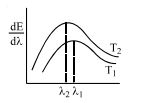
- 2Star $A$ has radius $ r$ surface temperature $T$ while star $B$ has radius $4r$ and surface temperature $T/2$ . The ratio of the power of two starts, $P_A : P_B$ isView Solution
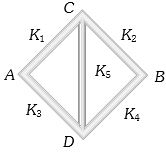
- 3Five rods of same dimensions are arranged as shown in the figure. They have thermal conductivities $K1, K2, K3, K4$ and $K5$ . When points $A$ and $B$ are maintained at different temperatures, no heat flows through the central rod ifView Solution
- 4View SolutionThe rate of radiation of energy from a hot object is maximum, if its surface is ...........
- 5$Assertion :$ Two thin blankets put together are warmer than a single blanket of double the thickness.View Solution
$Reason :$ Thickness increases because of air layer enclosed between the two blankets. - 6View SolutionWhile measuring the thermal conductivity of a liquid, we keep the upper part hot and lower part cool, so that
- 7The initial temperature of a body is $80°C$ . If its temperature falls to $64°C$ in $5$ minutes and in $10$ minutes to $52°C$ then the temperature of surrounding will be ...... $^oC$View Solution
- 8Four rods of same material and having the same cross section and length have been joined, as shown. The temperature of junction of four rods will be........ $^oC$View Solution
- 9If a graph is plotted by taking spectral emissive power along $y$-axis and wavelength along $x$-axis then the area below the graph above wavelength axis is ...........View Solution
- 10The spectral emissive power $E_\lambda $ for a body at temperature $T_1$ is plotted against the wavelength and area under the curve is found to be $A$. At a different temperature $T_2$ the area is found to be $9A$. Then $\lambda _1/\lambda _2 =$View Solution