Question
A sample of gas at temperature $T$ is adiabatically expanded to double its volume. The work done by the gas in the process is $\left(\right.$ given, $\left.\gamma=\frac{3}{2}\right)$ :

Answer

$T_1 V_1^{\gamma-1}=T_2 V_2^{\gamma-1}$

$T V^{1 / 2}=T_2(2 V)^{1 / 2}$

$T_2=\frac{T}{\sqrt{2}}$

$W=\frac{R\left(T_1-T_2\right)}{\gamma-1}=\frac{R\left(T-\frac{T}{\sqrt{2}}\right)}{\frac{1}{2}}=R T(2-\sqrt{2})$

Need a full question paper?

Generate a complete, print-ready paper with questions like this in minutes — across 16+ boards, with answer keys.
Start Generating Free

Similar questions

The metallic bob of a simple pendulum has the relative density $\rho$. The time period of this pendulum is $T$. If the metallic bob is immersed in water, then the new time period is given by
A $2 \mathrm{~kg}$ brick begins to slide over a surface which is inclined at an angle of $45^{\circ}$ with respect to horizontal axis. The co-efficient of static friction between their surfaces is:
Two vectors $\dot{A}$ and $\dot{B}$ are defined as $\dot{A}=a \hat{i}$ and $\overrightarrow{\mathrm{B}}=\mathrm{a}(\cos \omega t \hat{\mathrm{i}}+\sin \omega t \hat{j}$ ), where a is a constant and $\omega=\pi / 6 \mathrm{rad} \mathrm{s}^{-1}$. If $|\overrightarrow{\mathrm{A}}+\overrightarrow{\mathrm{B}}|=\sqrt{3}|\overrightarrow{\mathrm{A}}-\overrightarrow{\mathrm{B}}|$ at time $t=\tau$ for the first time, the value of $\tau$, in, seconds, is. . . . . .
A particle starts from the origin at $\mathrm{t}=0$ with an initial velocity of $3.0 \hat{\mathrm{i}} \;\mathrm{m} / \mathrm{s}$ and moves in the $x-y$ plane with a constant acceleration $(6.0 \hat{\mathrm{i}}+4.0 \hat{\mathrm{j}}) \;\mathrm{m} / \mathrm{s}^{2} .$ The $\mathrm{x}$ -coordinate of the particle at the instant when its $y-$coordinate is $32\;\mathrm{m}$ is $D$ meters. The value of $D$ is
The intensity of magnetic field is $H$ and moment of magnet is $M$. The maximum potential energy is.....$MH$
Which one of the following is not used to reduce friction
In a transistor the collector current is always less than the emitter current because
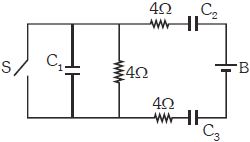
In the circuit shown in the diagram the capacitance of the capacitors $C_1 , C_2$ and $C_3$ are $4\ \mu F$, $6\ \mu F$ and $12\ \mu F$ respectively and the switch $S$ remains closed for a long time. When the switch $S$ is opened, which of the following statements will be correct about the current flowing through the battery $B$ ?
The critical angle between an equilateral prism and air is $45^o $. If the incident ray is perpendicular to the refracting surface, then
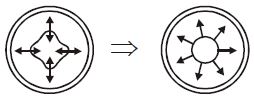
A soap film is formed on a circular frame. A loop of thread is lying on film. If the film inside the loop is broken, then tension in the thread will be : ($R =$ radius of loop, $T =$ surface tension of liquid)