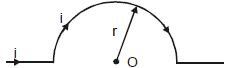
A semi circular arc of radius $r$ and a straight wire along the diameter, both are carrying same current $i.$ Find out magnetic force per unit length on the small element $P$, which is at the centre of curvature.

AIIMS 2019, Medium
Download our app for free and get started
The expression of magnetic force is given by,
$F = Bi \ell$
$\frac{ F }{\ell}= Bi =\left(\frac{\mu_{0} i ^{2}}{4 r }\right)$

Download our appand get started for free
Experience the future of education. Simply download our apps or reach out to us for more information. Let's shape the future of learning together!No signup needed.*
Similar Questions
- 1A spherical shell of radius $'R'$ carries uniformly distributed charge $'Q'$ is rotated about it's diameter with angular speed $\omega $ find it's magnetic momentView Solution
- 2A solenoid of $1000$ turns per metre has a core with relative permeability $500$. Insulated windings of the solenoid carry an electric current of $5\, A$. The magnetic flux density produced by the solenoid isView Solution
(permeability of free space $\left.=4 \pi \times 10^{-7} H / m \right)$
- 3View SolutionIf two streams of protons move parallel to each other in the same direction, then they
- 4Current $i$ is carried in a wire of length $L$. If the wire is turned into a circular coil, the maximum magnitude of torque in a given magnetic field $B$ will beView Solution
- 5A current $I$ flows along the length of an infinitely long, straight, thin walled pipe. ThenView Solution
- 6A charged particle (electron or proton) is introduced at the origin $(x=0, y=0, z=0)$ with a given initial velocity $\overrightarrow{\mathrm{v}}$. A uniform electric field $\overrightarrow{\mathrm{E}}$ and magnetic field $\vec{B}$ are given in columns $1,2$ and $3$ , respectively. The quantities $E_0, B_0$ are positive in magnitude.View Solution
column $I$
column $II$ column $III$ $(I)$ Electron with $\overrightarrow{\mathrm{v}}=2 \frac{\mathrm{E}_0}{\mathrm{~B}_0} \hat{\mathrm{x}}$ $(i)$ $\overrightarrow{\mathrm{E}}=\mathrm{E}_0^2 \hat{\mathrm{Z}}$ $(P)$ $\overrightarrow{\mathrm{B}}=-\mathrm{B}_0 \hat{\mathrm{x}}$ $(II)$ Electron with $\overrightarrow{\mathrm{v}}=\frac{\mathrm{E}_0}{\mathrm{~B}_0} \hat{\mathrm{y}}$ $(ii)$ $\overrightarrow{\mathrm{E}}=-\mathrm{E}_0 \hat{\mathrm{y}}$ $(Q)$ $\overrightarrow{\mathrm{B}}=\mathrm{B}_0 \hat{\mathrm{x}}$ $(III)$ Proton with $\overrightarrow{\mathrm{v}}=0$ $(iii)$ $\overrightarrow{\mathrm{E}}=-\mathrm{E}_0 \hat{\mathrm{x}}$ $(R)$ $\overrightarrow{\mathrm{B}}=\mathrm{B}_0 \hat{\mathrm{y}}$ $(IV)$ Proton with $\overrightarrow{\mathrm{v}}=2 \frac{\mathrm{E}_0}{\mathrm{~B}_0} \hat{\mathrm{x}}$ $(iv)$ $\overrightarrow{\mathrm{E}}=\mathrm{E}_0 \hat{\mathrm{x}}$ $(S)$ $\overrightarrow{\mathrm{B}}=\mathrm{B}_0 \hat{\mathrm{z}}$ ($1$) In which case will the particle move in a straight line with constant velocity?
$[A] (II) (iii) (S)$ $[B] (IV) (i) (S)$ $[C] (III) (ii) (R)$ $[D] (III) (iii) (P)$
($2$) In which case will the particle describe a helical path with axis along the positive $z$ direction?
$[A] (II) (ii) (R)$ $[B] (IV) (ii) (R)$ $[C] (IV) (i) (S)$ $[D] (III) (iii)(P)$
($3$) In which case would be particle move in a straight line along the negative direction of y-axis (i.e., more along $-\hat{y}$ )?
$[A] (IV) (ii) (S)$ $[B] (III) (ii) (P)$ $[C]$ (II) (iii) $(Q)$ $[D] (III) (ii) (R)$
- 7The earth's magnetic induction at a certain point is $7 \times {10^{ - 5}}\,Wb/{m^2}.$ This is to be annulled by the magnetic induction at the centre of a circular conducting loop of radius $5 \,cm$. The required current in the loop is......$A$View Solution
- 8A portion of a conductive wire is bent in the form of a semicircle of radius $r$ as shown below in fig. At the centre of semicircle, the magnetic induction will beView Solution
- 9The pole strength of a bar magnet is $48$ $ampere-metre$ and the distance between its poles is $ 25 \,cm$ . The moment of the couple by which it can be placed at an angle of $30°$ with the uniform magnetic intensity of flux density $0.15 $ $Newton /ampere-metre$ will be.......$Newton × metre$View Solution
- 10An electron is moving along positive $x$-axis.Auniform electric field exists towards negative $y$-axis. What should be the direction of magnetic field of suitable magnitude so that net force of electron is zeroView Solution