Question
A simple pendulum is constructed by hanging a heavy ball by a $5.0m$ long string. It undergoes small oscillations.
  1. How many oscillations does it make per second?
  2. What will be the frequency if the system is taken on the moon where acceleration due to gravitation of the moon is $1.67m/s^2$.
Answer

$\text{L}=5\text{m}$
  1. $\text{T}=2\pi\sqrt{\frac{\ell}{\text{g}}}=2\pi\sqrt{0.5}=2\pi(0.7)$
$\therefore$ in $2\pi(0.7)\sec$ the body completes 1 oscillation,
In 1 second, the body will complete $\frac{1}{2\pi(0.7)}$ oscillation
$\therefore\text{f}=\frac{1}{2\pi(0.7)}=\frac{10}{14\pi}=\frac{0.70}{\pi}$ Times
  1. When it is taken to the moon
$\text{T}=2\pi\sqrt{\frac{\ell}{\text{g'}}}$ where g' → Acceleration in the moon.
$=2\pi\sqrt{\frac{5}{1.67}}$
$\therefore\text{f}=\frac{1}{\text{T}}=\frac{1}{2\pi}\sqrt{\frac{1.67}{5}}=\frac{1}{2\pi}(0.577)=\frac{1}{2\pi\sqrt{3}}$ times.

Need a full question paper?

Generate a complete, print-ready paper with questions like this in minutes — across 16+ boards, with answer keys.

Start Generating Free

Similar questions

A rocket is launched vertically from the surface of the earth with an initial speed of 10km/s. How far above the surface of the earth would it go? Ignore the atmospheric resistance. Radius of the earth = 6400km.
From a uniform disk of radius R, a circular hole of radius $\frac{\text{R}}{2}$ is cut out. The centre of the hole is at $\frac{\text{R}}{2}$ from the centre of the original disc. Locate the centre of gravity of the resulting flat body.
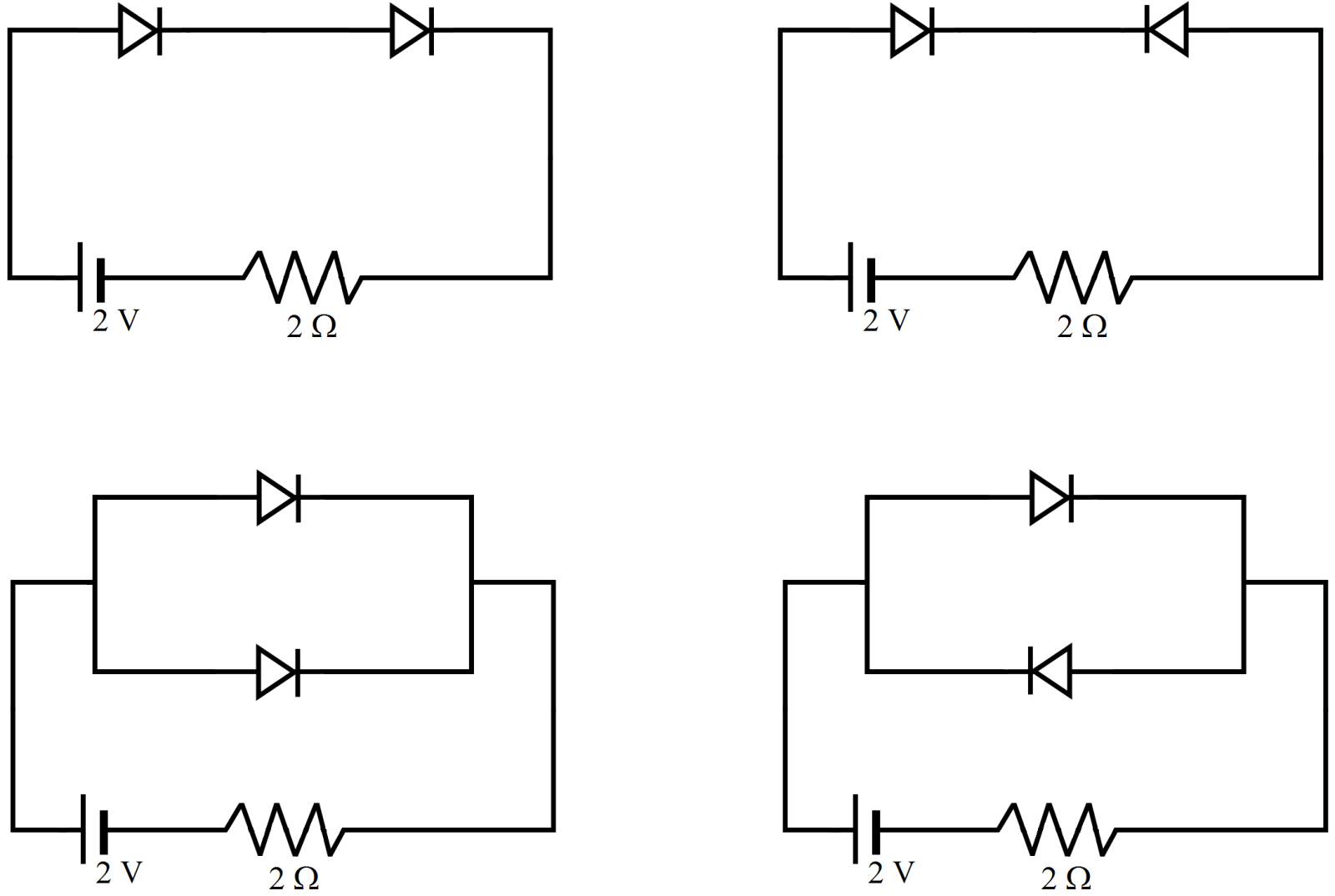
Find the currents through the resistances in the circuits shown in figure.
The electrical resistance in ohms of a carbon thermometer varies with temperature according to the approximate law. $R = R_0[1 + 5 x 10^{-3} ( - ).$ The resistance is $101.6$ at the triple point of water, and 165.5 at the normal melting point of lead $(600.5K).$ What is the temperature when the resistance is $123.4 ?$
From a uniform disk of radius R , a circular hole of radius $\frac{R}{2}$ is cut out. The centre of the hole is at $\frac{R}{2}$ from the centre of the original disc. Locate the centre of gravity of the resulting flat body.
A capacitor stores $50\mu\text{C}$ charge when connected across a battery. When the gap between the plates is filled with a dielectric, a charge of $100\mu\text{C}$ flows through the battery. Find the dielectric constant of the material inserted.
  1. Two particles of equal masses go around a circle of radius R under the action of their mutual gravitational force. Find the speed of each particle
  2. What is the binding energy of a satellite? Derive an expression for it.
A sound wave of frequency 100Hz is travelling in air. The speed of sound in air is 350m/s.
  1. By how much is the phase changed at a given point in 2.5ms?
  2. What is the phase difference at a given instant between two points separated by a distance of 10.0cm along the direction of propagation?
A rain drop of radius $2mm$ falls from a height of $500m$ above the ground. It falls with decreasing acceleration (due to viscous resistance of the air) until at half its original height, it attains its maximum (terminal) speed, and moves with uniform speed thereafter. What is the work done by the gravitational force on the drop in the first and second half of its journey? What is the work done by the resistive force in the entire journey if its speed on reaching the ground is $10 m s^{-1}$?
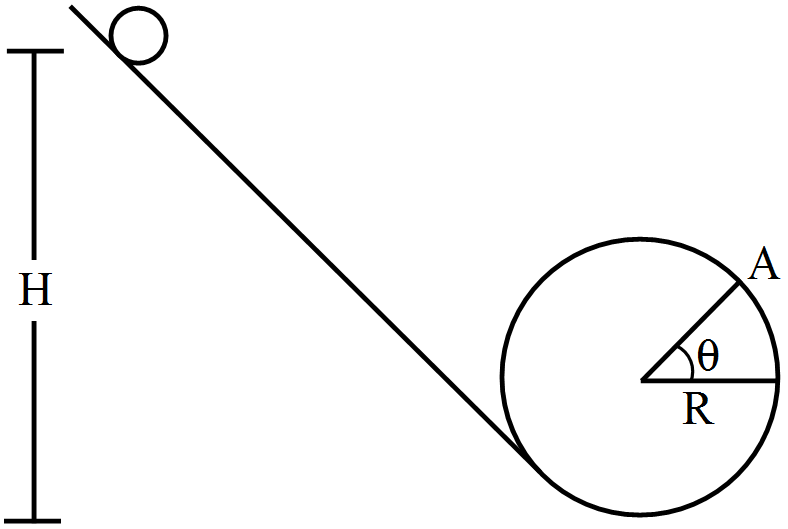
Figure shows a small spherical ball of mass m rolling down the loop track. The ball is released on the linear portion at a vertical height H from the lowest point. The circular part shown has a radius R.
  1. Find the kinetic energy of the ball when it is at a point A where the radius makes an angle $\theta$ with the horizontal.
  2. Find the radial and the tangential accelerations of the centre when the ball is at A.
  3. Find the normal force and the frictional force acting on the ball if H = 60cm, R = 10cm, $\theta=0 $ and m = 70g.